
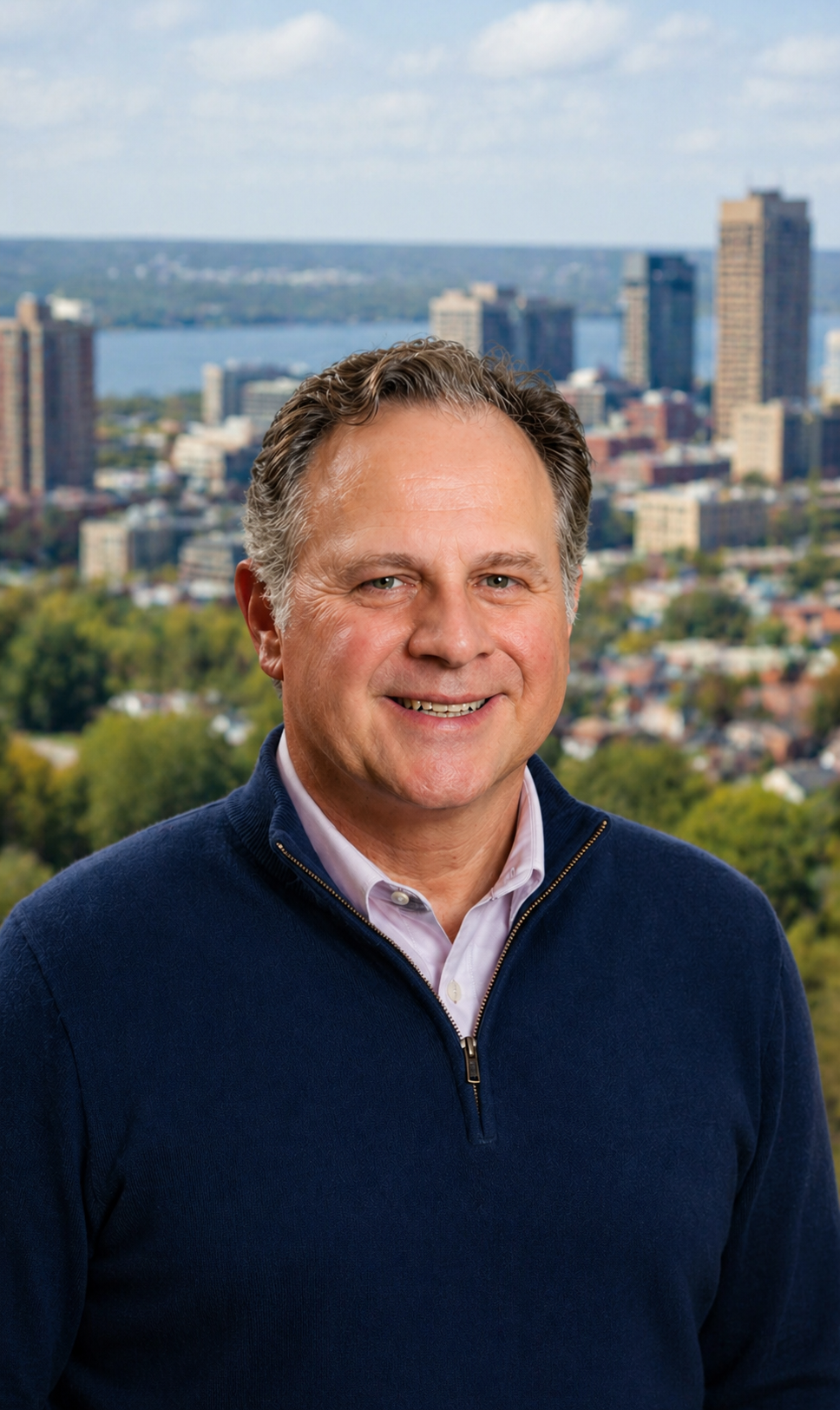
The following is the full transcript of The 155 Election Podcast interview with Hamilton Mayoral Candidate Rob Cooper. You can subscribe to The 155 Podcast on iTunes, Spotify, Amazon Music, or your favourite podcast app via RSS.
In Episode 247 of The 155 Podcast, Hamilton Ward 8 Councillor and 2026 mayoral candidate Rob Cooper discusses his plans for governing the City of Hamilton if elected mayor on October 26, 2026.
Cooper identifies capping tax increases and public safety as two of his principal priorities.
The interview is structured into three sections: candidate introduction and priorities, exercise of mayoral powers and responsibilities, and how they will inspire public confidence as leader of Hamilton.
The following transcript is organized by topic and question with timestamps.
RELATED: Read the full The 155 Podcast transcripts for mayoral candidates Keanin Loomis and Andrea Horwath.
Opening
Joey Coleman: Welcome to the 155 Podcast, interviews with candidates for Mayor, Council, and School Board in Hamilton, Ontario, Canada. Learn more about the candidates at hamiltonvotes.ca.
Episode 247.
Rob Cooper, you are running for Mayor of Hamilton. Welcome to the 155 Podcast.
Rob Cooper: [00:00:22]
Thank you, Joey. It’s great to be here.
First Section: About the Candidate, and Two Priorities
Tell Us About Yourself:
Joey Coleman: [00:00:24]
Briefly, tell us a little bit about yourself?
Rob Cooper: [00:00:25]
Born and raised in Hamilton, I’ve spent my whole life here.
I went to school in the East End, West End, East Mountain as well.
I launched my career here as well with Ernst & Young and had the opportunity to work at a number of different employers.
I am proud to be from Hamilton. I find Hamilton is one of those places where it’s three degrees of separation. Everybody knows everybody through somebody. And so it almost feels like a town. It feels like you’re connected to everyone around this place.
It’s a great place to live. And I continue to call it home.
Why Are You Running for Mayor?
Joey Coleman: [00:00:53]
Briefly, why are you seeking to be elected mayor?
Rob Cooper: [00:00:57]
Thank you, Joey. You know, I got elected in the fall and came to council with the idea of delivering on my promises. One of my promises was to cap taxes, to not exceed rate of inflation.
As you can recall, in December, I put that on the floor. I was ruled out of order. I was told that under strong mayor powers, only the mayor can set the tax rate in Hamilton.
And so at that moment, I decided that I’m going to deliver on my promises and I’m going to run for mayor.
What Are Two of Your Priorities?
Taxes and Public Safety
Joey Coleman: [00:01:21]
So we’re going to do things a little bit different in this interview. Listeners can find out more about your platform on your website. There are plenty of surveys on widely known issues, and I encourage listeners to visit my special elections website, HamiltonVotes.ca, where you can get links to all of the platforms, all of the surveys, watch the debates, read transcripts, and find out where you can vote.
Before I turn to how you will govern and how you will lead, briefly, I wish you to explain two of your platform priorities and why you think they are important.
Rob Cooper: [00:01:58]
Thank you. Number one is taxes. So as we all know, over the last four years, we’ve got a 23 per cent [property] tax increase. What did we get with that?
We got the worse roads in Ontario. Violent crime that we’ve never saw before. Homelessness at levels we’ve never seen before.
No financial statements at the city for the last three years. And I’m not talking audit [statements], I’m talking interim. And you know what I’m talking about there, Joey.
Planning, worse than the province. Approval [timelines], worse than Canada. So what we proved is that with a 23 per cent tax increase, you know, throwing money against problems, our lives got worse. We can’t throw money against problems.
What I’ve also found at the doors, people said to me, ‘Listen, Rob. I can’t afford these tax increase. I’m on fixed income. I didn’t get that 23 per cent tax increase. I’m going to be homeless’, especially seniors.
You know, that’s where it’s so important that we get our arms around this tax rate. And we’ve just recently seen the city come up with the next three years, 31 per cent. Now it’s 25. We got the mayor now talking about the idea. She’s going to do inflation. You have no financial statements. You have, taxes flopping around like that. Makes no sense to anybody. But we got to start running the city like people run their homes. And you don’t do 23% more than what you’re making or 31%. People live on rate of inflation. We got to get the city on a budget. And that budget has to be tied to rate of inflation. When you look at the fact that our budget this year, no actuals, no benchmarks, no [peer] data, no service levels since 2014.
I call that a guess. We could have put a dartboard on the wall and thrown a dart against it, be more reliable than what we did as a city. And that’s driving the affordability crisis in Hamilton. In my ward, 5,000 families are at food banks, 5,000. A lot of those people are people that are on fixed incomes. Families that have children, making a minimum wage or a bit more. We have seniors who are on pensions. That has to be addressed and I’m hearing that every door I go to.
Now, the other issue is violent crime. We’ve never seen the indiscriminate nature of crime in our city. There are stray bullets that are hitting people that aren’t even involved in crime. And they’re actually killing them. I had it happen in my ward, Upper James. A woman got off the bus, two guys doing a gun battle going down the street. Indiscriminately shot and killed. Bullet holes in houses. My own neighbour was killed a number of years ago walking out of his house. No arrest.
And so when you look at what happened downtown, and I know you live downtown, you know, we all know what’s going on down there. Random people stabbing people. And the whole idea that people don’t feel safe. It’s an unsafe and dangerous city. I’ve said that. And two of the other candidates said they didn’t agree with me.
Well, fact of the matter, Joey, when you say it’s unsafe and dangerous, if you cannot define the problem, you cannot fix it. And we have to define it for what it is. And that’s what people have told me when I’ve gone door to door. They say, you know, this city, I don’t feel safe. I don’t feel safe going downtown. I find it very dangerous.
They’re concerned about their family. They’re concerned about their spouses. And so those are the two top issues for me that we have to address as a city.
Mayoral Powers & Responsibilities: How Will You Structure and Exercise Duties?
What are the Powers and Responsibilities of the Mayor Under Section 284 of the Municipal Act
Joey Coleman: [00:04:34]
Let’s turn to Section 284 of Ontario’s Municipal Act, commonly referred to as the Strong Mayor Provisions or Powers.
From memory, what are the powers and responsibilities of the mayor under Section 284?
Rob Cooper: [00:04:49]
At a very high level. And thank you for telling me what that section was, because I didn’t know what it was called, 284, but I now know that. So, broadly, housing, tax rate, budget, hiring and firing. That’s how I summarize it. Those are the responsibilities that a strong mayor owns.
How will you structure the Mayor’s Office?
Joey Coleman: [00:05:04]
Before I ask you how you plan to exercise your responsibilities, let’s talk about the structure of the Mayor’s office.
How do you plan to structure the mayor’s office to ensure successful completion of your priorities?
Rob Cooper: [00:05:18]
Thank you, Joey. Very good question. And structure, to me, leads into governance.
What I see is that the councillors know their wards. And right now, there’s a gulf between the Mayor and the councillors. I am a very collaborative person.
What I like to see happen is I would like to see us start working with those councillors to look at them to give us direction in their wards. That’s how it’s got to work. And I actually want to have somebody in my office, to your point, that’s going to be responsible for that relationship between the mayor’s office and the councillors.
Now, we might get in a situation where we don’t agree, but you know what I find is that when someone has a particular idea and they have the chance to have a conversation, it develops into an even better idea. So that’s how I’d like to pursue it is to have those collaborative conversations, look at what we can do.
But if we get to something like a tax rate, and there’s a feeling of us that, you know, we’re going to be raising the taxes, say, I don’t know, 8 per cent. I got a problem with that.
So that’s where the strong mayor powers would come into play.
My preference is to work with the councillors. We all know what the issues are in the city. We all hear the same voices if we’re listening. We all should be able to come together. So I see it as a very collaborative model.
One, in which there’s going to be conversations going back and forth. I’m not looking for a gulf between the Mayor’s office and the councillors. As a matter of fact, what I see even the councillors running on, my colleagues that are currently on council and some of the new people are running as well, we’re all running on the same set of issues.
So there shouldn’t be these big gulfs. And I think as a city, that they’re looking at us to work together and be cohesive. We got to get real results.
If there’s a gulf between the mayor’s office and councillors’ results, it’s going to turn into inertia.
I’m committed to real change in four years, and that’s dependent on the structure of the Mayor’s office.
Section 284.5: Hiring the City Manager
Joey Coleman: [00:07:00]
Municipal Act Section 284.5. Appoint or dismiss the chief administrative officer. You get to hire the next city manager. What is your plan and what is your timeline?
Rob Cooper: [00:07:14]
My plan is to find someone who’s transformational. They don’t have to be from public service. They don’t have to be from municipalities. They don’t have to be from the private sector.
I want someone who can come in and transform the city. I want someone who actually has the ability to drive a culture. Right now, the culture is one of hindrance versus help. To do a culture reset, it actually involves generational change or overwhelming with new culture. Not everybody can do that. It’s a very specialized piece of work that needs to happen.
So in terms of that City Manager, and we’re also a multi-union environment, let’s be honest. I mean, we have a multi[-union] environment. We have some issues with what’s going on with some of our people groups, like the paramedics are very unhappy right now. I’ve talked to some of the other groups. They’re also very unhappy. And so we need someone that’s going to work through those issues. We need to modernize the city. There’s a whole piece here too around human resources. So I know everybody likes to talk about the City Manager.
I really believe, and you heard me say this the other day, I really believe the most important hire is going to be the Chief Human Resources Officer.
Cultural issues, succession planning issues, compensation issues, you know, you go through that whole list. And that’s why as much as everybody wants to focus on city manager, I really believe the key hire is going to be a Chief Human Resources Officer because of what we’re dealing with at the city. There’s people who are highly talented not being used properly.
There’s people that have been promoted to points where they’re beyond their capabilities. And so we need someone who understands that.
But we also have to be professionally developing people. You know yourself, Joey, Paul Johnson, he was a city employee. He came up through the ranks. Hamilton said, no, thank you. He’s now the city manager in Toronto. Wow. He’s doing an impressive job from what I’ve been told. And then we’ve gone to the street and hired people. And it’s like, why is it that we’re not developing our own talent?
And that’s, you can say, whether you want to say city manager, chief of human resources, that’s something we have to fix. If people don’t see a path within the City, why would they want to come and work there? I think it should be a destination of choice. And that’s something we need to turn it into.
Managing Council: Appointments and Structure
Joey Coleman: [00:09:09]
Municipal Act Section 284.8. establish or dissolve council committees, assign their functions, and appoint their chairs and vice chairs. What is your plan for structuring council for effective governance?
Rob Cooper: [00:09:23]
So much is going to [depend on] who’s on council. Because you’ve got to look at what talent you have there as well.
I once again believe in a collaborative model. One thing I found that dysfunctional in council was the chair role. And you know what I mean. There are different levels of being able to chair. There’s different experiences. And every month we flip some of these chairs, especially at General Issues Committee [Council committee of the whole], and it very frankly gets dysfunctional. It gets very dysfunctional. Sometimes there’s ideological bends that are happening. And I think it takes away from governing.
We got to have someone in that role who is neutral. Someone who is going to give everybody the opportunity to have their say and have the rules apply right across the board, no matter what their political leanings are.
I see that now as a very big weakness at City Hall. And that’s something I’d like to fix.
I’ve talked to [City Clerk] Matthew Trennum about what that could look like. We’re working through a couple models we’re talking about. But that’s one of the big things I’d like to address is that chair of whether it be GIC or the committees and what that looks like. In some ways, I think it’s kind of unfair to be throwing people into that role, asking them to do it when not everybody’s equipped to do it. We don’t even give people training for that role to be very honest about it as well.
So that’s where I do see a different approach. I’m not settled on what that could look like yet. I’m just kind of exploring it. But I think you’ve seen the same challenges I see there, Joey.
Hiring & Firing of Upper Management, and the Size of Upper Management
Joey Coleman: [00:10:38]
Municipal Act Section 284.6. Determine the municipality’s organizational structure.
You decide the size of the uppermost management. You decide performance standards and metrics. You can hire and fire directors and above. How will you exercise these responsibilities?
Rob Cooper: [00:11:04]
You know what I love about that section, Joey, is performance. Because that’s something that I think has really been missing. And it’s no slight on any employee at City Hall.
It’s more of a cultural thing and more of a general inertia thing at the City. I want our budget to be tied to outcomes. I want people to clearly know what they’re supposed to be delivering. People don’t know that now. Like if you ask someone what a service level for something is, they don’t know. If you ask them how they perform against it, they don’t know. And so I think what we have to do is, once again, get a budget that’s based on actuals. It’s going to be new for the city. Tied to service levels, which we haven’t done since 2014. And it also tells the constituents how we’re doing.
And this is about transparency. So we’re going to be telling people specifically, here’s what we’re going to deliver. Here’s how we did this month. Here’s how we did next month, whether it’s good or bad.
And that’s where I think it’s going to really help people in terms of being able to understand their performance, the expectations, the community’s expectations, and what the community is getting for their money.
Key Performance Indicators: First 100 Days
Joey Coleman: [00:12:04]
Key performance indicators. I hear from all three frontrunner candidates that performance management is a priority.
There are three questions on this topic.
One, what are three key performance indicators that you will measure and make public within the first 100 days?
Rob Cooper: [00:12:23]
The number one performance indicator to me is going to be taxes. That is a performance indicator.
The other one’s going to be is 100 days is like, so if I think of this:
We get November 15th, okay, [new term begins] take power. November 18th, we sign up [for council committees].
And as you know, in February, we’re going to have to have our property tax budget. December is going to be the water [budget]. And January is going to be the labour [operating] budget. So when I think of what’s happening in the first 100 days, the first three performance indicators are going to come out with, and it’s all related to taxes, but it’s going to be the water budget. It’s going to be that labour budget. It’s going to be a property tax budget.
That will set the tone for the next four years, that first 100 days. And those are the first three most important metrics coming out of the first 100 days.
Key Performance Indicators: Public Reporting Timeline
Joey Coleman: [00:13:06]
Question two on the topic of KPIs. What is your timeline for launching a meaningful public key performance indicator dashboard?
Rob Cooper: [00:13:15]
So that to me would be the service levels we’re talking about online. If I was to be honest with you, Joey, going back to 2014. People have no clue what the service levels are.
So I’m going to ask them as part of the budgeting process to come up with the service levels. I am hopeful that they can achieve it in 100 days.
I don’t know if that’s possible. I’m just being honest with you. But what we’ll be looking to do, if that’s not, it’s going to be very close to that. I don’t know how you do a budget if you can’t talk about your service levels. So I would see that as part of that.
February, March timeframe that we’re going to come up with our service levels of the city. I want to see that go on the website, and I want to start tracking against it.
Key Performance Indicators and Public Trust
Joey Coleman: [00:13:54]
Hamiltonians do not trust City Hall. Pick your measure. There are many out there. But consistently, lack of trust is a theme that comes through. How do you ensure that the KPI dashboard information is accurate?
Rob Cooper: [00:14:09]
Well, here’s how people will know. When someone looks on there and goes, hmm. It takes two years to trim my tree. At least that’s the number I’ve had residents tell me recently and I heard from the city. If we put up on the dashboard, [that] it’s going to take you six months. How do you know that’s real? In six months, your tree’s not trimmed. Guess what? It’s not true.
Now, in fairness, it may be the fact that we’re having a bad month. Like maybe something’s happened or whatever and say a pandemic or something came along, a kind of black swan incident. But the fact of the matter is people are going to know by their service experience.
They’re going to know. And that’s what’s going to reflect as well. So if we had six months for trimming trees and we’re taking seven months the last month, people would know it’s going to be seven months or it’s going to be wherever we are. That’s how people know. It’s just in their own personal experience.
The Budget: How Will Mayoral Candidates Keep Their Promises
Joey Coleman: [00:14:51]
Municipal Act Section 284.16. The Budget.
The City of Hamilton is the only Ontario city to have its credit rating downgraded during the past four years. The City of Hamilton is Canada’s worst ranked municipality for fiscal transparency, both because the city has failed to complete its audit since 2022, but also because the City of Hamilton does not provide detailed tracking of spending. The City of Hamilton is the only Ontario city to not finalize its mandatory financial information returns this Council term. There are three parts to this topic.
Promise to Cap Taxes: How You Will Achieve this Promise?
Joey Coleman: [00:15:32]
Let’s start with promises to cap tax increases. Municipalities are the only level of government that have to manually recalculate tax rates each year. This means taxes visibly rise each year, whereas provincial and federal taxes rise invisibly. There is only one effective means to control tax increases, and that’s to control spending. That means cutting management positions.
Rob Cooper: [00:15:55]
We disagree on that one.
Joey Coleman: [00:15:58]
Since you have already promised to control spending, the question is, how do you plan to restructure management to achieve your goals?
Rob Cooper: [00:16:06]
So I’ll say this to you. So as you know, with capping at rate of inflation, and some people get confused by this, right?
They think you’re saying capping taxes. I’m saying capping to the rate of inflation. So rate of inflation this year is running 3 per cent. Last year was running 2 per cent. You heard me talk at council about 2 percent. They came in at 3.87 per cent. They stopped cutting grass and a bunch of crazy things.
So it doesn’t mean it’s not going up. 3 per cent for this year would be the number we’re tracking to.
Now, you might also know, and you do know, in January, we’re going to be setting a four-year labour rate. That four-year labour rate ties into this whole discussion on inflation as well. You harmonize these two activities, you know what? You’re tracking basically at where you are. So there isn’t cuts, but there needs to be cuts.
You heard me talk the other day about I want to cut waste. The example I gave the other day was this Aberdeen Avenue, where we did a shave and pave last year. We’re going to put new pipes in next year. We did a bus garage, $147 million over. Procurement, lowest bid, all the change orders, and it becomes the highest.
$13 million is 1 per cent of everybody’s taxes. That $147 million [overage] we spent at that bus garage, is that 11 per cent, 12 per cent of people’s taxes? We got a 23 per cent tax increase.
We got to bring in the Ontario Procurement Guidelines and start applying it. It’s not just about lowest cost. And you know this, Joey. It’s about quality. It’s about local labour, which we have 1,900 people out of work right now. Tradespeople. It’s about lifecycle costs, not just initial costs of capital.
We’ve got to change that approach. We’ve got to adopt normal business practices that most organizations would use. When you start looking at basically how we’re being run, there is a problem there because we don’t see business cases. I’ve seen business cases saying, here’s how much money we’re going to spend. And I go, okay, you’ve heard me say this: what are the benefits? They essentially said we don’t have any.
That’s not a business case. If you’re doing something that has no business benefits, you’re just wasting time and money. So there’s going to be a whole different approach to how we deal with these things. To me, it comes back to outcomes. Right now the metric at the City is how much money do we spend? No outcomes.
It’s not about how much money you spent. It’s how you’re transforming the City. The City has to be getting better for the people in the City. And so that’s where I look and say, it’s not so much about the number of bodies we have, because some people make that mistake. It’s about the activities we do. It’s about how we take our resources and deploy it, and I’ve never seen an organization deploy resources in such an indiscriminate way as what the City does. That’s what drives these 23 and 31 per cent increases.
Let’s start with the fact that you need financial statements. Let’s start with the fact you need a budget grounded on those financial statements. You’ve heard the City talk about variances. What’s the variances based on? Every variance I’ve seen that’s reliable is based on actuals. So if you don’t have actuals, what’s the variances based on? It’s financial jargon that’s thrown around and the average person does not understand it.
As a CPA, the first question is, what’s this based on? And if we don’t have actuals, it’s actually meaningless.
Four-Year Budgetary Plan: 2027 to 2030
Joey Coleman: [00:19:07]
What is your budgetary plan for the next four years?
Rob Cooper: [00:19:11]
Thank you, Joey. My plan is to cap taxes at rate of inflation, which means we’re not going to exceed inflation. Sometimes it could be lower, but it will never be higher. What I really want to see happen is, you know, there’s certain pieces we have to do with the city that is going to drive economic growth. And one would be around homelessness, which I call mental health, drug addiction, trauma, violent crime, making our city the safest place in Ontario.
And going back to homelessness, my goal in four years is zero homeless. I know it’s on the website, so I’ll let people, but if you want to get into that more, we can.
And around infrastructure, you got to be able to get around town. People tell me they spend more time in traffic now than what they ever have. And they stay away from the family, their friends.
I really believe if we solve those three things, we can be the economic engine of Canada. [We have a] Seaport, Airport, most research-intensive university in Canada for 20 years, we need to commercialize, monetize what’s coming out of there. We’ve got regional healthcare. We’ve got primary steel production. When you put that package together, there’s no reason why we shouldn’t be the economic engine in Canada.
But we have to solve those three underlying issues. Without those, I’ve had people tell me their business is leaving Hamilton unsafe. It’s dangerous. And I could give you a number of examples. But the fact of the matter is this: when we solve those, we’re going to start bringing businesses back to the city. And what we have to solve, and you know this, at the beginning of this term, residential taxes were 86 per cent and business was 14 per cent. Today, it’s 89–11. And that speaks to those companies I’m talking about leaving Hamilton.
[We are the] highest in the province when it comes to residential support of our tax base, 89 per cent. What we have to do is get that more normalized. When that starts coming into line, there’s a real opportunity to bring down residential taxes even more, okay, when I’m talking about what that increases around inflation.
By the end of my term, I would like to be talking about residential tax increases much less than inflation. And that business tax, that’s got to come along. That’s one of our biggest challenges right now. So that’s what I see over the course of the four years, is it’s going to be pretty close to inflation when we come out of the gate here and look to wind that down over time as the business tax base starts to grow.
Discretionary Spending: The City of Hamilton Continue Purchasing “Awards”
Joey Coleman: [00:21:18]
Discretionary spending. I’m going to highlight one item of discretionary spending, and I’d like your thoughts on it. The City of Hamilton is one of Canada’s most award-winning municipalities. The City often cites the Distinguished Budget Presentation Award, which the City of Hamilton and approximately 1,800 other government bodies across Canada and the United States purchase each year.
Listeners can visit gfoa.org/budget-award-fees to see the purchase price for themselves. The City often cites this award to counter independent third-party reports from institutes and bond rating agencies regarding the city’s fiscal management.
What are your thoughts on this type of discretionary spending?
Rob Cooper: [00:22:09]
So I wasn’t familiar with that, Joey. So thank you about that. We’re going to have to have you involved in our budget deliberations this year because you bring a whole wealth to this. So here’s my problem with discretionary budgets: they’re not transparent. So when nobody’s looking, we’re spending money. Let’s be very frank. And what I call a discretionary budget is overtaxation. You only get discretionary budgets when you overtax the residents and you create a slush fund. And then you go and spend the slush fund when nobody’s looking and nobody talks about it. So when you come out with what’s been spent on these discretionary budgets, nobody knows about this stuff. If you say that to people in the community, which you have, it’s interesting to see how many people actually know this is going on.
I have a problem with discretionary budgets. I have a problem with the fact that, call it discretionary, well, I’ll even take it for discretionary reserves. That’s really what my problem is, okay? What we have to do is we have to have disclosure with the public. Every dollar that’s being spent, they should know about.
The idea that we’re going to be taxing people more for discretionary reserves and then spending it when people aren’t looking, I just don’t believe in that. I think it’s got to be wound into the budget process. Hey, this could be a great program of what you’re talking about. Let’s put it right in our budget. Let’s put it right in our budget. Say we’re committed to that and let’s make that decision. But the fact that we’re all of a sudden, when nobody’s looking, going and spending money on things that nobody knows about, it’s taxpayer dollars. These are the kind of spending items where people find, you know, they say to me all the time, by the time I spend the money on my groceries and my taxes, I get nothing left.
And so this is where I’m really of the mind, let’s not be deciding how people spend their money, okay? Let’s be transparent. Let’s put it out there. We got nothing to hide. And let’s take that approach. So would it be discretionary reserves, discretionary budgets? You know, I got to be honest with you, when you said discretionary budgets to me, my mind automatically went to discretionary reserves. Because you know, there’s a lot of those laying around the city, right? And you know what I’m talking about there.
Leadership as Head of Council: Leading on the Top Priorities
Implementing Basic Service Delivery, Citizen Service, and 3-1-1
Joey Coleman: [00:23:50]
We’re now turning to a new section of the interview. Let’s turn to leadership of council. I interview candidates in every ward across Hamilton. In those interviews, I ask them to list two of their priorities for the ward, two citywide priorities, two priorities to improve city services, two to improve quality of life, and two housing initiatives they wish to implement. The candidates have been door-knocking for months. They’ve met hundreds of thousands of Hamiltonians. Let’s talk about implementing, or not, some of these common priorities.
The top priority was fiscal accountability, spending control, property taxes, and affordability.
We’ve already discussed the budget, so we’re going to move to the second priority. Listed by nearly every council candidate were variations of basic service delivery, navigating City Hall, and a 3-1-1 service.
So here’s the question.
No matter the outcome of the ward races, a majority of Council will want to implement basic service standards, make it easier to navigate City Hall, and implement 3-1-1. How will you lead on these common priorities?
Rob Cooper: [00:24:59]
So I come back to an earlier discussion we had about tying the budget to service levels. Everybody’s talking about service levels. When they call in to City Hall, they don’t know when they’re going to get service. I’ll give you some examples of people that have worked on their properties that still haven’t been repaired. I got a gentleman from the time I got in council, we’re still having those discussions, even as yesterday, and I’m going like, it amazes me because our whole approach has to be around customer service.
We have to be customer-centric. And who that person is around customer centricity is the resident taxpayer. That’s the person who has got these big tax increases. And I ask them all the time, has your life got better? I haven’t found anyone whose life’s got better. Why? Because they’re not experiencing it. And I’m not advocating for a 23 per increase, as you know.
But just under normal service levels, I had an area in my ward that the snowplow went down, pushing all up people’s sidewalks. It took two weeks for the city to show up and get that snow off the sidewalks. Unacceptable. Unacceptable.
So that’s where we have to have those service standards. Everyone you talk to in the City feels like they’re underserviced. For a 23 per cent tax rate, we should be at the platinum level. But people don’t even feel like they got basic services.
I had a call the other day from a school principal because the mayor had quit cutting grass. The grass had all grown up. He says there’s homeless people and kids are trying to go to school through this area. Unsafe. Just wrong.
We got to have a City that makes sense. And we got to report back to the people in our communities what we’re doing. And when they call into the city, they have to experience that. We have to be responsible to the residents and taxpayers.
Fixing Roads, Sidewalks, and Infrastructure
Joey Coleman: [00:26:28]
Third most common priority, fix the roads, sidewalks, and infrastructure. How will you lead on this?
Rob Cooper: [00:26:36]
We need a plan. We can’t keep doing streets twice. You got the example of Aberdeen Avenue and Barton Street. Now, all work’s going to be done twice, twice as expensive.
Main Street, there’s a couple of councillors and bureaucrats that asked for Main Street to be done. I didn’t hear people asking about Main Street. We’ve got to represent the voices in our community, okay? And I’m running on that, the idea of it’s about your voice, your future, your Hamilton.
We’ve got people at City Hall that think they know better than the residents in our wards and in our city. The people who matter are the people in our city. That’s really the benchmark of what it comes back to. So we’ve got to build a plan around them, but we’ve got to do an integrated plan.
We’ve got to do an integrated plan. We’ve got to set priorities. We’ve got to understand what it is. I’ve also heard from people, Joey, as well as the roads and sidewalks, I’ve heard from people say that it’s just trying to get through the city is a problem. We call that throughput, getting your car through.
I have an area in my ward, Bonnington. The roads and sidewalks hadn’t been done for 63 years. Over the last 10 years, there’s been delays in doing it. It was to the point where a 70-year-old man told me, he said, a trip down the sidewalk broke my shoulder.
The sidewalks had asphalt on them. It looked like something you’d find in a war-torn country. It was absolutely abysmal.
First priority I had when I got to City Hall was have discussion around procurement to make sure it got procured. The money had been sitting there. It just hadn’t been procured. We got it procured. The sod’s just being laid now on the grass that they’ve had to do to do the sidewalks and the roads.
You know what it is? It’s a mindset. It’s a plan with real outcomes. People should know what’s being done when. It shouldn’t be a surprise. And so that’s where my commitment is to address that as well. I do believe roads and sidewalks are a real problem. We got to get them fixed and we got to get this done immediately.
Community Safety and Policing
Joey Coleman: [00:28:13]
Fourth most common priority, community safety and policing. Candidates widely cited this as an issue. There were a range of priorities. How will you lead on this priority?
Rob Cooper: [00:28:26]
Certainly. As you know, we’ve given the police 30 per cent more in the budget over the last four years. Parking lot needed paved? Done. Cameras needed? Got them. More staff needed? Did that this year. Got them. So why is it that people feel that, when it comes to violent crime or just petty crime, whatever, why do people feel that the city has become unsafe and dangerous?
It’s not because of the Chief [of Police]. It’s because we have a Mayor who won’t sit on the Police Board.
The political side of the City has to be firmly connected to the policing side of the City. When you have two islands, well, Hamilton shows what happens. I’m not going to be sitting there coming to Council and saying, you know what, I’m too busy to be on the Police Board. I recognize it as part of the job. As a matter of fact, safety is government’s first responsibility. And I will be taking it seriously. I will be tough on crime. Okay, rest assured, we will be tough on crime. We will get results.
I want busts of gangs, guns, and drugs. We know they’re in our community. I’m going to support the police. I’ve also said to people, and I’ll say it on your podcast as well, look at who your candidates are in your ward. Pick pro-policing candidates. If you pick defund candidates, you’re going to get something that’s going to make you very unhappy.
Everyone I speak to across the city feels that we need to have better police presence, visible policing, and we need to get real results. So I’m committed to that. I’ll be working very clearly with the current chief, who you know will be getting a new Chief soon because Chief [of Police Frank] Bergen’s going to retire, and I do think those are big shoes to fill.
I’ll talk about my ward. I’ll talk to you about the shooting that happened in Upper James, the shooting of my neighbour. You know, knock on wood and I won’t knock on the table because I know it’ll affect the sound, but I’ll say this. With the plan we put in my ward, we haven’t had shootings, okay? I want to take this plan we did in my ward with Chief Bergen and Superintendent Shawn Blaj roll it to the whole city.
People have to know that they can go to any part of the city, day or night, and feel safe. Right now, you and I could go to certain parts of the city, Joey, and both of us would feel unsafe. Unacceptable.
Parks, Recreation, and Community Facilities: How Will You Improve Them?
Joey Coleman: [00:30:32]
And finally, for this section, parks, recreation, and community facilities. Similarly, a wide range of proposals and positions from council candidates. Your thoughts?
Rob Cooper: [00:30:45]
I just put $2 million into my ward. It was all for parks. It’s one of the biggest investments ever made in my ward. Here’s what I recognize. The biggest challenge right now for, I’ll say, crime in Hamilton is youth violent crime. If you go up, go next door to the Mountain police station here. On the wall, all pictures of kids. We promised recreation centres in Winona. We promised recreation centres in Binbrook. We promised them in Waterdown.
Haven’t been built. When I was in Binbrook, I talked to 200 teenagers. I said, we’re going to get you a recreation centre. It’s my commitment to you that we’re going to deliver. You know, I had a 15-year-old say to me, what’s a recreation centre? It was an empty promise for so long, it means nothing. But here’s what’s important. If you don’t have the parks, you can’t have the volunteers to have the sports leagues. If you don’t have the recreation centres, you can’t have the areas where kids can go and do good things. When I was a kid, if I didn’t have Tom Jackson doing Huntington Park in my neighbourhood,
I don’t know what I would have done because that’s where we spend our time. We spend our time at the rec centres. We spend our time at the parks. And you need to have that.
Rolston, in my area, it was planned in such a way it has no parks. Where do the kids go and play? It’s such a vital part of our community. We have to engage our children. If we lose them as children, in some cases, we’ll make decisions that are irreversible for the rest of their lives.
It’s important that we immerse them in sports leagues. We immerse them in recreation. We immerse them in areas where they’re going to get good mentors. And so I’m a big fan of that.
I’ve committed that we will build those three recreation centres.
We have $600 million sitting in the bank that was supposed to be used for these things. We’re not a bank. We got to be building community. We got to be doing the things that bring us together and really develop the future for our young people.
Final Section: Character and Role of Mayor Questions
Public Confidence
Joey Coleman: [00:32:38]
How will you inspire public confidence?
Rob Cooper: [00:32:41]
I think public confidence comes through transparency and delivery.
Here’s what I say to people. Hang on to my literature. Put it somewhere safe. Pull it out. Because if we don’t deliver in four years, don’t vote for me again. That’s my promise to everyone.
Now, I said that in the ward race. I’m saying it here again. We had real deliverables in my ward race.
Rymal Road, Two Lanes, people said we need to [make] Rymal five lanes. Worked with the Province. We got the approvals. Shovels in the ground next year.
Over on Upper Wellington Street at Stone Church Road. We had two 20-storey towers going in. People in the neighbourhood said, ‘I’ll never see the sun again.’ I sat down with that developer. We had a beautiful conversation. I said, ‘you know what? What can we do?’ Three six-storeys going in, all the units being built. People said that could never happen.
Bonnington, 63 years. We’ve made things happen. Been on council, what, maybe in October? I think so when you and I first met on my swearing in. What a year. That’s a year.
I have the ability to deliver. What I’ve done in my career is really that, where I’ve gone into organizations that had a very minimal chance of success and been able to deliver for them.
The reason I’m coming to the City, I’m not here to break Bob Morrow’s record, okay? Bob Morrow was a great Mayor. I’m here to transform the City. When I’m done transforming the city, then we can bring in an operator. But that’s what this is all about. This is about coming and bringing real change. And so I’m going to be transparent in terms of what we’re going to deliver our service levels. We’re going to be transparent in terms of what we’re going to come up with.
I came up with my platform in June, way before any of the other candidates. And I said, here’s what we’re going to do. The other candidates just took my platform, one put tariffs on it, and the other just put it on his website. But you know what? Biggest form of flattery is imitation. So now that we’re all agreeing on what it’s going to be, now who can deliver? I have a track record of delivery.
The Mayor’s been learning on a job for the last four years, first time she’s ever governed, and we’ve seen what that costs us. This is 23 per cent, a very expensive model. The other person’s running, ran a chamber with 18 people. You know, he’s a steel lobbyist with maybe about 50. There’s 9,450 employees. That gentleman’s going to have a big learning curve. Now, if people want that learning curve over the next four years, okay, I’m the only person situated to come in and be able to deliver real transformational change, exactly what people are looking for. And I want to be held accountable. I want to be transparent. That’s why I’ve committed to all these metrics being out there because we have to develop trust in the city. The trust has been lost. And that’s something we grow over time. People just don’t give you trust. You lose trust like that. But to gain trust, it’s a journey, okay? And that’s why I want to put the proper pieces in place to build trust in the community.
Explain the Role of Mayor in 30 Seconds to Fifth Graders
Joey Coleman: [00:35:23]
This is one of my favourite things at City Hall. Ward councillors host the school tours of City Hall. Inevitably, one of the children will ask, ‘when do we get to meet the mayor?’
In 30 seconds, how do you explain the role of mayor to a group of fifth graders?
Rob Cooper: [00:35:43]
Thank you, Joey. Great question.
The role of mayor, along with council, brings to life what people experience in their community, whether it be snow removal, parks, recreation, you know, just every aspect of life. And so what I would say to those fifth graders is say, what you experience in your community is a direct result of the mayor’s role, council’s role, and the whole, I’ll say, City Hall, how we come together as a group.
Three Words to Describe Your Character and Leadership
Joey Coleman: [00:36:09]
It’s 2030. I’m writing an assessment of the council term that is just ending. What three words do you hope I will use to describe your term?
Rob Cooper: [00:36:20]
You know, Joey, I love this because you asked me when I got elected as a councillor last year and you caught me off guard. So in some ways, when you started this question, it brought back memories. You know, I would say this: how has our lives changed would be first and foremost. How has our lives changed over the last four years? Okay, so let’s say change, if you want a word. I would say communication. Do we feel like we’ve been part of this process? And I would also say transparency.
I really believe this: there’s only two good surprises in the year, your birthday, and if you celebrate Christmas, If you have a third surprise, it’s never a good surprise. I don’t believe in surprising people. I don’t believe, and we’ve seen some of that in this council where council’s been surprised that things go down in the mayor’s office, non-disclosure agreements, things like that. It shouldn’t be a surprise.
We should be as a community working together, communicating together, and effecting change together. This isn’t just about me. This is about all of us. This is actually a movement. People want real change in their city, and I’m just a voice. I’m just a person going and delivering on it. But that would be, I see, as the top three words to remember me by.
Closing Remarks
Joey Coleman: [00:37:20]
And now you can breathe a sigh of relief.
Would you like to provide any closing remarks?
Rob Cooper: [00:37:27]
Thank you, Joey. Thank you for today. I know a lot goes into this and not everybody recognizes it because it’s a podcast. They don’t see all that you’ve done and you bring together all the effort you put into this. And you do this as really a service to our community. You love Hamilton. I know you do. I talk to you about it all the time. So this has been a real joy for me to come and join you today.
I will say this to your listening audience: get out and vote. Two-thirds of the people did not vote last election. Only one-third voted. And I understand some of that. People say to me, well, you know, I struggled to find the issues I wanted on the ballot. I’ve listened to people. These are the issues they’re talking about. Come out and vote. Have your voice heard. As we’ve talked about, that Grade 5 class that Joey talked about, when they come to City Hall and want to know what happens at City Hall, City Hall affects your whole life.
This is the level of government that should attract the most voter turnout instead of the least. So please make a plan.
There’s October 26th is the date to vote. You can vote [in advance on] any weekend in October. And I would appreciate if you came out and voted for me because I’m going to City Hall because I want to represent you. And this is a conversation that we’re having now and will continue to have. Joey, thank you for today.
Joey Coleman: [00:38:39]
Thank you for joining us.
This was Episode 247 of the 155 Podcast. Learn more about the candidates at hamiltonvotes.ca
Production Details
v. 1.0.0
Published: October 8, 2026
Last updated: October 8, 2026
Author: Joey Coleman
Update Record
v. 1.0.0 original version
Discussion
0 commentsNo comments yet. Be the first to add your perspective.