
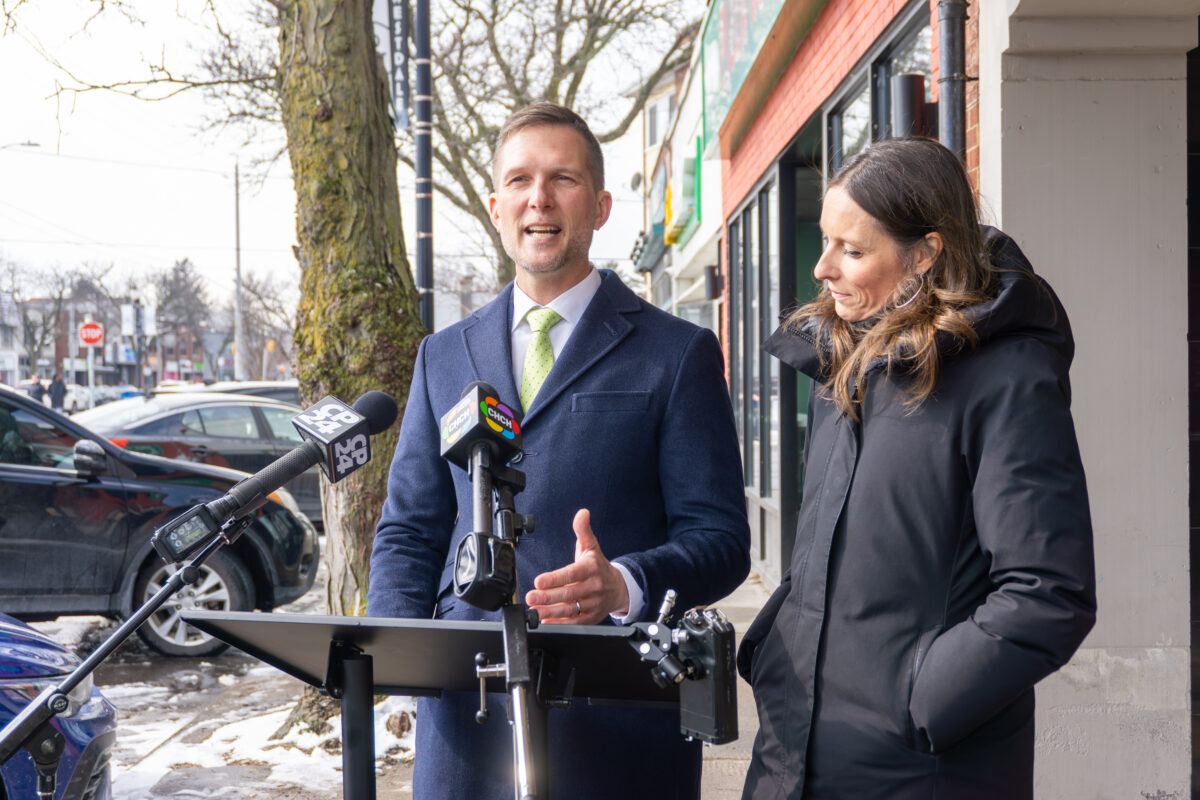
The following is the full transcript of The 155 Election Podcast interview with Hamilton Mayoral Candidate Keanin Loomis. You can subscribe to The 155 Podcast on iTunes, Spotify, Amazon Music, or your favourite podcast app via RSS.
In Episode 246 of The 155 Podcast, 2022 mayoral runner-up and returning 2026 mayoral candidate Keanin Loomis discusses his plans for governing the City of Hamilton if elected mayor on October 26, 2026.
Loomis identifies safe communities and revitalizing downtown Hamilton as two of his principal priorities.
The interview is structured into three sections: candidate introduction and priorities, exercise of mayoral powers and responsibilities, and how they will inspire public confidence as leader of Hamilton.
The following transcript is organized by topic and question with timestamps.
RELATED: Read the full The 155 Podcast transcripts for mayoral candidates Rob Cooper and Andrea Horwath.
Joey Coleman: Welcome to the 155 Podcast, interviews with candidates for mayor, council and school board in Hamilton, Ontario, Canada. Learn more about the candidates at hamiltonvotes.ca.
Episode 246.
Joey Coleman: Keanin Loomis, you are running for mayor of Hamilton. Welcome to the 155 Podcast.
Keanin Loomis: Thank you, Joey. Great to see you.
First Section: About the Candidate, and Two Priorities
Tell Us About Yourself:
Joey Coleman: [00:00:23]
So briefly, tell us a little bit about yourself.
Keanin Loomis: [00:00:27]
I am a proud Hamiltonian. I am a proud Canadian citizen. I am a father of three, a husband. I have a deep business background and ran in the last election because I decided that I wanted to be the change that we needed to see in this community. And as we saw over the last four years, things have not gotten better. They’ve only unravelled. And so the need to provide leadership in this community has only grown.
I’m ready to apply my skills to becoming the Mayor of the City of Hamilton, and I’m really excited about the opportunity.
Why Are You Running for Mayor?
Joey Coleman: [00:01:10]
Briefly, why are you seeking to be elected Mayor?
Keanin Loomis: [00:01:14]
Again, there’s no doubt that this community can be so much more. I don’t have to point out the city’s potential. It’s what I fell in love with when I moved here in 2009, and why my wife and I decided that this would be the place where we would put down our roots and raise our family. My wife is from here originally, so I always say she’s the one to either credit or blame for my being here.
We came back to Canada from the United States, where I was practising law in Washington, D.C., and my in-laws said, “Well, you can live with us while you figure out your next career path.” I knew that I was not going to practise law anymore. So I moved into their basement in the Upper Sherman and Mohawk area and really thought, okay, Hamilton will be a good jumping-off point for finding my next path, in Toronto, likely.
And I ended up falling in love with this community because of the potential.
At that point in time, we were getting an LRT before the [2015] Pan Am Games. We were getting a stadium on the waterfront. I loved the size of this community. It’s an urban community, a historic urban environment, with a size and distinctiveness that doesn’t really exist across Canada for a mid-sized city, and it has proximity, of course, to Toronto and the U.S. I saw all of the incredible assets here and, more than anything, I fell in love with the people, who were very welcoming to me in 2009.
So I applied my talents and skills, as a former lawyer, converting that into advocacy and organizational management, to start up Innovation Factory at McMaster Innovation Park and serve the innovation economy. Within three years of that, I became the voice of business and represented a thousand businesses in this community that employ 75,000 people. I loved the cause of fighting for Hamilton and the people of Hamilton, the businesses of Hamilton. But I thought that I could provide even more, and that’s why I ran in the last election.
It’s not just because of my love for the city. It’s also because I’m raising my kids in this community. I have three kids, and I’m focused on what type of city they are going to grow up in. Are they going to be attracted to putting down their own roots here as well? I think that’s every parent’s dream. After the last four years in particular, we really have taken many steps back. I was so happy and proud to be a part of the renaissance of this community, and it felt like that trajectory was inexorable and would continue. The last four years have proven that it’s not. It’s something we have to continue to work at and tend to, and it requires leadership.
After the Hamilton Chamber of Commerce, I went to the Ontario Chamber of Commerce and joined the West Harbour GO commuter class to travel down to Union Station in downtown Toronto and work with Ontario’s biggest businesses and build incredible relationships with folks at Queen’s Park. Then, for the last few years, I’ve been the voice of Canadian steel as the head of the Canadian Institute of Steel Construction, representing a national industry that is very important to Hamilton, continues to be important to our economy, and is the basis of our identity as Steeltown.
That is an industry, the fabrication industry, that is distinct from the production of steel that we know so well here in Hamilton, with Dofasco and Stelco. We have a number of incredible fabricators here in Canada, but they’re more spread out, from St. John’s to Vancouver Island. It’s an industry of 30,000 people that supports another 100,000 jobs.
Through that I’ve further enhanced my advocacy skills and my relationships in Ottawa, especially with tariffs now threatening the industry, and in provincial capitals across the nation. I’ve gone on to represent and run even larger organizations, associations and industries across this country.
I have the municipal advocacy experience and the experience of running an organization here. I’ve helped run a provincial organization, and I’ve run a national organization as well. So I think I’m in an even better position to lead Hamilton into the future. We’ve got a lot to address because of the leadership over the last four years, so that need has not gone away. In fact, the cause that is Hamilton has only grown for me as a leader.
Leadership is my vocation, and I’m ready to apply those skills and all of that experience to the cause of turning around this city.
What Are Two of Your Priorities?
Safe Communities and Downtown Revitalization
Joey Coleman: [00:06:29]
We’re going to do things a little differently in this interview. Listeners can find out more about your platform on your website. There are plenty of surveys on widely known issues, and I encourage listeners to visit my special elections website, hamiltonvotes.ca, where they can get links to all of the platforms and all of the surveys, watch the debates, read transcripts, and find out where you can vote.
Before I turn to how you will govern and how you will lead, briefly, I wish you to explain two of your platform priorities and why you think they are important.
Keanin Loomis: [00:07:06]
Thanks for that question, Joey. I’m happy to share part of my platform, which is called the SMART Plan. It’s an acronym for Safety, Mobility, Accountability, Responsive Government and Taxpayer Respect.
You can go to voteloomis.ca to see all the elements of our platform as we roll it out. We’ve rolled out the safety, mobility and accountability parts. Over the next week, you’ll see responsive government and taxpayer respect.
There’s a reason why safety is number one. To me, it is the most important element. It is what is truly causing residents across this entire community to lack confidence in Hamilton’s future, because of how much is playing out on our downtown streets in particular.
The top items of my first 100-day agenda are these.
First, hire the next city manager, because that’s the most important decision I will make and the very first decision I need to make. Second, get my first budget passed, because the clock is ticking immediately upon inauguration. Third, we must make an appreciable impact downtown, particularly on homelessness. We have to have a far more coordinated response to homelessness, mental health and the public disorder that we are seeing playing out on our streets.
We have launched a couple of initiatives within the platform: to create Safe Public Spaces Hamilton and Safe Routes to Schools as well. These help create standards for our public spaces: cleanliness standards, safety standards, lighting, paraphernalia in parks, those sorts of things. Then we tie response times to those. If a light is out in a park, let’s get to that within a certain period of time. If a crack pipe is on a playground, let’s get to that absolutely immediately. And then there is accountability around that, being able to see exactly how we are addressing these issues, and whether we’re doing it right, doing it quickly and doing it as I promised.
Part of our safety plan is to address downtown safety and the economy at the same time, because they are so jointly linked. It is not only a moral imperative but an economic imperative that we address this. We know that the economy operates on confidence, and right now there is a complete lack of confidence in our city. Primarily that is a lack of confidence in our leadership and in what is happening in City Hall.
So we will create a downtown renewal team, which will bring together all of the various elements within the city that touch on downtown: mental health, public health and so on. We’ll create a welcoming street service and real pathways off the street for folks who are experiencing homelessness. We’ll create clean, safe and welcoming public spaces and really focus on downtown investment.
Those are just some elements. It’s a very broad plan, and it’s based on my years of experience, not only as the voice of business in this community but also working downtown, at the Standard Life building in Jackson Square. I’ve seen downtown pre-renaissance, I saw it through its renaissance, and I’ve seen it, of course, decline since. The plan is also based on all the relationships I have. And it’s not just internal to the city. We also need all the other institutions and stakeholders in the city, the anchor institutions. Part of my plan is to reconstitute the Hamilton Anchor Institution Leadership Group, which was a coalition of all the major institutions that operate here in the city. It’s a group that hasn’t met in years, which to me is absolutely crazy, because those are significant resources that we already have in the city. They’re all ready and willing to work together. I’ve seen it happen. I was part of it happening when I was a voice at that table. But it’s not happening right now.
It requires working with BIAs, with local businesses, and with all the social services agencies that are downtown as well. What you would hear repeatedly from them, and I know you know because you have many, many conversations, is that they are all thirsting for leadership, particularly from the mayor’s office. It is the mayor’s responsibility to bring all these people together and to ensure that the services are coordinated and that we’re all rowing in the same direction. And you know as well that it’s just not happening right now. Everybody is in their silos.
For me, this is the most obvious need. I’m not saying that it’s easy, but I’m saying we can make an appreciable impact immediately, because everything is already there and everybody’s ready to go. They’re just waiting for the leadership that’s required. I’m encouraged by this plan because it was built with input from citizens, from the players downtown, the social services agencies and businesses, with which, as you know, I’m very familiar and have always kept in touch. We also built it with people who are city managers in Ontario right now. We tested the plan against the assumptions, asking, is this actually possible? And it is, because it’s bringing everybody together in a way that is just not happening right now. So safety is certainly the number one issue that we need to address, and I’ve outlined a number of ways in which we’re going to do that.
Mayoral Powers & Responsibilities: How Will You Structure and Exercise Duties?
What are the Powers and Responsibilities of the Mayor Under Section 284 of the Municipal Act
Joey Coleman: [00:13:07]
Let’s turn to Section 284 of Ontario’s Municipal Act, commonly referred to as the Strong Mayor provisions or powers. From memory, what are the powers and responsibilities of the mayor under Section 284?
Keanin Loomis: [00:13:22]
My understanding is that it gives the mayor the ability to override council on matters that are important to the provincial government and its mandate. The other major aspects are executive power, so the ability to hire the City Manager and other senior leadership within City Hall. And then there’s a whole bunch of responsibilities related to budgeting and financing, really putting the onus on the mayor to control the budgeting process.
It is a mix of things that, to be fair and honest, Joey, even current mayors are grappling with. We’re seeing this repeatedly, and I know very intimately some of the discussions that are happening in other communities, and the type of discussions that are happening at AMO, the Association of Municipalities of Ontario. Mayors are all grappling with this, and there is a lack of clarity and direction about some of these things.
The most important thing for folks to understand is that we’re now starting to identify best practices. How should a mayor who has strong mayor powers and an obligation to introduce the budget do so in a way that continues to seek and get input from folks on council? The same goes for hiring. It’s so new that even those who are intimately familiar with the rules and the law are grappling with exactly how it’s done. But, like I said, we’re able to look at how colleagues are doing this across the province.
The important thing for me will be having those conversations with my colleagues and my peers and understanding how best to optimize the strong mayor powers in a way that doesn’t take the power away from councillors, and thus from the constituents they represent.
How will you structure the Mayor’s Office?
Joey Coleman: [00:15:22]
Before I ask you to explain how you plan to exercise your responsibilities, let’s talk about the structure of the mayor’s office. How do you plan to structure the mayor’s office to ensure successful completion of your priorities?
Keanin Loomis: [00:15:38]
The great thing is that I’ve run many organizations now, so I have a full understanding of what is required to run a successful organization. The budget of the Hamilton Chamber of Commerce, for example, is about the same size as the budget of the Mayor’s office. So for me, it’s like, okay, I know what that looks like. You’ve got to have a Chief of Staff. You’ve got to have somebody who does all the scheduling, and somebody who is the point person for all of the various calls and inquiries that the Mayor’s office inevitably gets. Those are really important. You’ve got to have a Director of Communications, a Director of Policy, an outreach person.
Especially in this day and age, you’ve also got to have somebody who can help you communicate. Putting you aside, because you’re so very unique, we are experiencing a decline in our local media. So I think it’s really important for the Mayor’s office to be far more communicative and to take on more of the communications function of the City itself. As I go across the city, the one thing I hear repeatedly, whether it’s Garner Road or other issues that pop up, is that people don’t know what’s going on. They have no understanding, because there’s absolutely no communication happening. In this day and age, with social media and with local media that is hurting, it’s the Mayor’s job to have our own communications function as well.
All of that, of course, requires government relations support, federally, provincially and municipally. That’s really important, and how it gets done, in terms of staffing versus using a GR [government relations] firm, we’ll figure out. What is the ideal setup? And what does the mayor’s office do versus the City Manager’s Office and the City function itself? Communications, for example, is kind of a shared function there.
Again, I know how to run organizations of this size and have done so very successfully. I’ve always surrounded myself with good talent. I think you know that. If anybody in Hamilton could see what I did at the Canadian Institute of Steel Construction, that was a complete turnaround. I took a very demoralized workforce and turned it into one where everybody was energized by their work and by the cause of working for the Canadian steel industry.
This is what I’m really looking forward to, because this is Organizational Management 101. I have thought long and hard about how I will structure the mayor’s office and how that particular important cog works within the much broader, almost $3-billion corporation.
Section 284.5: Hiring the City Manager
Joey Coleman: [00:18:37]
Municipal Act Section 284.5: appoint or dismiss the chief administrative officer. You get to hire the next City Manager. What is your plan, and what is your timeline?
Keanin Loomis: [00:18:50]
My plan is to have help on an interim basis coming into this position, to give me a little bit of time to run an open and transparent process by which we will hire the next City Manager.
I’m thankful to have this opportunity. I think it’s really important that we have a complete reset in the City of Hamilton. As I said earlier, this is going to be the first and most important decision I make in my entire tenure, and it’s got to be right. I need somebody who has broad, large, complex organizational experience, somebody who can help take my SMART Plan and work with me and council to implement it.
I think the SMART Plan is a blueprint and a strategic plan for how we are going to turn around the city, but I’ve got to find the ideal person who will be able to implement that, and do so very effectively. Part of that means I want somebody who has knowledge of Hamilton and experience in Hamilton, who understands the players and the issues very quickly. I understand the appeal of a fresh set of eyes coming in from outside, somebody with big corporate experience. But we’ve got to move quickly. A new executive coming in needs time to understand things. I’ve done this. It took time to understand the Canadian steel industry, for example, well enough that I could effectively make changes. I need somebody who can hit the ground running right away.
So this will happen, certainly. I would say by Christmas we will know that. It will be an open process. I will be seeking advice and will probably form a committee with some members of council, to ensure that I have buy-in and support from that body. The city manager now has one boss, the mayor, but the city manager is going to have to work with all of council to implement the SMART Plan, or whatever other agenda we come up with, that will help lead the turnaround of the city.
Managing Council: Appointments and Structure
Joey Coleman: [00:20:59]
Section 284.8: establish or dissolve council committees, assign their functions, and appoint their chairs and vice-chairs. What is your plan for structuring council for effective governance?
Keanin Loomis: [00:21:13]
I want to work with the City Clerk and work with Council so that we have a full understanding of how we’re going to operate. Of course, there are ways in which they’ve done so over the course of many terms, and we can’t be too disruptive of that. I think it’s important to hit the ground running without tinkering too much with the overall structure and governance of the city.
When it comes to committees in particular, I know that so many of them have not met at all over the course of the last four years. I was on a number of committees as the voice of business: the Open for Business Committee, the LRT committee, the Immigration Partnership Council. There were so many other committees that I was part of that were very active. You were at many of them, doing yeoman’s work, covering City Hall and covering the minutiae there. Those committees serve a purpose. As the city, as council, and as the Mayor look to implement an agenda, we’re consulting the right people. So of course it starts with getting these committees up and running and having the right people around the table. I think that can be very effective as we seek to address the major challenges Hamilton is facing.
The Mayor cannot do this alone, despite whatever strong mayor powers give the mayor. No one person can do this alone. This is a collaborative effort. It starts with me and the City Manager, which has to be an incredible partnership. Of course, I need to work with all of Council. I think that’s another opportunity: this Council is thirsting for a mayor who will actually reach across the aisle, who will actually work with them, who will actually communicate effectively with them. So we don’t need to change radically how council works. What we need to change radically is the relationships between the Mayor and the councillors, and the committees that should be providing their best advice to our agenda.
Hiring & Firing of Upper Management, and the Size of Upper Management
Joey Coleman: [00:23:27]
Municipal Act Section 284.6: determine the municipality’s organizational structure.
You decide the size of the uppermost management. You decide performance standards and metrics. You can hire and fire directors and above. How will you exercise these responsibilities?
Keanin Loomis: [00:23:46]
It’s going to start with the City Manager, no doubt, and then I’m going to work with the City Manager to determine exactly all of that. The City Manager is the Chief Executive Officer, so I don’t want to get into tinkering operationally. I think the Mayor has to understand what the mayor’s job is. The mayor’s job is to be the board chair of the Corporation of the City of Hamilton. So I will find that right person, somebody I know I can work with and have a durable partnership with, and then we’re going to work together to make sure we have the right people in the right positions. Then I will focus on the ceremonial stuff associated with being mayor.
My major goal is to work closely and collaboratively with the other 15 directors on the board of the City of Hamilton. Those relationships are my primary responsibility. With council’s input, I hire the city manager and let them take care of that. I must manage those 15 people. The good thing for Hamilton is that I have great relationships with basically all of them. I know them all well, what their priorities are, and some of the issues they’re dealing with in their own constituencies. I work really hard to maintain beneficial, good-faith relationships with all of them, because we have so many hard issues to work through. I know we’re not going to get unanimity on everything. I don’t expect that. But I believe I can get to nine votes with this group of councillors on most everything. And if you can’t, you don’t put the motion on the table. So much of the work has to be done beforehand.
I’ve seen repeatedly how this really hampers our progress, because we don’t have a Mayor who’s doing the work, who has worked out all the things in advance and who knows where the votes are. I think that is political malpractice. It would certainly not be how you run any large organization.
That is what needs to change more than anything: the culture in City Hall. It always has been, and it will be my primary goal to fix that.
Key Performance Indicators: First 100 Days
Joey Coleman: [00:26:07]
Key performance indicators. I hear from all three frontrunner candidates that performance management is a priority.
There are three questions on this topic.
One, what are three key performance indicators you will measure and make public within the first 100 days?
Keanin Loomis: [00:26:27]
Number one would be the number of unhoused people on our downtown streets. I know there are probably about 2,000 folks on the unhoused list that we have in Hamilton, but really we’re talking about 200 to 300 people in the city’s core. That’s what is playing out in front of our eyes every single day. So how do we, project by project, transition those folks into housing? Housing is health care, and that is the group of people that need it first. So that would be number one.
We need to figure out the other metrics. A lot of this is an executive function, so I want to really work with the City Manager to identify what our KPIs will be and what the dashboard will be. Every organization I’ve ever been part of has a dashboard, a one-pager that says, here are the things. Financial health is very important, so I would say tax increases: what’s the measure every single year, and what are we going to accomplish there every year as we work to address the inefficiencies of government and look at every single way in which we deliver services? Annual tax increases would be number two.
Number three would be something like this: if one of the imperatives is to fix the damn roads, it would be how much new surfacing is being done over the course of one year, two years, et cetera.
Key Performance Indicators: Public Reporting Timeline
Joey Coleman: [00:28:10]
Question two on the topic of KPIs. What is your timeline for launching a meaningful public key performance indicator dashboard?
Keanin Loomis: [00:28:19]
Well, I’ve got to hire the City Manager first. Let’s work on that. I would say that’s probably something we could do. I think that’s also part of the budgeting process.
So probably within the first 100 days we can have a really good understanding of what that dashboard will look like and what the key performance indicators are. I want to talk to every department, too. What are they measuring right now, and is that the right thing for them to measure? Those get added to the dashboard as well. It’s very much a senior management exercise. Again, no one person can do this. I’m not coming in and saying it must be this, this, this. This has to be a collaborative effort. That’s how organizations are run successfully.
Key Performance Indicators and Public Trust
Joey Coleman: [00:28:59]
Hamiltonians do not trust City Hall. Pick your measure. There are many out there, but consistently, lack of trust is a theme that comes through.
How do you ensure that the KPI dashboard information is accurate?
Keanin Loomis: [00:29:15]
You have to demand accountability throughout the entire organization. One of the things we announced on Tuesday morning was unleashing the city auditor, the Auditor General, giving that person more resources to help us in the turnaround and in the review of the service delivery of the City. Through that process, we’ll be identifying whether we’re accurately reporting or not. So internal is important, and a lot of this requires the City Manager’s buy-in and then execution.
The other thing is how we are communicating. All of this needs to be readily accessible and easy. If you were to look up the City’s budget right now, where would you go? You know better than anybody. It is difficult to find anything related to any aspect of the operations of the City of Hamilton through its website. The dashboard needs to be up there for everybody to see, almost updated in real time. As I’m getting the updates, the City and its constituents should get the updates as well.
The final thing is communication, and that’s not hard at all. It is the one thing that will change immediately, and you see how accessible and communicative I am right now through the campaign. That’s not just a campaign thing. That’s exactly how I am going to govern. If Garner Road is a problem for a good part of the city, I think it behooves the mayor or management within City Hall to explain to residents what is happening. People can understand. Construction projects go awry. They go awry when you’re fixing your back deck or doing your bathroom. They go awry when you’re fixing a road, and part of that is culvert work, and all of a sudden we found a stream that had been buried. That is understandable for people. Just communicate it, and you lower the temperature within those communities.
People trust you because you’re informing them of what is actually happening, instead of being left to their own devices, wondering what’s going on, with things spiralling out of control on Facebook and becoming untruths and all of that sort of stuff. So I think the final and most important thing is just us, as City Hall, communicating to the residents of Hamilton.
That starts at the top, and as mayor, I will bring a whole new, fresh perspective and way of executing on the communications.
The Budget: How Will Mayoral Candidates Keep Their Promises
Joey Coleman: [00:31:56]
Municipal Act Section 284.16. The Budget.
The City of Hamilton is the only Ontario city to have its credit rating downgraded during the past four years. The City of Hamilton is Canada’s worst-ranked municipality for fiscal transparency, both because the city has failed to complete its audit since 2022 and because the City of Hamilton does not provide detailed tracking of spending. The City of Hamilton is the only Ontario city to not finalize its mandatory financial information returns this council term. There are three parts to this topic.
Let’s start with promises to cap tax increases. Municipalities are the only level of government that have to manually recalculate tax rates each year. This means taxes visibly rise each year, whereas provincial and federal taxes rise invisibly. There is only one effective means to control tax increases, and that’s to control spending. That means cutting management positions.
Since you have already promised to control spending, the question is, how do you plan to restructure management to achieve your goals?
Keanin Loomis: [00:33:13]
You are absolutely right that tax increases have gotten out of hand. That is one thing I hear repeatedly at the doors. People cannot believe that our taxes have risen by almost 25 per cent over the last four years, because we sure as hell aren’t getting service levels increasing by that amount. In fact, they’ve only been declining. I hear this every single day at the doors and at events.
The other thing people can’t understand is why we’ve grown the workforce in the City of Hamilton by almost 1,000 people. That’s about a 12 or 13 per cent increase in the size of government. Are we getting a 12 or 13 per cent increase in services? Absolutely not.
So I think it is imperative, as part of our overall City Hall turnaround, to do what we announced, which is zero-based budgeting. Basically, that means looking at every single service we deliver over the course of my first term and forcing every department to start its budgeting not from the previous year’s budget but from zero, building it up from there and having to justify every single dollar spent in rebuilding that budget. We are going to initiate that with the new City Manager and staff within the city. In doing that, we’re going to have to ensure that we have the right people in the right jobs, and the people of Hamilton are demanding that.
So one thing I want to say to you is, yes, controlling spending is important, and we’ve got the plan to do that and the imperative to do that. The other thing we can do is grow the tax base. That’s the fun part. That’s the stuff I can’t wait to get going on: the economic development agenda here in the city.
Hamilton has such amazing assets across the entire huge city that we have here, and so many reasons to attract investment. One of the issues is that City Hall needs to get out of the way, make things easier, and really focus on its reputation. Not only is it a difficult place in which to do work, it’s an unsafe city as well, so we’ve got to address those two things. But we have enormous opportunities.
I really do want to help people understand that it’s not just about controlling spending, though that’s important. It is also about growing the tax base.
Four-Year Budgetary Plan: 2027 to 2030
Joey Coleman: [00:35:51]
What is your budgetary plan for the next four years?
Keanin Loomis: [00:35:55]
I am not going to throw out a number right now. I think it is irresponsible to peg tax increases to something like, for example, inflation. First of all, what measure of inflation are you talking about? Second, in doing so you’re locking yourself in. You’re saying we’re only going to grow by this much, when we know that means there are services that are going to have to be cut. I’m looking at it from the opposite angle, saying we need to rebuild the city from the ground up, starting with zero-based budgeting, and then we’ll arrive at a number. It has to be a number that can be absorbed by the taxpayers.
We are far too often going to the taxpayers and businesses in this community every single time we need more revenue. We have to recognize that it’s far too much, that there’s an affordability crisis out there, and we need to keep tax increases as low as possible. Folks do want lower taxes, but they also don’t want cuts to their services, so we have to figure out how we’re going to do it.
It requires, as I’ve said, a complete turnaround of City Hall. Then we will ensure that we are spending money as efficiently as we can, managing our tax dollars in a way that Hamilton taxpayers deserve, because they work hard for their money and they demand, expect and deserve greater discipline in how we spend it. But we also protect the core services, and we do better in delivering those services as well.
Discretionary Spending: Should The City of Hamilton Continue Purchasing “Awards”
Joey Coleman: [00:37:27]
Discretionary spending. I’m going to highlight one item of discretionary spending, and I’d like your thoughts on it. The City of Hamilton is one of Canada’s most award-winning municipalities. The city often cites the Distinguished Budget Presentation Award, which the City of Hamilton and approximately 1,800 other government bodies across Canada and the United States purchase each year. Listeners can visit gfoa.org/budget-award-fees to see the purchase price for themselves.
The city often cites this award to counter independent third-party reports from institutes and bond rating agencies regarding the city’s fiscal management. What are your thoughts on this type of discretionary spending?
Keanin Loomis: [00:38:19]
Well, in this particular case, it’s an absolute lie. The fact that anybody spent any time going after this and then purchasing this designation is, to me, irresponsible and demonstrates that we don’t have our priorities straight in this community. I know how much work gets put in behind those things. I’ve seen it before. We did it, for example, with the bid for Amazon HQ. We put a lot of money into that and a lot of resources across the entire city, and we added to that as the Chamber. I thought it was important because it was actually a useful exercise. It produced a glossy brochure, but it also helped us understand what all our strengths were. It was a marketing exercise that I think ultimately had benefits.
But in this case, that was a waste of somebody’s time, a waste of our tax dollars, and it was a lie. We know that we’re actually not managing our finances appropriately. So if you could find for me more of those examples that we can cut out of the budget, I would appreciate that, Joey.
Leadership as Head of Council: Leading on the Top Priorities
Implementing Basic Service Delivery, Citizen Service, and 3-1-1
Joey Coleman: [00:39:35]
We’re going to turn to a new section of this interview. Let’s turn to leadership of council. I interviewed candidates in every ward across Hamilton. In those interviews, I asked them to list two of their priorities for the ward, two citywide priorities, two priorities to improve city services, two priorities to improve quality of life, and two housing initiatives they wish to implement. Candidates have been knocking on doors for months. They’ve met hundreds of thousands of Hamiltonians. Let’s talk about implementing, or not, some of these common priorities.
The top priority was fiscal accountability, spending control, property taxes and affordability.
We’ve already discussed the budget, so we’re going to move on to the second priority. Listed by nearly every council candidate were variations of basic service delivery, navigating City Hall, a 3-1-1 service.
So here’s the question.
No matter the outcome of the ward races, a majority of council will want to implement basic service standards, make it easier to navigate City Hall, and implement 3-1-1. How will you lead on these common priorities?
Keanin Loomis: [00:40:50]
The good thing is they happen to be embedded within my SMART Plan. This is something that must be executed by the new city manager and senior management and then the staff of City Hall. It is exactly the type of thing that we must address. Part of this goes to the lack of trust in City Hall that we must restore. When it comes to a 311 service, that’s not a revolutionary idea. Other cities have implemented it, and we can certainly learn from them. I would say to the city manager: go talk to community so-and-so that has done a successful implementation of that. I’m all about looking at best practices and determining what’s been done well in other cities and what we can be doing here.
It’s all about empowering City staff to do this. And the great thing is that I built my platform based on what I was hearing. I did the Building Bridges listening tour, where we went to every single community as we were building out our platform. So I’m happy to know that they’ve been hearing the same things. That’s why it’s in our platform. I’m glad to hear it’s in their platform and will be their priority as well. This is where getting the directors of the Corporation of the City of Hamilton aligned sounds like it’ll be very easy. Then it’s over to the staff to implement.
Fixing Roads, Sidewalks, and Infrastructure
Joey Coleman: [00:42:13]
Third most common priority: fix the roads, sidewalks and infrastructure. How will you lead on this?
Keanin Loomis: [00:42:21]
Again, it’s the same thing. Great, this is now a common priority and something we need to do. When it comes to fixing the roads in particular, I always go back to the auditor’s report on this very topic. It’s maybe more than 10 years ago now. I love the city’s Auditor General. I think some of the best work being done in the city is being done out of that department. I think Charles Brown is a great leader and somebody we need to listen to. In that particular case, the report outlined all the ways in which we were deficient in our procurement of resurfacing our roads and all the ways we can be doing better. As far as I know, nothing’s been done, and we can see that across our entire city.
I was just talking to folks in the city’s Public Works Department, folks on the front lines, and they tell me we still have contractors who have been excluded from bidding on contracts in Toronto doing road resurfacing here in Hamilton. I think that’s absolutely nuts. I think it’s crazy that we’re not enforcing our warranties, that we’ve become the city where you can dump your crappy asphalt. There is a difference in the quality of asphalt. So there are all kinds of ways in which we can be doing better and getting more value for our money.
The other thing we’re promising in terms of fixing the roads is a one-dig policy. Everybody across the city, and I get so many questions that end with, “Make that make sense, please,” says things like, “My road was resurfaced two years ago, and then they came back the year after that to put in the pipes. What the hell is going on here?”
The one-dig policy requires Public Works to sit down and say, “Okay, what do we need to do in this corridor? We need to sequence this properly, so we’re digging up the road once and getting it done.” There are all kinds of ways in which we could be doing better.
The blueprint is out there, and we need to be implementing it. I’m happy to hear that there’s a common interest in getting that done.
Community Safety and Policing
Joey Coleman: [00:44:26]
Fourth most common priority: community safety and policing. Candidates widely cited this as an issue. There was a range of priorities. How will you lead on this priority?
Keanin Loomis: [00:44:39]
The very first thing I will do is take my spot on the Hamilton Police Services Board. The Mayor gets the opportunity to sit on that board if they so choose, and I will be doing so for my entire term. That is how you exercise leadership. You can’t interfere with the operational independence of the chief, but there’s a whole bunch of other things you can do to ensure accountability and to ensure that the voices of our constituents and the voices of councillors are also being represented at that table.
That’s the first thing. I already talked about Safe Public Spaces Hamilton, in terms of creating consistent safety standards, risk-based response times, and safer routes to schools, parks and community facilities. As a father of three, that is an imperative to me. Their safety is paramount, and that’s the same for families across this community, and for the aged in this community as well. Getting around is really difficult in Hamilton. I talked about bringing all the anchor institutions together, which I think is necessary for us to really deal with some of the more difficult, intractable problems in this community. Then there’s the downtown safety and economic plan, where we focus on the biggest issue in terms of safety, which is right now our downtown. We must act immediately. I promise a 100-day action plan where we’ll work on what we’re going to be measured against, and then we’ll display those results at the end of the 100 days, because that is one of the very first things we need to make an appreciable impact on.
Parks, Recreation, and Community Facilities: How Will You Improve Them?
Joey Coleman: [00:46:19]
And finally, for this section, parks, recreation and community facilities. Similarly, a wide range of proposals and positions from council candidates. Your thoughts?
Keanin Loomis: [00:46:32]
Again, I think this all goes to Safe Public Spaces Hamilton, that element within our platform, because public spaces are all of those things: parks, libraries, community centres, et cetera. We need to make sure that they are meeting the needs of our constituents, that they are safe and clean and operational. We’re seeing a lot of our infrastructure getting to the point where it’s at end of life, and we really need to be addressing that as well. But I’m really happy to hear that there is commonality across the candidates running. It sounds like something we can work on very quickly, making sure that the staff within the city make it a huge priority. It’s all within our plan. But this is a moral imperative. This is where parents and everybody in this community expect, because we have a shared ownership in all of this, that it works for us and that City Hall is accountable when it doesn’t.
Final Section: Character and Role of Mayor Questions
Public Confidence
Joey Coleman: [00:47:38]
How will you inspire public confidence?
Keanin Loomis: [00:47:42]
We’ve talked about a lot of it. I think being transparent and being communicative are key. I think decorum on council is important as well. We saw on Tuesday morning [September 22] at the Chamber debate, and we can understand why there is dysfunction around that council table when you see my two competitors bickering with each other as they did. We’re not focused on the right things. People want to see seriousness, and they want to see us working really, really hard to address the biggest challenges facing Hamilton. Then it’s all about execution: are we executing in a way that people can see for themselves the transformation of the city? And are we holding ourselves accountable? We have seen so many things happen in the last four years where nobody’s been held accountable, and folks are really frustrated with that.
I think it’s not easy, but it’s also not hard, because it’s fundamental that we operate in that way. The 550,000-plus citizens are all investors in this city, and they are entitled to see the city work for them, and work for them in a transparent manner.
Explain the Role of Mayor in 30 Seconds to Fifth Graders
Joey Coleman: [00:49:02]
This is one of my favourite things at City Hall. Ward councillors host school tours of City Hall. Inevitably, one of the children will ask, “When do we get to meet the Mayor?”
In 30 seconds, how do you explain the role of mayor to a group of fifth graders?
Keanin Loomis: [00:49:21]
The good thing here, Joey, is that I have a fourth grader, so what I tell her is that the mayor is the political leader of this community, the person who needs to make sure that the city is working for them. Whether it be the pools they are taking their lessons in, the routes to school they are taking, or the parks and playgrounds, make it personal. This is what they experience. So help them understand that this is all part of a much broader organization that I am the leader of.
Three Words to Describe Your Character and Leadership
Joey Coleman: [00:49:56]
It’s 2030. I’m writing an assessment of the council term that is just ending. What three words do you hope I will use to describe your term?
Keanin Loomis: [00:50:06]
Turnaround, progress, optimism.
Closing Remarks
Joey Coleman: [00:50:10]
And now you can breathe a sigh of relief.
Would you like to provide any closing remarks?
Keanin Loomis: [00:50:17]
I just want to say that I have grown as a leader in front of the eyes of everybody in this community, as the voice of business in this community, as somebody who ran in the last election. I think people understand my motivations. I’m doing this not for power, a paycheque or a pension. I’m doing this for my kids. I’m doing this for the other kids across this great community. I’m about to speak at a seniors’ centre, the Sackville Hill Seniors Recreation Centre [this podcast was recorded on September 25], and they’ve helped build this city. They saw the city in its heyday. I see myself as the next generation to take over. We have a massive challenge right now, but this has to be the pivot point for the future generations that will inherit the work that we do right now. I’m really focused on that.
I have the plan, and I’m ready to lead.
Joey Coleman: [00:51:20]
Thank you for joining us.
Production Details
v. 1.0.0
Published: October 8, 2026
Last updated: October 8, 2026
Author: Joey Coleman
Update Record
v. 1.0.0 original version
Discussion
0 commentsNo comments yet. Be the first to add your perspective.