
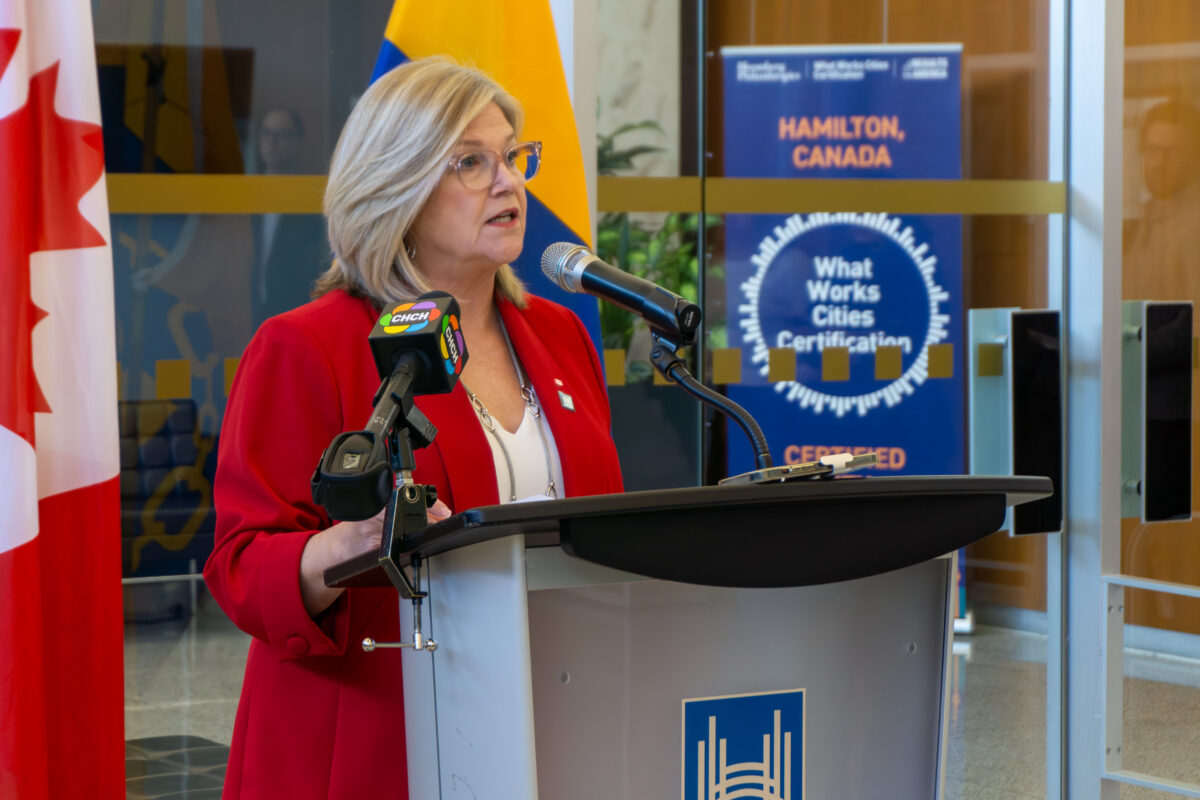
The following is the full transcript of The 155 Election Podcast interview with Hamilton Mayor Andrea Horwath who is seeking re-election. You can subscribe to The 155 Podcast on iTunes, Spotify, Amazon Music, or your favourite podcast app via RSS.
In Episode 245 of The 155 Podcast, incumbent Mayor Andrea Horwath discusses her plans for continuing to govern the City of Hamilton if re-elected as mayor on October 26, 2026.
Horwath identifies responding to U.S. tariffs and revitalizing downtown Hamilton as two of her principal priorities.
The interview is structured into three sections: candidate introduction and priorities, exercise of mayoral powers and responsibilities, and how the candidate will inspire public confidence as leader of Hamilton.
The following transcript is organized by topic and question with timestamps.
RELATED: Read the full The 155 Podcast transcripts for mayoral candidates Rob Cooper and Keanin Loomis.
Opening
Joey Coleman: Welcome to the 155 Podcast, interviews with candidates for mayor, council, and school board in Hamilton, Ontario, Canada. Learn more about the candidates at hamiltonvotes.ca.
Episode 245.
Andrea Horwath, you are running for re-election as mayor of Hamilton. Welcome back to the 155 Podcast.
Andrea Horwath: [00:00:23]
Thank you. I appreciate you doing this.
First Section: About the Candidate, and Two Priorities
Tell Us About Yourself:
Joey Coleman: [00:00:24]
Briefly, tell us a little bit about yourself.
Andrea Horwath: [00:00:27]
I’m a lifelong Hamiltonian. I was born at St. Joseph’s Hospital. I went to McMaster University. I went to high school in Hamilton East and grade school in Stoney Creek, where I was raised, and spent some time in factories when I was young. Before that, I was picking fruit in Winona and Stoney Creek farms.
After university, I did some worker education work. Then I went to some not-for-profit housing work with Niagara Peninsula Homes. Then the legal clinic in Hamilton for about six years.
Then off to city council in 1997 to 2004, [before winning a] by-election in Hamilton East represented that riding, which then turned into Hamilton Centre for the NDP, became the leader [of the Ontario NDP] in 2009, took Official Opposition in 2018, and retained official opposition in 2022, then ran for Mayor in 2022. And now, four years later, I’m running again.
Joey Coleman: [00:01:30]
Briefly, why are you seeking re-election?
Andrea Horwath: [00:01:33]
I’m seeking re-election because I really believe that Hamilton has a lot of momentum right now. I’ve brought a lot of resources to this city through my relationships.
By that I mean resources from other orders of government, so financial support. But also, a great deal of investment has come to Hamilton as we transform our economy.
Notwithstanding that we have the headwinds of the tariffs that are once again in front of us, this city has a great future, and I’m determined to be a part of it.
What Are Two of Your Priorities?
Tariff Response and Downtown Revitalization
Joey Coleman: [00:02:01]
We’re going to do things a little differently in this interview. Listeners can find your platform planks on your website. There are plenty of surveys on the widely known issues that they can read, and they can visit hamiltonvotes.ca to watch debates, read transcripts, and find links to those surveys.
Before I turn to how you will govern and how you will lead, briefly, I wish you to explain two of your platform priorities and why you think they are important.
Andrea Horwath: [00:02:28]
One of the platform priorities I have is fighting against the Trump tariffs. We cannot control Donald Trump. I cannot control Donald Trump. But what I can do is put forward a response that protects Hamilton businesses, workers, and our community. And that’s what I’m doing.
So I’ve put a seven-point plan out, which people can look to in the links that you’re providing, and I’m grateful for that. I will be bringing the motion [to Council]. I circulated the motion to clerks and the councillors yesterday [September 24].
Editorial Note: the motion was passed unanimously by City Council.
So I’m looking for them to add anything that they think I might have missed so that we can prepare for the very destabilizing situation that Trump has brought to us yet again. That’s number one.
Another of the major platform planks that I’m running on is our downtown, because I love our downtown, and it’s the front door to our city. It’s also the heartbeat of our city. I’ve brought a lot of interest to our downtown. When the TD Coliseum was stuck, I unstuck the TD Coliseum to get that investment increased from the $50 million original investment to the $300 million. I got that Delta Agreement, if you will, over the finish line. I was able to assist with a number of other initiatives, including the ones that deal with our challenges.
Downtown is at a bit of a crossroads and it’s a very complex place. We have some difficulties, but we also have a great deal of momentum. And so whether that’s bringing acts like the Junos, the Grey Cup, connecting with those kinds of organizations and the Minister of Tourism, which I did do quite a bit when Stan Cho was in that portfolio.
That’s what brings the acts and the dollars to our downtown and animates our downtown. We now have a downtown strategy. Again, that’s something that’s visible on the city’s website as well. And I look forward to not only, you know, we’re already started. We’ve started implementing our strategy. But I want to make sure that that strategy continues to grow and thrive and get the attention and resources that it needs. Because our downtown, it’s, as I said, it’s the heart and soul of the city, and it’s our reputation, and it’s doing well. It needs to do better.
Mayoral Powers & Responsibilities: How Will You Structure and Exercise Duties?
What are the Powers and Responsibilities of the Mayor Under Section 284 of the Municipal Act
Joey Coleman: [00:04:45]
Let’s turn to Section 284 of Ontario’s Municipal Act, commonly referred to as the Strong Mayor Powers or Provisions.
From memory, what are the powers and responsibilities of the mayor under Section 284?
Andrea Horwath: [00:04:58]
The powers and responsibilities of the mayor under Strong Mayor Powers include the tabling of a budget with very specific timelines. The ability to veto decisions that are passed by council within a time frame. I believe it’s 10 days, if I’m not mistaken. The requirement to sign off on all the bylaws and the ability to issue directives to the staff. And I’ve used some of those powers, as you will know. But that’s, in a nutshell, really what they are. I could also veto the budget at the end of the amendment period that councillors have to amend it, which I’ve never done.
How will you structure the Mayor’s Office?
Joey Coleman: [00:05:39]
Before I ask you how you plan to exercise your responsibilities, let’s talk about the structure of the Mayor’s office.
How do you plan to structure the Mayor’s office to ensure successful completion of your priorities?
Andrea Horwath: [00:05:50]
Well, I’m glad you asked that question, Joey, because one of the big pieces I need to do with the Mayor’s office, there’s two pieces. One is the communications piece needs to be ramped up. It’s something that we’ve identified as being maybe a weakness. And I’m okay to talk about those kinds of things because you can’t fix something unless you acknowledge it. So that’s a big piece.
And why is that one big? Because we’re heading into the LRT construction phase in this next term of council and making sure that people know that they can get a hold of the Mayor and that the Mayor’s office is communicating not only with the people directly affected along the LRT line, but also the rest of Hamilton so that people have an understanding of what’s going on.
Yes, that gets done corporately, but there is a responsibility for the Mayor’s office when something transformational like that is taking place, that the Mayor’s very, very much engaged in the communications and the feedback that Hamiltonians will want to share during that transformational project.
Section 284.5: Hiring the City Manager
Joey Coleman: [00:06:49]
Municipal Act Section 284.5. Appoint or dismiss the chief administrative officer. You get to hire the next city manager. What is your plan and what is your timeline?
Andrea Horwath: [00:07:00]
The next City Manager is absolutely an opportunity right now, particularly when you look at the opportunities that the City has in front of it. I’ve made a commitment to ensure that the City Manager is hired with a number of councillors involved and me, with a professional firm involved, as was the case, and voices from the community as part of the panel to hire the next City Manager.
The timeline would be as soon as possible, but not so soon that it doesn’t give an opportunity for new councillors to settle a tiny bit and perhaps be a part of that process.
Managing Council: Appointments and Structure
Joey Coleman: [00:07:41]
Municipal Act Section 284.8. Establish or dissolve council committees, assign their functions, and appoint their chairs and vice chairs.
What is your plan for structuring council for effective governance in the coming term?
Andrea Horwath: [00:07:55]
That’s a very good question as well. And I’ve been thinking about it a lot. In fact, I’ve been looking at some of the other councils in Ontario and other provinces in terms of how they function. And that for me is currently a work in progress. I’ve been talking to the City Clerk about that. I’ve been talking to the senior leadership team about that. And when council reconvenes after the election, if I’m given the honour to serve again, that is going to be a top priority. Because I think there’s some improvements that can be made, and I don’t want to do that without a proper review and significant input from those who will be impacted by it.
Hiring & Firing of Upper Management, and the Size of Upper Management
Joey Coleman: [00:08:34]
Municipal Act Section 284.6. Determine the municipality’s organizational structure. You decide the size of the uppermost management. You decide performance standards and metrics. You can hire and fire directors and above. How will you exercise these responsibilities?
Andrea Horwath: [00:08:51]
I will not do anything different than I’ve done last time. I believe that the organization is best operated by the bureaucratic head, the person who’s responsible for the staff. So I hire the City Manager. The City Manager manages the City, manages the staff, manages the senior leaders. I don’t believe that it’s appropriate for the political side to chop off heads because the direct reporting responsibility for senior leadership team lies with the city manager. And that’s a boundary I think that’s important.
And I think it’s also important not just, you know, corporately in terms of a corporate structure and proper corporate functioning with the division between governance, if you will, and administration or the bureaucracy.
However, I also think it’s important because it has an impact on the morale of staff. People need to know that the people that they’re reporting to are reporting up to the next management level and that at the end of the day, it’s a professional organization that is fair, that has operational requirements and structure, that expectations are clear, and that the fulfilment of those expectations have consequences that are clear. And that’s something that belongs with the administration, that belongs with the bureaucracy, not with a politician, respectfully.
Key Performance Indicators: First 100 Days
Joey Coleman: [00:10:23]
Key performance indicators. I hear from all three frontrunner candidates that performance management is a priority. There are three questions on this topic.
One, what are three key performance indicators you will measure and make public within the first 100 days as Mayor?
Andrea Horwath: [00:10:40]
Well, that’s an interesting one as well, because we are trying very hard to bring more dashboards online. In other words, more of those representations of the goals that the city has in the various departments and how they are being realized or not and where the gaps are. So I think it’s not only about a KPI, but it’s about being able to see the organization almost in a way that’s more transparent through the dashboard process. What I would love to be able to do is have more people understand what those dashboards are about and be able to find them. So in terms of transparency, you can put all these things in place. So for example, I’ll give you one.
When I first got elected last time, I became the Mayor [in November 2022], and within a couple of weeks, we had a huge sewage leak issue that was realized off of Burlington Street. 26 years there had been sewage that was going directly into the lake. The advice I got from the senior team at that time was, well, we don’t have enough information to tell the public. Well, it’s going to take a couple of weeks for us to understand what’s going on. And immediately I turned that around and said, no, that’s not what’s going to happen.
We’re going to tell the public right away and let them know that we don’t have all the information. But as we get the information, we’re going to give it to them. What came of that, though, is, which is a good thing. I think that was the right thing to do. And that’s how I’ve been operating, unless there are legal things that require me to not do that. But having said that, one of the things that came of that is a new process whereby the staff of Hamilton Water innovated.
And they started to proactively, through data, look at where the possible issues such as these might be happening in other parts of the city. And so they began to proactively look at those weak areas to prevent the same kind of thing happening again. All of that data is online. Where the leaks are happening, all of those pieces are now online so that people can see them.
So yes, it’s KPIs, but it’s also as much data transparency as we can get for folks that are interested in following up on an ongoing basis.
Key Performance Indicators: Public Reporting Timeline
Joey Coleman: [00:12:58]
Question two on the topic of KPIs.
What is your timeline for launching a meaningful public key performance indicator dashboard?
Andrea Horwath: [00:13:08]
Well, again, the process of putting that together will include the city manager that gets hired. I don’t believe it’s appropriate to do that without the city manager because they’ll be responsible for the KPIs. But also, I think it’s important to make sure that we have the ability for our IT people to get that done in a timely manner as well. So I will have to be cognizant of that. It will have to be after the next City Manager is hired.
Key Performance Indicators and Public Trust
Joey Coleman: [00:13:36]
Hamiltonians do not trust City Hall. Pick your measure. There are many out there, but consistently, lack of trust is a theme that comes through.
How do you ensure that the KPI dashboard information is accurate?
Andrea Horwath: [00:13:53]
Well, I think that one of the most important things that we’re doing and we’re continuing to do is try to provide more access to City information. And I have a little list of the things that I’m going to quickly look at, but there’s no doubt that we are putting more information out there and not requiring people to go for FOIs, for example.
We are always adding to our open data capacity. In fact, our online presence is available in 80 languages now, my.hamilton.ca. We’re also working really hard to make sure that we’re AODA [Accessibility for Ontarians with Disabilities Act] compliant in a much better way than we have been in the past.
The budget always seems to be a bit of a challenge because of the volume. But these are things. So from my perspective, trust and transparency isn’t just about information, but it’s about making sure that everybody can access the information in the way that they can utilize it the best. That’s always a work in progress and needs to continue. I would say it.
The other thing about trust that’s frustrating that I’ve noted, and I don’t know how you fix it, is people get frustrated when, for example, there’s an Auditor General’s report. And folks say, well, everything’s gone wrong and, you know, this city’s terrible. How can we trust them?
But that’s the whole point of the Auditor General, is for the Auditor to look at whatever they think is appropriate because they’re independent, so it’s not politically driven. And whether it’s through the waste and fraud hotline or whether it’s through information that the auditor’s getting from other sources, the Auditor sets a work plan every single year. He also reports back on the findings, but then whether or not the recommendations have actually been followed up upon by the bureaucracy. And then a couple of years later, he reviews that information and provides a follow-up report.
So that’s a lot of time between the various things. And I don’t think people necessarily understand that there’s a whole process that happens after the Auditor General gives a report. Do I wish that there was no need for an Auditor General to ever have to do a report? I think all Hamiltonians would wish that, but that’s just not reasonable in terms of the size and complexity of an organization like Hamilton. It is a good practice to do that.
I don’t know how we make it more obvious when the follow-up actions take place and then the final kind of review, if you will, or re-issuance of whether or not there has been positive systemic change over time takes place. So that’s the one thing on the transparency and trust. The other thing is the frustration around the legal requirements. And I know people… People say, oh, this happened and nobody got fired. Well, in fact, often that’s not the case. Often the case is that people do lose their jobs when things go awry. There have been several examples of that in this last term, and rightfully so.
One of the challenges for myself as the Mayor, and the Council, is that we have legal obligations from a human resources and a corporate perspective in terms of preventing the city from being sued, from disclosing people’s names specifically and/or information that would easily identify who those people are that have been fired. Again, that’s a lot of stuff. It’s a lot of gobbledygook, if you will. But that’s the reality. And I know that that frustrates people. And I understand that it frustrates people.
On the other hand, people will know that there has been a lot of change at City Hall. There have been a lot of people who are no longer at City Hall. And what I would say to people is you have to read between the lines. When I got to City Hall, there were a lot of problems. I’m not saying there are no problems now, but oftentimes problems require fixes that are as big as people leaving the city, leaving their employment, people not performing, not being prepared to step up, then no longer going to be working for the city because we have to do better for the people of Hamilton.
I hear people all the time say, I don’t like high taxes, but I don’t mind paying taxes if I feel that I’m getting the value for money. And those are the goals that we have to keep in mind and have the staff, upper levels of management, as well as mid-management, that can help people rest assured that their tax dollars is bringing value.
The Budget: How Will Mayoral Candidates Keep Their Promises
Joey Coleman: [00:18:26]
Municipal Act Section 284.16, The Budget.
The City of Hamilton is the only Ontario city to have its credit rating downgraded during the past four years. The City of Hamilton is Canada’s worst-ranked municipality for fiscal transparency, both because the City of Hamilton has failed to complete its audits since 2022, but also because the City of Hamilton does not provide detailed tracking of spending. The City of Hamilton is the only Ontario city to not finalize its mandatory financial information returns this council term. There are three parts to this topic.
Promise to Cap Taxes: How You Will Achieve this Promise?
Joey Coleman: [00:19:00]
Let’s start with promises to cap tax increases. Municipalities are the only level of government that have to manually recalculate tax rates each year. This means taxes visibly rise each year, whereas provincial and federal taxes rise invisibly.
There is only one effective means to control tax increases, and that’s to control spending. This means cutting management positions. Since you have already promised to control spending, the question is, how do you plan to restructure management to achieve your goals?
Andrea Horwath: [00:19:31]
I’m not sure I agree with your premise that the only way to reduce spending is through cutting management. I don’t necessarily agree with that premise.
And I would say that I think that’s proven by the Auditor General’s reports, the last topic we were just talking about. There are many ways to reduce spending. And it speaks to some of the other pieces around the financials that you’re talking about.
When I arrived in the Mayor’s position, it was very clear that not only was the City not operating at an even modern, modestly modern capacity when it came to technology. In other words, we had systems that were not being fully utilized because people, yes, they know, they just never took it up and they just didn’t want to get the training. And so that’s nonsense and that stopped, right?
So we began to not only deal with the fact that if we’re bringing technology, you have to actually learn the technology. That helps with efficiencies, but also the manual processes in divisions and departments were antiquated and there were no performance measures. There were no processes by which to create efficiency and effectiveness and change the organization’s processes to make it more effective, whether that’s through customer service effectiveness or whether that’s spending effectiveness, there was nothing, nothing. The organization’s been lumbering along the same way for about 30 years.
That’s the reality that I found when I got there. So there are many ways, many ways. One way that we are now maxing, I have to say maximizing, speaks to the issue of the financial records and that speaks to the cybersecurity attack that we had.
What I just said about our systems being poor, our IT systems being poor, had been actually reported in Auditor General’s reports, as I’m sure you know. The funding was never adequately put in place. It was bumped for a couple of years to avoid having it hit the budget.
And then we got caught with our pants down, which is what one of the councillors described it as. And it’s the truth. And it’s caused us a whole lot of pain. And it’s caused Hamiltonians a whole lot of frustration because to rebuild the records that we lost so far have taken about 4,000 hours under the kind of supervision, if you will, by KPMG. And those rebuilding of records and of information is what has prevented us from having the audited statements. But we are still getting budget variance reports regularly that help us to be assured that we are at least getting some information as overseers in terms of how money is being utilized.
That’s a long way to say the efficiencies and effectiveness are more than just management. I do also want to say very quickly, though, that the other impact of the cybersecurity attack is we are future-proofing the city in terms of our technological capacity and our training up of our workforce to provide not only today’s standard, but to future-proof us for the future when it comes to technology.
Four-Year Budgetary Plan: 2027 to 2030
Joey Coleman: [00:22:54]
2027 to 2030 budgets. What is your budgetary plan for the next four years?
Andrea Horwath: [00:23:00]
What I want to achieve in the next four years is ensuring that we have taxes that are reasonable for people while making sure that the priorities of the city are looked after.
After the experience I’ve had this past four years, recognizing that our budgets need to be further enhanced by the other orders of government being at the table, which I’ve been able to improve in the last four years in terms of the amount of resources we receive as a city, that needs to push forward. But also the other global issues that we’re facing right now and the impacts those may have.
That’s something I worry a lot about because, of course, we’re having that situation right now with Trump’s tariffs. Nobody can predict what the future brings, but what we can do is adjust our budgets to protect the people and the workers and the businesses of this city. I certainly hope we don’t have another four years of this kind of chaos, but I think there are things that we need to do to future-proof ourselves in that regard economically as well. And that’s why one of my plans is to continue to work with HOPA, the Hamilton-Oshawa Port Authority, to have Hamilton become a first port of entry so that we can continue our economic expansion and diversification so that we can be not only a better part of the Trans-Canada supply chain, getting goods back and forth across our country, but as importantly, getting goods directly to global markets from Hamilton and in from global markets to Hamilton, taking trucks off the highways, getting containers onto rail from ships and vice versa.
Discretionary Spending: Should The City of Hamilton Continue Purchasing “Awards”
Joey Coleman: [00:24:41]
Discretionary spending. I’m going to highlight one item of discretionary spending, and I’d like your thoughts on it. The City of Hamilton is one of Canada’s most award-winning municipalities. The City often cites the Distinguished Budget Presentation Award, which the City of Hamilton and approximately 1,800 other government bodies across Canada and the United States purchase each year.
Listeners can visit gfoa.org/budget-award-fees to see the purchase price for themselves. The City often cites this award to counter independent third-party reports from institutes and bond-rating agencies regarding the City’s fiscal management.
What are your thoughts on this type of discretionary spending?
Andrea Horwath: [00:25:28]
I’m not one of those people that believes that a city should operate in a cocoon. I believe that we should be looking at what other cities are doing and not doing.
I know that there are councillors and possibly mayoral candidates that believe any discretionary spending, whether it’s sending our economic development teams to technology trade shows, for example, in the United States or overseas, that that’s a waste of money, that professional development is a waste of money, that trying to help our staff keep up with the times and innovate is a waste of money. I disagree with that completely.
I think that there is a lot of value to those kinds of initiatives as long as they are properly documented and the results are obvious. And so I would look to, for example, our expansion in life sciences in terms of what we’re doing as a city economically. We have significant life sciences expansion. And by that, I mean things like radiopharmaceuticals, advanced manufacturing in medical devices, etc.
These are the kinds of things that come to Hamilton because our staff go out and go to those trade shows, make connections, have conversations and discussions, and bring investment here from other jurisdictions, from international companies, etc. We just cut a ribbon on one called AtomVie not very long ago, a couple of weeks, and they manufacture radiopharmaceutical products that literally directly target an individual patient’s cancer cells and go to those cells and kill the cancer that’s manufactured right here in Hamilton. They just opened recently. So far, they’ve assisted and they’ve helped to elongate people’s lives, so keep people living longer or help cure their cancers, 4,000 people around the world.
We have an innovation hub here when it comes to science, technology, healthcare, with our hospitals, with our universities, with our college.
In order for us as a City to partner with those organizations, we need to invest in our people to be able to bring that home. So in terms of your specific example, I don’t have a specific on that one because I haven’t done a lot of research on it. But what I can say is that there’s often this sense that we just cocoon ourselves and don’t spend any money, don’t send staff anywhere, don’t do professional development, and somehow we’re going to grow and blossom as a city. That’s nonsense.
We have to be out there looking at what’s happening, being on the cutting edge, and learning from others, because recreating the wheel is much, much easier if you can see the wheel that you’re trying to recreate.
Leadership as Head of Council: Leading on the Top Priorities
Implementing Basic Service Delivery, Citizen Service, and 3-1-1
Joey Coleman: [00:28:20]
So we’re now turning to a new section of the interview. Let’s turn to leadership of council. I interview candidates in every ward across Hamilton. In those interviews, I ask them to list two of their priorities for the ward, two citywide priorities, two to improve city services, two to improve quality of life, and two housing initiatives they wish to implement. The candidates have been door knocking for months. They’ve met hundreds of thousands of Hamiltonians. Let’s talk about implementing, or not, some of these common priorities.
The top priority was fiscal accountability, spending control, property taxes, and affordability.
We’ve already discussed the budget, so we’re going to move to the second priority. Listed by nearly every council candidate were variations of basic service delivery, navigating City Hall, and a 3-1-1 service.
So here’s the question.
No matter the outcome of the ward races, a majority of council will want to implement basic service standards, make it easier to navigate City Hall, and implement 3-1-1. How will you lead on these common priorities?
Andrea Horwath: [00:29:26]
I already am. I’m already leading on all those priorities.
The 3-1-1 system was supposed to start by the end of this year. We’ve run into some challenges around the availability of cell service. Believe it or not, Hamilton’s a big city. And so we don’t have equal access to cell service in the city. So we’re working on that as well. So what’s delayed the 3-1-1 at this point has been not wanting to launch a new service that all Hamiltonians can’t take advantage of. Now we’re working on making sure that people do have reliable access to cell service to be able to get us over that hump.
On navigating City Hall, we’ve already begun to move a lot of pieces into my.hamilton.ca. But I also want to commit to, and I have committed to, making sure that people have access to City Hall, not just digitally. This is something important for seniors particularly and folks that are not as digitally adept. And that’s something that we will continue to do through provision of materials and information at all of our public spaces. But bringing a lot of services online. So we’ve done permits and licensing and some basic development approval processes for small projects already are online.
What we are now doing is more or less working through any bugs. So it’s not just a matter of throwing stuff online, but there are feedback loops to make sure that people can provide feedback about their experience, what’s working, what’s not working. And there’s a continuous improvement piece built into all of that. And we’re going to continue to provide more and more of that access when it comes to City Hall.
I don’t have the drawings in front of me, but the physical space in City Hall, in terms of the physicality of it, is under renovation right now. There’s definitely a desire to make City Hall something that people feel that they can easily access. A big part of it is customer service.
Can I say culture at City Hall? When I became the Mayor, I realized that there was a bit of, I mean, I described it as a bunker mentality, a little bit of a bunker mentality where, you know, City Hall was very inward-looking.
That’s not what a City Hall should be. It should be very outward-looking and very welcoming. So we’re trying to change that culture each and every day, trying to remind people that their job at City Hall is important. It’s important because it serves the people of Hamilton. That’s what we’re here for. That’s what we do. So that’s a work in progress as well.
On basic service delivery, again, it’s about making sure that people not only can provide feedback about their experience, but then that experience feedback leads to change. And that’s where the customer service piece comes in again. It’s not just a matter of assuming this is what things look like, but what does it really look like? What are the learnings that I’ve had?
Not that long ago was around services for children because we need a way to address the concerns about youth in our city. So I called a meeting of many, many service providers, including ones at the city, the school boards, independent to not-for-profit organizations. And we discovered a couple of things. First, that even around that table of professionals, people didn’t know what each other were doing, nor did they know how to necessarily refer to another service that was sitting around that table. So this is a problem. If people who are in children’s services don’t even know what services are available for children and families, how does a family know what services are available? So we’re finding that there are big gaps that need to be addressed, and we’re addressing those gaps. If you don’t look, you won’t find them. So that’s an important piece.
There’s one other thing that I think is important in terms of navigating City Hall, and that is City Hall is not just a physical space. City Hall is represented in everything and every place in this city because the city or City Hall, colloquially, is responsible for it. But there is a physical space called City Hall.
What I’ve tried to do as mayor is to open up that City Hall to the people of Hamilton and ensure that people know that it’s not my City Hall and it’s not the staff City Hall and it’s not the councillors’ City Hall. It’s the people’s City Hall. So as many events, as many celebrations, as many meetings that we can have, as many public initiatives that we can host at City Hall, what we try to do.
I’ve been trying to make sure that City Hall is utilized by our public. So whether that’s hosting an Iftar every year, which I started and will continue to do if I’m given the honour of continuing to serve, whether it’s an opportunity to have our Holocaust Remembrance Day ceremonies at City Hall, whether it’s any number of things, whether it’s education about a particular faith or cultural organization that exists in our city, or the Black Community Leadership Awards and those kinds of things.
All of those things are, that’s what the city is. That’s who the city is. Those things belong at City Hall. Those people belong at City Hall. And people need to know that it’s their City Hall.
Fixing Roads, Sidewalks, and Infrastructure
Joey Coleman: [00:34:37]
The third most common priority, fix the roads, sidewalks, and infrastructure. How will you lead on this?
Andrea Horwath: [00:34:46]
This past budget, we bumped up the attention to roads and sidewalks particularly, I believe $106-million increase in the addressing of that infrastructure particularly. Not because only how awful it is and that it needs to be done, but it’s a safety issue as well. It’s a safety issue for people who are walking, people who are cycling, people who are driving.
The other thing I did was try to figure out why. Why are the roads so bad? Why is it such a mess, really? And I acknowledge it like everybody else does. It’s a problem. And I learned that there were some procedures internally that stretched the time between resurfacing of a road to, I think, too large of a gap. So what that means is the deterioration got worse and worse and worse every season.
But the time that it was, quote-unquote, in the budget to be fixed was too far out. So that means you have to collapse those timelines, make them shorter, especially as our climate changes. And we have the kind of weird winter that we had last time, freeze and thaw, freeze and thaw, freeze and thaw. If that’s going to continue to happen, then the deterioration of our roads is going to continue to accelerate. Then we need to look at the time frames between when we do that kind of maintenance.
It’s interesting because I know that there are some folks who are running for Mayor talking about only dig once or don’t pave twice. If your underground infrastructure gets done every 30 years, you can’t wait 30 years to repave your road. You have to do a shave and pave maybe every 10 years, maybe every five. I think it depends on the shape of the road. But I believe with technological changes and monitoring, with the ability of people to actually report potholes and problems with sidewalks and those kinds of things online, we’re getting much better at that. And that’s why that increased investment took place. And that’s why we’re looking systemically at what are the things that we need to do to prevent the deep level of deterioration that’s been allowed to happen over… Look, it didn’t happen in four years.
Just to be clear, it didn’t happen in four years. There’s a problem here that’s been ongoing.
Much of it has, you know, has been, let’s just say Barton Street, which is now being paved. It’s not going to be on the CAA list next year. That’s for sure. And that’s a positive thing. James Street as well as, you know, there’s been a number of roads that have been done, which isn’t to say there aren’t roads that are causing some frustration. I think of Garner Road particularly in Ancaster that it’s really driving people batty, and rightfully so.
Community Safety and Policing
Joey Coleman: [00:37:20]
Fourth most common priority: community safety and policing. Council candidates widely cited this as an issue. There were a range of proposals. How will you lead on this priority?
Andrea Horwath: [00:37:34]
One of my frustrations currently is that we lost some tools to help with particularly speeding, and that causes us some problems because we cannot have police officers in every neighbourhood dealing with speeding. Unfortunately, that’s a decision that was taken out of our hands. We weren’t one of those municipalities that were abusive when it comes to cameras for speeding. But I understand that there were some that were over the top.
That wasn’t my decision to make. That was the Premier’s decision to make, and he made that decision. That takes away one of the tools that would have helped us to reduce speeding in neighbourhoods.
I think there’s a couple of things that people think about when it comes to safety. One is gun crime and violence and auto thefts, etc. All of those stats are going down, which you probably know. I don’t know if you have a link in your podcast to the crime stats, but I certainly do have them. And if you don’t mind, I’m just going to let your audience know the crime stats that we’ve seen reducing in Hamilton. Because I don’t think that people feel, and that’s as important, I don’t think people feel that it’s much safer. But gun crime is down, I can’t find my stat, but gun crime is down, I believe, about 50 per cent. Car thefts are down, okay, there it is. Shootings are down 50 per cent since 2022. Auto thefts are down 36 per cent. And break and enters are down 29 per cent.
But the reality is people still feel unsafe. When you have someone steal a car and hit a building in your neighbourhood, that makes you feel unsafe. When you hear of someone being shot in Stoney Creek or an attack on someone downtown, that makes people feel unsafe. And so I believe there are pieces around that that are different in kind of neighbourhoods where there’s cars speeding and they don’t see enough police or there’s a break and enter and they don’t see enough police and what’s happening in the downtown.
So I think there are different pieces there and we have to address them all.
On the downtown piece, we are working hard to create a downtown that feels more safe. So you’ll know that there’s been a police substation being put in Jackson Square. We’ve increased the police patrolling in downtown. I have some platform pieces which people can link to around making sure that we have a kind of a code of behaviour downtown, if you will, not something that’s necessarily going to be enforced, but expectations that we can expect from each other around how do we all enjoy our downtown. Cleanliness is a big piece of it. The broken window syndrome, if people don’t know what that means, it means that if you have a lot of dirt or if downtown looks unkempt and not well taken care of, then it’s going to feel like not well taken care of and a bit scary. So we’ve bumped up the cleaning and the maintenance in the downtown, and we’re going to do that even more in my plan.
So there are lots of pieces. It’s a complex problem. It’s not just one solution. Policing is not the only solution. There are other solutions, including things like in other communities other than the downtown, but even in the downtown, things like neighbourhood watch programs, things like seniors watch programs, things like us helping to connect people in community so people feel more part of a community and so people are having eyes on each other and eyes on the neighbourhood. And I don’t mean inappropriate cameras that are inappropriately filming people. I mean getting back to that sense of community. But the police also do play an important role, not only in terms of reactive, but in terms of proactive education and helping community members to understand what they can do to keep themselves safe and their neighbourhoods safe. And I think of that particularly around seniors, because we’re seeing crimes against seniors. And I think about the thefts and those kinds of things that are happening on the increase. And I’m very hopeful that we can be better at those kinds of interactions where the police are providing some proactive workshops and tips for people.
Parks, Recreation, and Community Facilities: How Will You Improve Them?
Joey Coleman: [00:41:47]
And finally, for this section, parks, recreation, and community facilities. Similarly, a wide range of proposals and positions from council candidates. Your thoughts.
Andrea Horwath: [00:42:00]
Before I say anything about this, I do want to say I’m happy and excited to get the list that you’ve put together. And I hope that I’ll be able to receive it if I’m given the honour of serving again in a more formal way. That would be wonderful.
I did do this with the councillors last time around when I was first elected Mayor. Invited them in to talk about, you know, what are your priorities? What are your priorities locally? Maybe not as… specifically as you did to all of that, but I did have those conversations.
And so when it comes to the wards, particularly as the Mayor, it’s really important to make sure that you’re paying attention to the ward councillors because they know their wards and the constituents at a micro level in the way that you will never be able to as the mayor. And so this kind of response to what’s happening in the wards is very much. Not only I wouldn’t say the responsibility of the councillor, but it’s the purview of the councillor.
And as the Mayor, it would be my responsibility to be supportive of and assist with problem solving and solution finding with the ward councillors. And we’ve been able to do that the last four years on a couple of specific matters. But let’s face it, every single Hamiltonian lives in their neighbourhood. And they want to have the best possible neighbourhood to live in for themselves. They have a family for their family and also not only where they live, but where they work. I’m absolutely a partner when it comes to the ward councillors and what they’re identifying.
But we do have a deficit when it comes to recreation facilities and the condition of some of our facilities. And we need to make sure that our recreational master plan has the investment it needs to be able to move forward and provide enough services for community-wide because these are the things that create a better quality of life for folks.
Final Section: Character and Role of Mayor Questions
Joey Coleman: [00:43:50]
How will you inspire public confidence?
Andrea Horwath: [00:43:54]
Public confidence, I believe, is about accessibility, being out in the public, being available to the public, making sure that when the public reaches out that they get responded to. Not only being available to the public in terms of you come to a meeting at City Hall, but being out and about in the public and not simply walking through a space, but engaging people, chatting with people, being accessible in that real human and personal way.
This is what I love most about the kind of role that I’ve played for many, many years now as an elected person is connecting with people. And I think through connection, you learn so much. Through listening, you learn a lot.
And I think when you’re listening and you’re learning and you’re receiving feedback and then you’re acting on that feedback, I think that creates public confidence. I also think that having the ability to connect with the other orders of government in a way that brings results also brings confidence. It’s something that I think people can see as true leadership. I don’t have a problem in that regard.
I know a lot of folks in both the federal and provincial governments. I have great relationships there. And those relationships bring resources and results and make sure Hamilton’s voice is at the table. So whether it’s big city mayors, whether it’s getting the city back involved with the Association of Municipalities of Ontario, whether it’s being able to call up the Minister of Environment or the Minister of Transportation or the Federal Minister of Regional Economic Development, Evan Solomon.
These are all folks that I have on my Rolodex. But the important part is not just to have them on your Rolodex, is to use those connections to bring Hamilton into the spotlight. And I think that engenders some confidence as well.
Joey Coleman: [00:45:43]
This is one of my favourite things at City Hall. Ward councillors host the school tours of City Hall. Inevitably, one of the children will ask, when do we get to meet the mayor?
In 30 seconds, how do you explain the role of mayor to a group of fifth graders?
Andrea Horwath: [00:46:02]
I’ve had the opportunity to do this many times, both at City Hall and when I’m invited into classrooms, which I’ve been invited in as a mayor, as a city councillor, as an MPP. And what I love to do is ask the kids questions about what they think the city does. And then we talk about what the city does, what councillors do, what the mayor does, but what the MPPs do and what the MPs do. The city, the province, the federal government. It’s a really fun thing to talk to kids about civics.
Three Words to Describe Your Character and Leadership
Joey Coleman: [00:46:30]
It’s 2030. I’m writing an assessment of the council term that is just ending. What three words do you hope I use to describe your term?
Andrea Horwath: [00:46:39]
Effective, inspirational, efficient.
Joey Coleman: [00:46:43]
And I’d like you to listen to some audio of what you said four years ago.
Archival audio (Andrea Horwath, 2022 campaign): [00:46:49]
Collaborative, successful, and future thinking. For council, it would be collegial, open-minded, and engaged with community.
Joey Coleman: [00:47:00]
How do you feel you did?
Andrea Horwath: [00:47:03]
I think we did fairly well on some of them and not so well on others. And I’ve learned from that experience because one of the things that happened is we had a big turnover of council, as you know, and I was new. So it was a situation where a lot of us were learning on the job at the time. And I think that nearer to the end of the council term, people were having a better ability to collaborate than perhaps they were at the beginning as folks were trying to figure out their space. We know for sure there’s going to be some turnover no matter what this time as well. I hope to be the Mayor, to be able to take that learning that I had in the first term, to be able to then help with some of that collaboration and some of that understanding of how we work together as a team with our staff to push the city’s future forward.
Closing Remarks
Joey Coleman: [00:47:51]
And now you can breathe a sigh of relief.
Would you like to provide any closing remarks?
Andrea Horwath: [00:47:56]
I would say that one of the things I’m very proud of in this city is the number of… initiatives that I’ve had opportunity to unstick. So the airport was stuck. It’s now improving. We have a $400 million investment coming. We have passenger service from Porter. That’s a big part because I got that lease renewed. Jamesville, the MZO, was a big part of the work that I did. Of course, people will know perhaps that folks were evicted from their homes in the North End in the City Housing Hamilton Project 10 years ago. And those buildings sat empty and a blight on the neighbourhood all those years.
The buildings are now down. I successfully got the provincial government to issue a ministerial zoning order to allow us to build housing on that site, which CN was preventing us from doing. I was able to get the investment, the bumped up investment. I believe I’ve already talked about that with the TD Coliseum is underway. The LRT is finally under construction.
None of these things happen by accident. They happen through determination. They happen through knowing who it is that you need to talk to and being relentless in the advocacy on behalf of the city of Hamilton. And if people have seen what I’ve done over my entire political life,
I am a fierce advocate for this city, always have been, always will be.
Joey Coleman: [00:49:22]
Thank you for joining us.
Production Details
v. 1.0.0
Published: October 8, 2026
Last updated: October 8, 2026
Author: Joey Coleman
Update Record
v. 1.0.0 original version
Discussion
0 commentsNo comments yet. Be the first to add your perspective.