
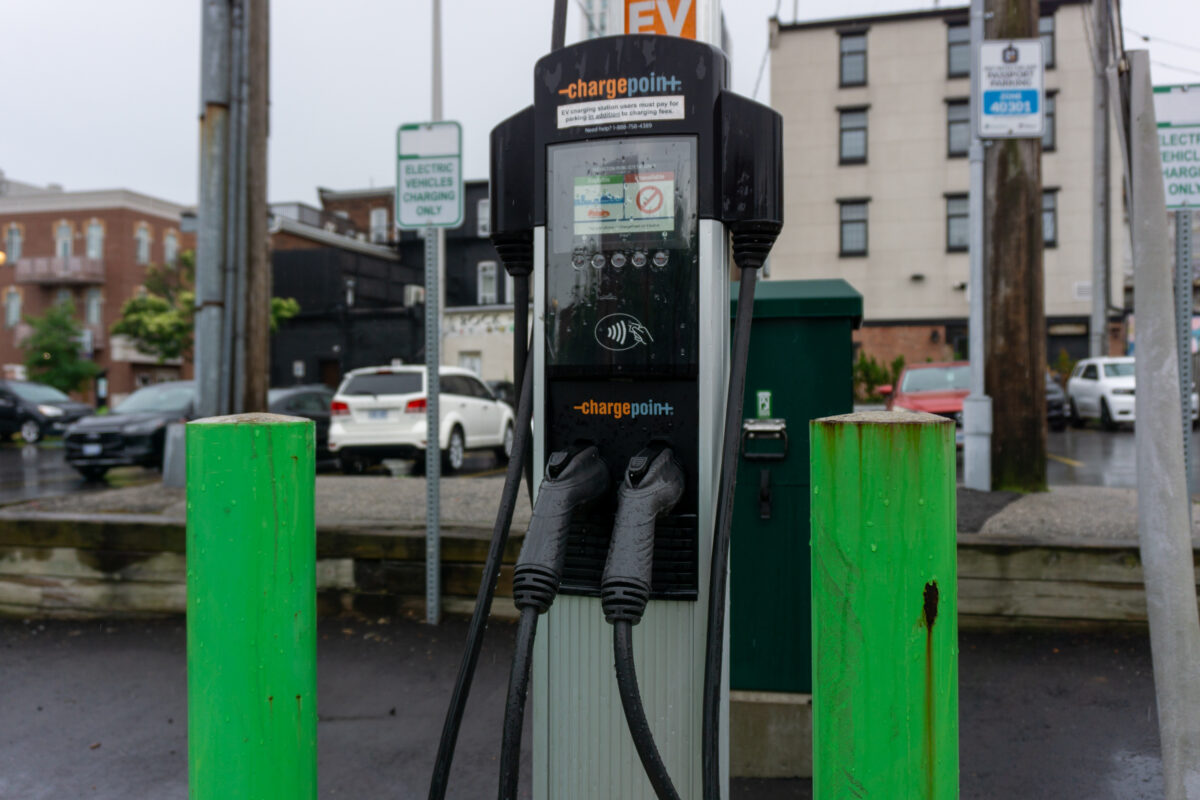
Hamilton’s new electric vehicle parking requirements are now in force, requiring EV chargers in at least one parking space per unit for most residential housing types, and in 15 per cent of spaces for larger residential buildings.
The City of Hamilton and the West End Home Builders’ Association (WE HBA) have reached a settlement at the Ontario Land Tribunal establishing a transition exemption for certain developments already in the planning pipeline. Under the agreement, developments with zoning approved on or after April 10, 2019, that submit a complete building permit or planning application within three years of the requirements coming into force will be assessed under the former parking standards.
“WE HBA is pleased that a practical and balanced settlement was reached. We support preparing communities for the continued growth of electric vehicles, but Hamilton’s original requirements went well beyond what other municipalities in Ontario were requiring and would have imposed significant costs on new housing,” wrote WE HBA CEO Mike Collins-Williams in response to emailed questions.
“The settlement recognizes that developments should be future-ready without forcing homebuyers to pay today for infrastructure that may not be needed for many years.”
The settlement does not apply to the Lime Ridge Mall and Eastgate Square properties. The owners of both properties continue to appeal the EV parking requirements for their specific sites.
The agreement makes minor amendments to the parking regulations passed as part of By-law 24-052. The by-law decreased minimum parking requirements, and in many areas served by public transit eliminated them entirely, to facilitate residential intensification to support the City’s urban boundary freeze.
For single detached dwellings, street townhouse dwellings, duplexes, triplexes, and fourplexes, the new rules require that at least one parking space be equipped with an EV charger where parking is provided. Semi-detached dwellings and multiple dwelling townhouses must have one EV charger per dwelling unit where parking is provided per unit.
Larger residential buildings must have EV chargers installed in 15 per cent of parking spaces. The remaining 85 per cent of spaces must have conduit installed to support future EV charging. Combined, all parking spaces in larger residential buildings must be either charger-equipped or conduit-ready.
Non-residential commercial and institutional uses must have EV chargers in 15 per cent of their parking spaces. The City requires that all chargers meet a Level 2 standard or higher.
The City’s Director of Engineering Services, Brian Hollingworth, a transportation engineer, said the amendments support energy efficiency and promote the use of environmentally friendly vehicles while ensuring the feasibility of developments already in progress.
WE HBA had expressed concerns that applying the new standards to projects already in planning would disrupt development and require costly architectural and engineering redesigns.
The settlement “also provides important transition provisions that protect projects already in the development pipeline. We believe this is a sensible outcome that supports both housing affordability and long-term sustainability,” said Collins-Williams.
The site-specific appeals for 999 Upper Wentworth Street (Lime Ridge Mall) and 75 Centennial Parkway North (Eastgate Square) are ongoing. Both properties are planned for large-scale residential development.
The OLT settlement approval order is available online here.
Production Details
v. 1.0.0
Published: June 9, 2026
Last updated: June 11, 2026
Author: Joey Coleman
Update Record
v. 1.0.0 original version
v. 1.0.0 changed decision link to CanLII. (June 11, 2026 2:00 p.m.)Â
OLT Information
Case Number: OLT-24-000544
Status (as of June 9, 2026): No scheduled dates for remaining appeals.
Discussion
0 commentsComments are closed on this story.