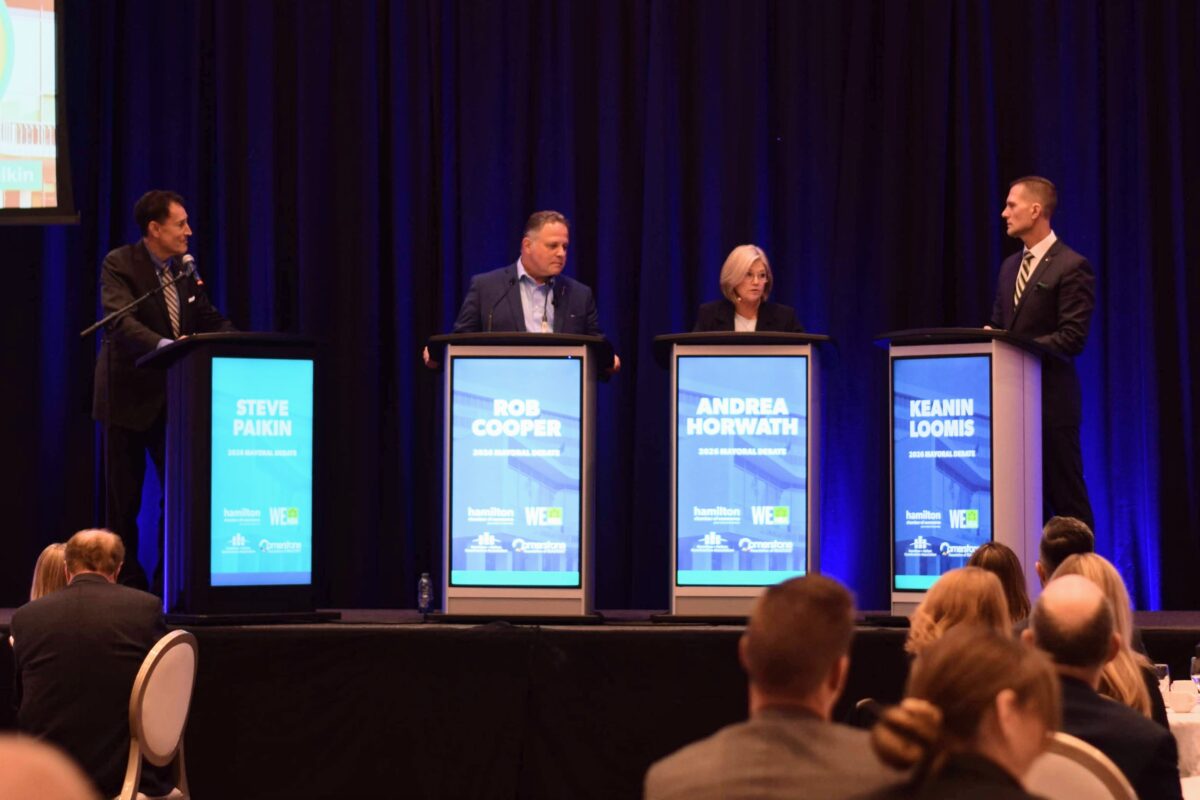
The first Hamilton mayoral debate of the 2026 election was held on Tuesday, September 22, 2026, at Carmen’s Banquet Centre. The event is organized by the Hamilton Chamber of Commerce, the West End Homebuilders, the Cornerstone Realtors Association, and the Hamilton-Halton Construction Association.
Moderator Steve Paikin was joined by candidates Rob Cooper, Keanin Loomis, and Andrea Horwath for a discussion of issues facing Hamilton and decisions the Mayor of Hamilton will need to make during the upcoming 2026-2030 Council term.
TPR took a full video recording of the debate, and it is available on YouTube here. The liveblog coverage is archived here.
Below is a lightly edited transcript, cleaned up for readability. The timestamps link directly to that segment of the YouTube recording.
Opening Remarks
Steve Paikin — 00:00:07
There we go. Hi, everybody. Great to see so many big numbers out this morning for what I expect to be a very stimulating debate. Let’s just do a little housekeeping before we start here. We have, I guess, divided our discussion this morning into seven different segments: everything from choosing the next City Manager to AI and data centres, future of the downtown, and so on. The gist of this will be not to run this like a very formal debate. We’re not going to have a stopwatch on all the answers. We just want to have a nice engagement. I haven’t seen you yet this morning. Let me shake your hand.
Steve Paikin — 00:00:41
I saw Her Worship the Mayor Andrea Horwath, and I saw Keanin Loomis, but I did not see you yet, Rob Cooper, so hello. No stopwatches. We just want to have a nice discussion here this morning. Every time I ask a question, I will get each of you to offer an answer, and then after that, you know, you can engage in some debate. And my job, obviously, is to make sure that you don’t all yell at each other all at once, so we have a nice, energetic, but civilized discussion. Let me also, as I have to do from time to time, do this whole full disclosure thing, because my baby brother right here [Jeff Paikin, Horizon Homes] is in the home building business and has publicly endorsed the Keanin Loomis campaign. So I put that out there in the interest of full disclosure. But that’s him, not me. I’m neutral, just so you know. And now away we go.
Segment 1: Choosing the Next City Manager
Steve Paikin — 00:01:32
Our first topic is going to be choosing the next City Manager. And I’d like to hear from each of you on what you are looking for in the person who will get that job. And through each segment, we’ll have a different first-person start. So, Rob Cooper, why don’t you start with that one?
Rob Cooper — 00:01:45
Thank you, Steve Paikin. It’s a great honour to be here with you all today. And Steve, this is really special having you with us, so thank you. What I’m looking for in a City Manager is I really believe we have to transform the city. It’s not working for a lot of people right now, just in terms of outcomes and what’s happening, and we need someone with that kind of experience. I’m not tied to the fact that it’s going to be someone who’s actually got city experience. I’m not tied to the fact they’re in the public sector. They must be transformational. We need someone who has multi-union environment experiences. We have a cultural problem at the city right now. It’s really around hindrance instead of help. And so we need someone to be able to deal with that. We need someone to be able to take our financials, link it to service levels. We have this disconnect right now where we don’t see financials for three years. I need someone that has some financial acumen. We need a strong communicator. And as I said, we have to do cultural change—someone that’s going to share the mayor’s vision and council’s vision.
Rob Cooper — 00:02:38
I’ve already been talking to my colleagues about what this looks like, but I’m also going to say this to you right now: the most important hire in the next city council is not going to be the City Manager. It’s going to be Chief Human Resource Officer. Okay, the problems we have in the city are HR-related. And so whether it be culture, comp, retention, succession plan, I don’t see that as being the top hire, but it’s a very important hire.
Steve Paikin — 00:03:00
Andrea Horwath, what are you looking for?
Andrea Horwath — 00:03:02
Thanks very much, Steve. I appreciate the question. I think that what we are in a—in a situation of right now as a city is that we have some challenges for sure, but we also have some amazing opportunities. And so what we’re looking for, what I’m looking for in a City Manager, is somebody that can help us get through some of those challenges, but also seize the opportunities that are before us. Some would call it, you know—I think that Mr. Cooper said culture problem. We certainly have systemic problems at City Hall. And you will have seen the number of people in top leadership situations that have left the city. That wasn’t by accident. You cannot make the kind of changes necessary in terms of cultural change or systemic change without making some changes at the top.
Andrea Horwath — 00:03:59
The City Manager really does provide an amazing opportunity for us. And so we need somebody with the competencies to be able to seize those opportunities, to be able to continue the transformation that is underway, to continue to push forward on modernizing, if you will, our city, the transformation of our technology and our customer service, the transformation of our ability to provide people with the kind of city that they deserve. That’s been long missing at the City of Hamilton.
Andrea Horwath — 00:04:33
Beginning to address and unwrap some of those challenges that have existed, we need somebody that’s prepared to take that on, but to do it with accountability, and with transparency, and in collaboration with a team—both on the governance side with council, but also building a team of managers that can help with that effort.
Steve Paikin — 00:04:55
Thank you. Keanin Loomis.
Keanin Loomis — 00:04:57
Good morning, Steve. Welcome home. Thank you. And welcome to all of you for being out here this morning. Thank you for that. And thank you to the organizers of this event as well. I go from being a host of this event to being up here on stage, one of the participants. And I understand why you would question my judgement in doing that, because to be frank, I question my judgement sometimes as well. But I’m doing it because I’m raising a family of three in this community. I’ve got three kids, and I’m doing it for them. They deserve, your kids deserve, your grandkids deserve, we all deserve great leadership in this community, and I decided to step up and be the change that we need to see. I think Hamilton has amazing potential to be a world-class mid-sized city, a real jewel in Canada, and we need world-class leadership to help us get there.
Keanin Loomis — 00:05:44
As a CEO, I have done a lot of hiring over the course of my career and gained a reputation for being a great judge of talent. And I look forward to this opportunity because this is where the reset of the city starts. This will be the very first decision I make and will be the most important decision that I make in my tenure. So my first priority will be hiring the right City Manager through an open process, because accountability starts at the top, and it starts with the mayor, and this must be a great partnership between the mayor and the City Manager. So we need an experienced executive who can lead a large and complex organization and initiate the turnaround that this city needs. We need somebody who can attract and retain great people and really improve the culture in City Hall. This is the most demoralized workforce I have ever seen in City Hall, so we have a huge challenge in front of us.
Keanin Loomis — 00:06:35
And I need a City Manager who can help work with me and with council to implement my SMART plan, the platform that I am running on, and implement it effectively. Somebody that can identify the difficulties that Hamilton faces. So I want somebody who knows Hamilton because I don’t want somebody coming from outside and taking a year to understand who the players are and what the challenges are in this community, because we need to start getting going now. We do not have any time to waste. And my SMART plan will enable them to get the best services to residents. We don’t need a right approach or a left approach. We need a smart approach to hiring the City Manager.
Steve Paikin — 00:07:06
Thank you. Let me jump in here and try and get some discussion now among the three of you about perhaps sharing with us one thing that you would want the new City Manager to do differently in terms of the way the city currently operates.
Rob Cooper — 00:07:18
Mayor Horwath, you want to start us off on that?
Andrea Horwath — 00:07:22
The challenge that we have is that we need a transformational change in the way that the city does its work. That change was underway and it needs to be pushed forward in a much stronger way. We need to make sure that our next City Manager is able to not only deal with the cultural issues that we continue to have, but we also need a City Manager that understands our city, that understands what it takes to build a great city. We need somebody that is not only a top-notch executive, but somebody who understands that the job of a City Manager is to provide accessible services in a transparent way to the people of this city and the businesses of this city.
Andrea Horwath — 00:07:59
We need someone to understand, that understands and knows the economic opportunity that we have here, and that is able to partner with the private sector, partner with the not-for-profit sector to reach the goals that this city has in front of it. And I can say this for sure: that those people exist. I will definitely, once again, have firm, a professional firm, helping with that process. I will have, and I’m making this commitment, a panel of people to assist with that process of bringing in a City Manager, including city councillors, including some professionals like people from the business community, like people from the broader community, and we will work together with the people on that panel to bring a City Manager that will be able to fulfil all of the requirements that we have as well.
Steve Paikin — 00:09:00
Okay, anybody else want to add to this? Commitment to transparency and accountability. Rob Cooper.
Rob Cooper — 00:09:06
Thank you, Steve. You know, when you look at City Hall right now, one of our biggest problems: we’re all talk, no action. We get no outcomes. If you’re a builder or planner in Hamilton—I just opened a building in my ward, 16 months to build, record, six years for approvals at the city. Unbelievable. The last four years, we’ve got a 23 per cent increase in what happened. We’ve got the worst roads in Ontario. We’ve got homelessness at levels we’ve never seen before. We have no financial statements for the last three years. Planning is the worst in the province. We’ve got to move from this approach of inertia to outcomes. And that’s the most important thing I’m looking for when we move on with this new City Manager. We can’t continue to do all this talk.
Rob Cooper — 00:09:46
I ask people all the time, ‘Has your life got better in the last four years?’ And I’m still looking for the one person who has, because you know what? It’s just not working for people. So we need a City Manager that understands how to move from hindrance to help and how to make your lives better.
Andrea Horwath — 00:10:00
Can I just say that it’s—it’s actually not the fact that we have not made strides in our planning. We’ve taken our planning processes, site plan particularly, down by almost 50 per cent, 40 per cent reduction in the timeframe for our site plan approvals to occur. So that’s not accurate. We’ve invested $106 million just last year in road repairs and pothole repairs. That work is being done. That infrastructure is being renewed. Those were the priorities then. We have different priorities now. With the tariffs that are in front of us and Donald Trump, we have to refocus our energy on that that is in front of us.
Andrea Horwath — 00:10:42
We’ve made investments. Absolutely. We increased the taxes to do that. Absolutely. You can’t provide changes in infrastructure. You can’t invest in roads without having the resources to do that. But what you can do now is refocus on what’s in front of us.
Rob Cooper — 00:11:03
I’m looking around this room and I’m seeing people who have told me how long it takes them to get through planning, told me how long it takes to do a permit, told me that every time they come to the city with a list of stuff done that they’ve been asked to do, they get a new list. You know, when you think about what—it’s the most expensive thing in Hamilton. We talk about development charges all the time. The development charge we don’t talk about: land carrying costs. When you buy a property and you have to be five and six years in planning at this city, what does it cost you? I’ve had people tell me, ‘If I could sell my land in Hamilton, I’d leave tomorrow.’ I’m just—thank God the kids sell their land, okay? And so that’s the reality. And so you know in this room because this is the group that’s been telling me this: how bad it is and how much we have to change.
Steve Paikin — 00:11:42
Last quick word from Mr. Loomis on this, then we move to the next topic.
Keanin Loomis — 00:11:45
Well, I just want to say, again, we need world-class leadership to help us as a city get to being a world-class city. And it’s true that over the last four years, under the leadership of both of my competitors here, that the city has suffered. And I think everybody here would unanimously agree with that. So we need a transformational leader who can lead the turnaround of the organization, really focus on the culture of the city, because it doesn’t matter what strategy you have in place. If you don’t have the culture right, culture eats strategy for breakfast.
Segment 2: AI and Data Centres
Steve Paikin — 00:12:11
Okay. Let’s move on to our second segment here, which is AI and data centres. Andrea Horwath, you’re going to get the first chance to respond. Where do you see data centres fitting into Hamilton’s economic development strategy?
Andrea Horwath — 00:12:24
Thank you for that question, Steve. It’s an extremely important one. I think it’s very clear that the AI data centre story that Hamilton has is not the American story. What we have in front of us is an opportunity for a not-for-profit government or public, if you will, data centre that will house Canada’s data, and so that it’s not sitting with Trump, it’s not being manipulated or protected or utilized by big tech giants in the United States, that in fact the data that is necessary for our researchers, for our scientists, for our universities, colleges across the entire country could be in Hamilton on a brownfield site with a closed-loop cooling system, with all of the pieces that make sense for us.
Andrea Horwath — 00:13:12
It’s not about ChatGPT. It’s not about generative AI. What it is about is cancer modelling. What it is about is having our data, our sovereign data, protected and being able to be easily and reliably accessed by our scientists and researchers, and that will bring all kinds of economic opportunity to Hamilton. It will create activity on a brownfield site that has been fallow for some time, and it is really about making sure that that infrastructure that exists on that site, like the power grid, is utilized in a responsible way, which it can be done
Andrea Horwath — 00:14:01
on that piece of land because the power already exists there. So it really is about how to do an AI data centre properly, how to do it right, and that’s why we made that decision with the facts and the information necessary, which is, I think, what people would expect for councillors and leaders to do.
Steve Paikin — 00:14:19
Keanin Loomis.
Keanin Loomis — 00:14:20
I want investment, I want jobs, and I want Hamilton to compete for the industries of the future. And my first question as mayor will always be: is this the best investment for Hamilton? Data centres could bring major investment. They could strengthen our industrial tax base, and they could support Canadian data sovereignty, but we need to understand the whole deal, and the proponents of these projects need to be forthright with both council and residents of the city. Who pays for the infrastructure? What are the electricity and water demands? How many permanent jobs will these create? How many other jobs will it support? What does our tax base gain, and what are the overall community impacts? Developers should pay their fair share, and Hamiltonians shouldn’t subsidize someone else’s business case. I’ll bring the right expertise together, establish Hamilton’s conditions first, and then make the decision. But we need to act quickly. As we see, the provincial government and the federal government, they are actively marketing our Steelport lands, and we are not at the table.
Keanin Loomis — 00:15:13
As our Prime Minister said, when you’re not at the table, you are on the menu. So we need to do the homework first. We need to establish Hamilton’s conditions first, and then we need to make the best decision in the interest of Hamilton.
Steve Paikin — 00:15:23
Mr. Cooper.
Rob Cooper — 00:15:24
Thank you, Steve. We’ve got to start meeting in a moment. We’re just not doing that in Hamilton. We have historical examples of our LRT. As Hamiltonians, we love to debate, and we’ve been 18 years debating an LRT. We’re going to do another two more. Data centres is 2.0 on this. We should have met the moment. We should have been ready for this. Our community was asking key questions, and nobody had those answers. We had a controlled bylaw, which was the best somebody could come up with, only to discover it really didn’t help us. So now as a community, we’re—we’re having this debate again: should we or shouldn’t we? We’re divided. These things should not divide us. These should be transparent conversations we have as a community. We figure it out in advance, and we meet the moment. We cannot no longer be trailing. This is nothing new. Everybody knew data centres exist. There was NDAs at the city where discussions were going on that the councillors didn’t know about. And the fact of the matter is, we could have been ready, and we weren’t. We’ve got to stop doing this. We’ve got to be proactive. We’ve got to be thoughtful. The environment’s important.
Rob Cooper — 00:16:21
People are important. We need to see the business cases on these things. But you know what? That should all be done in advance. We shouldn’t be scrambling around in the moment trying to figure out at a Committee of Adjustment whether we should or shouldn’t be doing these things. We see it in development. We see it in data centres. We see it in LRT. We’ve got to start changing this. This is where I see a real critical moment going forward where we actually meet these moments.
Andrea Horwath — 00:16:41
Can I just say—and I thank you for that, Steve—the data centre issue and the LRT issue are issues that we are working on right now and that we are going to succeed on. I’ve already… finished the job, finally, on the LRT. It is under construction as we speak. I’ve been able to unstick a lot of these projects because I work hard with the other orders of government. And is it definitely the case that those other orders of government have a role to play when it comes to data centres? Absolutely. Do we want to lose $2 billion of investment from the federal government and to McMaster when it comes to AI data centres?
Andrea Horwath — 00:17:18
Absolutely not. But what I can tell you is that I knew this from day one and needed to get the information to the councillors to be able to make an educated decision. The bottom line is any councillor can bring any resolution that they want at any time. So I would agree with Rob that in fact—that’s an irresponsible thing to do. You shouldn’t just lay things on the table. You have to have the information, and councillors deserve to have the information to make educated decisions, because that’s what people expect, and that’s our responsibility. But what I can also say is, well, I got that information. I provided the opportunity for councillors to learn. There are some councillors, including one of the candidates on this stage, that had to have his donors twist his arm to be able to agree to moving forward on a data centre. Are we in the process of this?
Andrea Horwath — 00:18:10
The studies that he talks about? Absolutely we are. He should know that, and so should you. Yes, we’re in the middle of those studies. The federal government and the provincial government are putting out their—their platforms or their frameworks, if you will, for data centres. They control the energy grid. They control water and water use in terms of the—any contamination or problems with our water. We have to have those folks doing that work, and absolutely the city is doing the work on our side as well. The—it’s about the facts. It really is about the facts, and that’s what people deserve.
Steve Paikin — 00:18:43
There’s a sort of an understanding in debate rules that when somebody takes a poke at somebody else, the person poked gets a chance to respond first. So here we go.
Rob Cooper — 00:18:50
Sometimes the mayor has a problem finding the real facts, right? And this is an example here, but I don’t even know what she’s talking about, donor. But I will tell you this: let’s talk about what happened at City Hall. There’s an NDA the mayor knew about she wouldn’t share with councillors like myself. Big secret. We walk into a council meeting blind. Forty people show up, and therefore the—the control bylaw. We ask questions; we didn’t get answers to. The mayor decided to have a—please, please. The mayor decides of a special session of experts. And then what we find out? We find out that the Planning Act says universities don’t have to come through; the bylaws don’t apply to them. We find out that what’s happening at McMaster and at Frid Street is we actually can’t control. We find out Steelport lands we can’t control. So what would have happened if we put that control bylaw in place? We would have actually got sued. We would have lost. That would have been taxpayer dollars wasted.
Rob Cooper — 00:19:43
We can’t go into these things blind, and I feel I went into that thing blind, and I discovered as I went through the process, it should never happen that way. If there’s not transparency for the councillors, there’s not transparency for the community. We’ve got to stop doing things in the back rooms and start doing things that everybody in Hamilton can see, just like the financial statements. No financial statements for three years. The councillors have not seen an interim financial statement in three years. Unacceptable. And this seems to be the culture City Hall right now that we have to break.
Andrea Horwath — 00:20:09
I’m sorry, Mr. Cooper. You sit on the Audit, Finance and Administration Committee. You can tell us all, actually, what you’re hearing about financial statements.
Rob Cooper — 00:20:17
Financial statements we were told we’re getting before this election, and magically they’re showing up after the election. You want to tell us why.
Andrea Horwath — 00:20:25
At the bottom—at the bottom—the bottom line is this: we know that you sit on that committee, and we know that you haven’t gotten the results that you need to get, but I think we all agree. There isn’t anybody on this stage or in this room that thinks we don’t deserve audited financial statements. What Mr. Cooper’s not telling you, of course, is that we do get regular budget reviews that show any variances that are happening any time. [SPEAKER_01],00:20:48,00:20:50,I have not seen interim financial statements for the past three years. Maybe you get them and you are not sharing them with us!”
Andrea Horwath — 00:20:50
Well, then you’re not reading your agendas, and you’re not opening your packages. I mean, I’ve seen you do that many times.
Rob Cooper — 00:20:54
Maybe then you are not sharing them with us.
Andrea Horwath — 00:20:56
And I understand that. You’re new. There’s a lot of work that needs to be done to get up to speed. And you’re working in a vacuum. But certainly, there’s a—I think you have a bit of an allergy to the truth
Rob Cooper — 00:21:09
I don’t think you’d recognize it.
Segment 3: Downtown Hamilton
Steve Paikin — 00:21:10
Friends, I’m going to jump in here and say that’s time for that segment here. Keanin Loomis, you get the first statement in our third segment here, which is about Downtown Hamilton. Despite considerable care and investment and attention, Downtown Hamilton continues to be a far cry from what it could or should be. We hear about safety. We hear about homelessness, vacant storefronts, the overall business environment. These are all significant issues. Going forward, what would you do differently? Mr. Loomis, first shot at this.
Keanin Loomis — 00:21:40
Downtown Hamilton has enormous potential. I don’t need to tell you that. It is what has attracted me to this community from the very beginning, and it’s what sets us apart from Brampton or Mississauga. We have major investments underway and incredible assets to build on, but what we lack is safety. And the lack of safety undermines the confidence of everybody here in this room to continue to invest in downtown. And I have a plan to change that. We need—is the leadership to bring these pieces together and turn that potential into results. So the public has told me we needed a downtown safety and economic plan—that is in my SMART plan. We’ll create one accountable downtown renewal team to coordinate city services. I’ll establish a first 100 days work plan with clear priorities and measurable results. And we’ll focus on the fundamentals of a downtown, which is safe and welcoming public spaces, reliable city services, strong businesses, investment, and more people choosing to spend their time downtown.
Keanin Loomis — 00:22:32
And we’ll make sure that major investments like LRT work together with everything else happening in the core to create lasting economic opportunity. We have too much invested in our downtown not to get this right. And as mayor, I’ll bring the leadership needed to turn that potential into results.
Steve Paikin — 00:22:46
Mr. Cooper
Rob Cooper — 00:22:47
Thank you, Steve. Two issues come up continually in our downtown: one’s public safety, one’s homelessness, right? I’ve had businesses tell me they’ve left the downtown because of the condition that’s down there and just feel unsafe. As a matter of fact, if you look at our tax base, 14 per cent business revenue, 2022, today 11 per cent. Three percent of business have fleed downtown. And some of the issues are around public safety. I’ve said it’s a very dangerous, unsafe place. These other two candidates don’t believe it is. If you can’t call it out, you can’t fix it. You’ve got to be able to find a problem. So what I believe is we’ve got to prevent crime. There’s got to be a greater role and engagement in our schools with our police. I mean, we’ve seen where the police moved out and the gangs moved in. Well, it’s time to get the gangs out of our schools, because you can’t learn. It’s time we start investing in recreation, sports, mentorship, and community programs.
Rob Cooper — 00:23:32
We need enforcement. I will sit on the police board. I’m not going to take a holiday. I’m not going to say I’m too busy. Because you know what? We put 30 per cent more in the police budget, but they need the support of the mayor and that police board. And I’m also going to target guns, gangs, and drugs. It shows up as violent crime in Hamilton. It’s a drug model we’ve got to break, okay? And we’re going to do proactive enforcement, visible policing. In terms of rehabilitation, we’re going to get things in place so when people come out of these being arrested, that they’ll have actually programs to go into. My goal is to make Hamilton the safe city in Ontario. When we talk homelessness…
Rob Cooper — 00:24:08
What do we do today? We give people a needle, a pipe, a sandwich, a bed, and do it again tomorrow. Well, that’s a very expensive model. What I want to do is I want to get the help that people need, and my goal is to get people off the streets. There’s no way that we should be funding what we’re funding if we’re not getting outcomes. I say this: if we’re not getting outcomes, we’re going to stop funding those organizations and move the money over to the ones that are. My goal in four years is zero. And you say, ‘How can you say that?’ Because without a goal, we’ve just seen what happened. We went from 1,600 to 2,100, and we’ve got to solve this problem. No business is going to come to Hamilton and invest if we have a downtown like we have right now.
Steve Paikin — 00:24:41
Andrea Horwath.
Andrea Horwath — 00:24:42
Thanks very much. You know, I’ve been in Hamilton my entire life, and I can remember when I was a kid going to the Lister Block to get my ears pierced with my mom. I grew up in Stoney Creek, and so it was a big, big outing for us to go downtown. She took us downtown often because it’s the heart of our city. It’s the front door to our city, and it’s really an important piece of our image and of our future. And you’ll see the changes that are happening right now in our downtown. We’ve increased street patrols by police, which is helping in our BIAs, and they tell us that. One of the things that we have done as well is we have moved the police presence from King William Street.
Andrea Horwath — 00:25:25
The main station’s still there, of course, but we have the policing hub, the substation, facing King Street and Jackson Square. Again, businesses are telling me that’s making improvements. The other improvements in our downtown is the TD Coliseum, a $300 million investment grown from $50 million, which was stuck in the last phases, and I cut the red tape to unstick that project. Similarly, we have, as I said, the LRT. Many people tried to get that LRT over the finish line. I finally did. Why? Because I have close relationships with the representatives at the provincial government, including the premier and including the transportation ministers. We’ve also had a 50 per cent reduction in shootings. We’ve had a 36 per cent reduction in theft, a 29 per cent decrease in break and enters.
Andrea Horwath — 00:26:14
But the other thing I’ve done is piloted a response not dissimilar from the one that Rob just talked about. We actually have a plan to transition people off of the streets and into housing that gives them enough supports so that they’re able to live independently. We’re doing that right now, so there’s no doubt. You can talk about what you might do, but what I can affirm right now is that we are doing a number of those things. And similar to what Mr. Loomis said, we’re expanding the clean teams already—we’ve been doing that for just over a year.
Andrea Horwath — 00:26:52
We’re beefing up the integrated care teams and response teams, some of them led by police, some of them led by hospitals. Developing and enforcing public space rules is something that I want to be doing next. I’ve been to many communities where it’s very clear what the rules are about public space and respect, and we need to do that in Hamilton. That’s on my agenda. A fast tack—fast-track response team for all of the businesses and BIAs is another piece that we need to put in place as we continue to make our downtown a more safe and a more safe-feeling place. Converting more vacant office buildings—because we have a challenge, as we know, with vacant office buildings—into housing: we have a number of those already on the go, and look forward to continuing that effort. And again, we need to really pump up our wraparound programs that we have to help people who are on the streets to be able to be housed.
Steve Paikin — 00:27:47
Let’s get some open debate on this. Mr. Loomis, is the current approach working?
Keanin Loomis — 00:27:51
All you have to do is head downtown and see for yourself. No, it’s not. All you have to do is ask anybody here that is invested in downtown: they’re not getting the support they needed, they’re not getting the action that they needed. I’ve spent many years—I live in the lower city, I’ve worked downtown, worked in Jackson Square. I know downtown very well. I know all the players in downtown. And right now, everybody is frustrated with how things are going. We must do better. It is imperative that we do better to re-establish downtown as the beating economic heart of our engine. And I think it’s also really important that we not talk down our downtown. People aren’t going to invest; they’re not going to have any confidence if what we’re saying is that it’s dangerous to do so.
Andrea Horwath — 00:28:28
I think you’re just doing that. I think both of you guys are just doing that. What I’m saying is those improvements are happening, and anybody who doesn’t think that they’re happening hasn’t spent much time in the downtown. I know you haven’t been around for the last couple of years, and I know you live on the Mountain, but I do live in the downtown. I’ve lived in the downtown pretty much since I finished university, and it—it went from really getting to a better place before COVID, and then, unfortunately, everything turned around. So we are rebuilding that confidence in our downtown, and we wouldn’t be getting the investments we’re getting. We wouldn’t see all of the activity, not only on James Street North and King William Street, but Augusta Street, Hess Village. Business is growing. New restaurants are coming. Even John Street South is getting vibrant. That is what is happening in our downtown.
Andrea Horwath — 00:29:19
James Street South is getting—is becoming more vibrant. This wouldn’t be happening if everything was still the same, and so it’s not. And so I agree with Mr. Loomis: let’s make sure we’re celebrating the victories. We can talk down about things that we’re—that aren’t where they need to be yet, but if we don’t recognize that we have amazing improvements that are already happening, then we’re never going to be able to build on our successes, because we won’t even acknowledge.
Steve Paikin — 00:29:46
Mr. Cooper, and then Mr. Loomis for response.
Rob Cooper — 00:29:47
Thank you, Steve. I met a gentleman who had a fintech firm, came to Hamilton, thought it was going to be a great opportunity, and started out with a couple of employees, got into the hundreds. He said, ‘You know, I’m leaving Hamilton.’ I said, ‘Why are you leaving Hamilton?’ He said, ‘This was your destination you came to.’ He said, ‘You know what? I can’t attract employees here. My people that are here don’t want to be here because it’s too dangerous.’ You go to any neighbourhood in Hamilton…
Andrea Horwath — 00:30:10
We just found an insurance company from Ancaster, downtown.
Rob Cooper — 00:30:15
And so he said that, you know, it was so dangerous that he was leaving Hamilton. And so even when you start looking around, you know, the mayor maybe doesn’t want to acknowledge this, but we had open drug use in our city. I go to Toronto, I don’t see open drug use. You go to Vancouver. I mean, sometimes the mayor talks about normalizing and saying it happens all over Ontario. It really doesn’t. It really doesn’t. We have some unique things happening here that we have to call out and we have to fix. And we can all ignore it, and then people can go downtown and feel unsafe. As a matter of fact, you can go in parts of Hamilton right now, in the middle of the day, and feel unsafe. I believe Hamilton should be so safe you could go anywhere with your family at any time of the day or night and feel safe. And we have to talk about that, because not talking about it got us what we have now.
Steve Paikin — 00:30:57
Mr. Loomis.
Keanin Loomis — 00:30:59
I was just gonna say, I haven’t gone anywhere. I haven’t gone anywhere, even as leading a national association. I’ve remained in downtown, living in the city, and it’s tough to explain to my little girl when we drive down to dance class what exactly is happening on our streets. And I think that the mayor needs to get out and talk to people across this community, because every single corner of this community—whether it’s in Binbrook, Waterdown, Stoney Creek, Winona, and especially residents downtown—feel unsafe and are not wanting to go downtown. And so, again, the results speak for themselves.
Andrea Horwath — 00:31:29
Well, I would say that there have been people from many parts of the United States who are sending love letters to the City of Hamilton because of our downtown. When we had the Junos very recently in the downtown—in fact, the most successful Junos ever in the history of Canada Junos—we had people from all over the country raving about our downtown: how walkable it is, what a great restaurant scene we have, how great our TD Coliseum was for the show. So again, you can’t, on the one hand, you know, talk the talk and not recognize when the walk is being walked. Yes, there are still challenges in the downtown. Of course there are. But one of the things that we must acknowledge is that there are also solutions. But those solutions don’t happen overnight. And we are definitely—and I am definitely—working very hard and will continue to do so to move the downtown further ahead from where it is now:
Andrea Horwath — 00:32:22
Yes the police, yes business, yes residential. But we have to make the downtown a place where people want to live as well, because the downtown needs to be a place where people can not only bring their family, but have a family. And that’s happening as we speak. More and more young families are living in the downtown, in the condos, but also in the neighbourhoods surrounding the downtown. And that is going to continue to help us succeed as a downtown. But the downtown itself needs to be a place where people feel safe, comfortable, and where there are third spaces where people can actually spend some time without having to spend a lot of money—places where they can bring their kids, not just to shop, but to hang out for a while.
Segment 4: Property Taxes and Municipal Spending
Steve Paikin — 00:33:02
Okay, that is the last word on that segment. Let us move on to the next one now. And we are going to—okay, he’s going to come up and replenish water. Good idea. Property taxes and municipal spending—that’s our next segment. And Rob Cooper, you get the first chance to respond to this one. And we’re just going to have a very neutral, open-ended question for starters here. I’m good, thanks. All right. What do you believe is a reasonable approach to property taxation over the next four years?
Rob Cooper — 00:33:32
Thank you, Steve. I came up with this in June. I said we need to cap taxes at rate of inflation. I ran on that in the by-election last fall. You know, I came to council and started talking about it. They told me only the mayor can set the tax rate. So when I got elected, it was 8.9 per cent. Got dropped to 4.25 per cent. How do you drop a tax rate like that? Finally, I ended up at 3.87 per cent. We just saw recently the next three years was going to be 31 per cent. The forecast dropped it to 25 per cent, and now magically yesterday the mayor says it’s going to be a rate of inflation.
Rob Cooper — 00:34:06
I come back to the fact we have no financial statements, we have no benchmarks, no peer data, no service levels from 2014. How do you have any confidence in what’s going on in the city if you can just drop tax rates like that? I believe the key to being at rate of inflation is the fact that we’re going to focus on outcomes. If we’re not delivering, we’re not doing it, okay? Very different approach. What happens right now, we just focus on how much money is being spent. Spending money should never be the threshold. Should be: what? How are we moving our community forward? What are those outcomes that we’re getting? And I’ve earlier gone through all the—if you look at the last four years and the 23 per cent, as I said to you, it shows you that throwing money against problems solves absolutely nothing. And what’s on the horizon? We’re going to be voting on that rain tax again. We put a vacant unit tax in place.
Rob Cooper — 00:34:53
Every answer to every problem at City Hall right now is more taxes. That cannot be the answer. It’s got to be making your life better and focusing on outcomes. So rate of inflation is the number that I’ll be targeting, Steve.
Steve Paikin — 00:34:59
Thank you. Can I just—a quick word to Ben in the back there: can you leave all the mics hot all the time? Because I’m hearing some wonderful little asides up here that I fear the audience isn’t hearing. And I want them to get the full flavour of everything. Okay, Ms. Horwath, you’re up next.
Andrea Horwath — 00:35:13
Thanks very much, Steve. When I became the mayor of the city, it became very clear: roads and infrastructure needed fixing. Houses needed building. People needed to feel safer in our city. And so those things take investment. Those things take investment. And that’s what we did. We invested in the priorities. There are others as well, but just to illustrate, that’s the challenge that I was facing when I took the mayor’s chair. And so that’s what I did. I made those investments. But today we face a very different challenge: Trump and his tariffs are before us yet again.
Andrea Horwath — 00:35:57
And that requires different solutions, immediate action. And that’s why I’m going to keep property taxes below inflation, because if we continue to grow and build as we want to, if we are going to be able to actually do that, Hamiltonians need some relief and some certainty about the future. I’m not going to be able to stop Trump; none of us are. But I do have a responsibility as the mayor of the city to put together a response—not talk, not a plan, but an actual response. And that’s what we are doing. And can I just say this: which is that the idea that only the mayor sets the tax rate is a fallacy. I’m sorry, you’ve been there long enough to know how it works, and if you don’t know how it works, then you haven’t been paying attention. I put a draft budget forward. It’s required by law. That’s what I do. I put a draft budget forward with some priorities and some goals,
Andrea Horwath — 00:36:52
and then the council gets to decide what to do with that budget, and then—I mean, the councillors who bother to actually put amendments forward and to actually make a difference with the budget. Some don’t; others do. Having said that, at the end of the day, when all the amendments are in, that becomes the budget unless I veto it as the mayor. I didn’t ask for that. That’s how it works. That’s the legislation, which you would know, Steve. Anyway, so back to the point. The point being this: the budget that’s passed by the city is passed by all of us. And not once have I vetoed
Andrea Horwath — 00:37:28
the decisions that have been made by the council as a whole. Every amendment that comes up gets voted on in a democratic way. And at the end of the day, I can veto all of them if I want to, and I’ve never vetoed one. Why? Because that’s the opportunity for that voice and that democratic process in the way that the government has changed how we run our municipalities. And I think it’s extremely important. And so that’s how it’s done. Unfortunately, your story is not quite accurate.
Rob Cooper — 00:37:53
So Strong Mayor Powers in Ontario came in three years ago. The mayor sets the tax rate. The mayor presents the budget. Council has no say on the tax rate. We don’t get a vote on the tax rate.
Andrea Horwath — 00:38:02
That is not true. That is not true.
Rob Cooper — 00:38:04
It certainly is true.
Andrea Horwath — 00:38:05
No, it is not.
Rob Cooper — 00:38:07
So when you look at it, you need a licence to drive a car. You need a licence to have a gun. You need a licence to be a doctor. To be a strong mayor, you don’t even have to balance a chequebook. And that’s what’s scary about it. It came without any sort of prerequisites. Anyone could be a strong mayor. And you look at what happened in Hamilton here. We’ve never seen this before.
Andrea Horwath — 00:38:23
You should take it up with the provincial government, your friends over there.
Steve Paikin — 00:38:26
Mr. Loomis, let’s hear from you on this issue.
Keanin Loomis — 00:38:28
Yeah, I think it’s becoming clear to everybody that we need a grown-up in City Hall. Hamiltonians work hard for their money, and City Hall has a responsibility to respect that. City Hall has a responsibility to bring greater discipline to every single dollar it spends. And that’s why I’m proud to be able to announce today the A in my SMART plan, which stands for accountability, and you’ll have the rest of the platform over the course of the next week, because Hamiltonians deserve to know where their money is going. So here’s what we’re going to do: we’re going to optimize services by completing a City Hall turnaround, by hiring the right City Manager and conducting a responsible review of the entire corporation—a complete city reset. We’re going to do so by introducing zero-based budgeting, which means every department should be made to justify every single dollar they spend, and each of them will start with zero dollars from the previous cycle, which means that they will only get what they need while respecting our core services.
Keanin Loomis — 00:39:19
We need to unleash the Auditor General, give the Auditor General greater powers to learn from their findings and create outcome-based solutions. Number four, we’re actually going to implement a hiring freeze. You know there’s been a hiring freeze in City Hall. However, almost a thousand new employees have been added to the payroll. That’s where your tax increase is going. So under my leadership, we will grow the tax base by—no, we’ll be talking about economic development, but we’ll also be stopping wasteful spending and finally get taxation under control. Because when City Hall needs more money, businesses and residences shouldn’t be the first place as they look.
Steve Paikin — 00:40:01
I wonder if each of you could. Sorry, go ahead.
Andrea Horwath — 00:40:03
Just a couple of clarifications. First of all, the Auditor General is a completely independent officer. They don’t need to be leashed or unleashed; they are already unleashed. The Auditor General decides what kinds of initiatives they’re going to research or report on. And it’s not up to the Auditor General to actually fix the problems; the Auditor General tells the administration how to fix the problem. So this is the same way it happens provincially and federally as well. So just for clarification, there’s no such thing as an unleashing. On the other hand, the other clarification is when it comes to hirings, over half of the hirings that have been done are both mandated and paid for by the other orders of government, particularly by the provincial government.
Andrea Horwath — 00:40:44
So, you know, again, the facts matter, and it’s an issue of, I get it, not really knowing because you’re not there to know the details there. The other piece about that is a lot of the hirings have been paramedics, they have been nurses for long-term care, they have been frontline firefighters. I don’t see a single person in Hamilton that doesn’t want to see those kinds of services there to help people when they need it. And that’s important for people to understand.
Steve Paikin — 00:41:18
There was a bit of a poke in there. So, Mr. Loomis, you want to come back on that?
Keanin Loomis — 00:41:21
Well, again, I would just say that, you know, again, we need a grown-up in the room. The Auditor General’s reports are great, but they’re not being followed at all by this administration.
Andrea Horwath — 00:41:32
That’s inaccurate.
Keanin Loomis — 00:41:33
And so there’s, you know, a lot of advice that we can, and we can be adding more resources to
Andrea Horwath — 00:41:37
the Auditor General. Again, that’s inaccurate, Steve. It is inaccurate. Even Rob knows this. It’s inaccurate. The Auditor General’s reports come in; members of the administration have to respond to those and put a plan in order. And then there are regular—either a year or two years later—the Auditor General, on the committee that you’re on, reports back on the success or not of the implementation of the recommendations. It’s just—I mean, it’s just a procedural fact, and I get it: we know that because we’re there; you don’t know that because you’re not there.
Andrea Horwath — 00:42:10
But that’s how it works. So—so people need to know that. Are they doing it fast enough? That’s something you might want to talk about. But the bottom line is that process is there for a reason.
Steve Paikin — 00:42:20
Okay, Mr. Cooper.
Rob Cooper — 00:42:22
I have to say: so, in all the organizations I’ve been, there’s been a Chief Internal Auditor. I know some smaller organizations don’t have that, and so Mr. Loomis may not be familiar with it, but the fact of the matter is, is a Chief Internal Auditor has the ability to do whatever they want. They set an audit plan, they go with direction of things that come up, and you’ve seen those audit reports come out. And I have to agree with the mayor that, you know, our Chief Internal Auditor, I think he’s doing a great job. He’s been turning over some really important files, and the recommendations that the staff have been actually taking and implementing, and I believe it’s made the city better.
Rob Cooper — 00:42:55
And so, you know, I take exception to the fact that Mr. Loomis is claiming the Chief Internal Auditor somehow is leashed and he’s not able to do his job. That, to me, is actually offensive.
Steve Paikin — 00:43:05
Mr. Loomis?
Keanin Loomis — 00:43:06
I would just say, given the behaviour that we’re seeing today, it’s, I think, a huge benefit for me not having been on council. A reset will only happen when we clear the decks and we bring a new and fresh leadership into City Hall.
Steve Paikin — 00:43:20
Would each of you be prepared to list one thing that you might be prepared to phase out, reduce, cut, in order to avoid raising taxes more than you might otherwise have to? Okay, let’s start.
Rob Cooper — 00:43:36
Yeah, first thing I’ll cut is waste.
Steve Paikin — 00:43:38
Well, specifically what?
Rob Cooper — 00:43:40
Well, so here’s an example: so we all know Aberdeen Street last year we did a shave and pave; next year we’re going to dig it up, put pipes under it. Anytime you do road twice, it’s twice as expensive. We’re going to do the same thing on Barton Street. We need a plan into our roads in terms of—of what needs to be fixed and when it needs to be fixed in the investment. You just can’t do this stuff ad hoc. I know people want to respond to it because it was, like, ranked as the worst roads, but I can put a whole lot of other roads on that list that need to be fixed.
Andrea Horwath — 00:44:05
Ms. Horwath?
Andrea Horwath — 00:44:06
Thanks very much, Steve. One of the things that’s become clear is that our ambitious plans around our infrastructure replacement have been funded, but haven’t been implemented at the speed that we had hoped. And so I’m looking at the amount of dollars in our operating budget that we’re putting into the work that needs to be done in the future—be reasonable about that. This is what people told us in the last budget process around the public consultation that we had: they want infrastructure investment, but we need to look at the pace because of the cost, and that’s directly from the people of the city who fed back that information. So we do have a lot of infrastructure needs. We have about a $5.5-billion infrastructure deficit right now.
Andrea Horwath — 00:44:59
We are definitely in the process—the city is—of doing that work, but the work is not being done at the pace that we wanted, and so we’re going to scale back a little bit on the funding, because at this point we have to invest the money that we have right now to fix that—in that infrastructure. But I don’t disagree in terms of making sure that we are changing the pace at which we are dealing with our roads, because one of the things that has become clear is the—the process was broken, and it’s now being fixed by our new General Manager of Public Works to make sure that we’re doing the maintenance that’s required in a more swift schedule so that we don’t get to the situation that we’re in now.
Steve Paikin — 00:45:41
Mr. Loomis, last 30 seconds in this.
Keanin Loomis — 00:45:43
So, yeah. As I said, Steve, we’ll be doing a complete review of every single service that the—the city delivers, starting with zero-based budgeting, so every just—every expense will have to be justified through that process. We’ll find efficiencies; we’ll also grow the—the tax base as well. And I think we’re going to gain a huge amount of productivity gains out of fixing the culture in City Hall, because, as we all know, think of how productive you were in the job that you hated the most versus how productive you were in the job that you loved the most.
Segment 5: Retaining Talent
Steve Paikin — 00:46:11
All right, let’s move on to the next segment, and this one is called Retaining Talent, and Andrea Horwath, you’ll get the first chance to respond. What does Hamilton need to do differently to ensure that young professionals, skilled tradespeople, and entrepreneurs either want to come here or stay here?
Andrea Horwath — 00:46:28
Well, that’s a really great question, and it’s one that I’ve spoke about many times to folks in this room, to the Chamber and others, because that is what we have here. We have a lot of talent. We have a lot of entrepreneurial success that already exists. We have a lot of people who are looking to entrepreneurship. We have a lot of students at McMaster and at Mohawk and at Redeemer that are the top brains, really, in our—in our country and in—in our—in many, many fields. And what we need to do is make sure we keep them here. So that’s something that we’re all working on. And what does that look like? It looks like opportunity. It looks like things like AI data centres. It looks like continuing to partner in fields where we’re seeing a lot of growth, so particularly life sciences. Folks might know or not know this, but we are now a global hub for radiopharmaceuticals.
Andrea Horwath — 00:47:21
Many, many investments have come here in that regard. I could talk about that under a different topic. But the LRT is something that draws young people, helps people move from one part of the city to the other. In fact, we had 100,000 new hours of HSR capacity in this last year. Why? Because we know that young people like to take public transit as well. We need to deal with the missing middle housing and we’re well on our way. To do that, young people need to know that they can afford a place to live in our city, and that’s a huge priority. We need to make sure our neighbourhoods are great neighbourhoods for young people to come to and to raise their family in. Our parks, our trails, our waterfront, all of these things are things that will help people to stay here. But we have not only the radiopharmaceutical hub, but we also have significant investment in advanced manufacturing, providing jobs.
Andrea Horwath — 00:48:17
We have a growing agribusiness sector. Again, not only growing of food, but manufacturing that food and beverage. We’re one of the best logistics super hubs in the province, but certainly in Southern Ontario. All these things are assets that we will continue to support and that will help us to continue to bring the investment and keep young people here because this is where they want to be. They want to be home.
Steve Paikin — 00:48:49
Mr. Loomis, what should we be doing differently to ensure talent stays here or comes here?
Keanin Loomis — 00:48:55
So Hamilton’s future depends on whether talented people can see a future for themselves here in Hamilton, not just for their first job, but for raising their family as well, just like I and my wife did in 2009. We have the best people here developing skills at our amazing institutions: McMaster, Mohawk, Redeemer. And I want them to have the choice to stay and contribute. We also have great talent who is leaving Hamilton to go to university elsewhere, just as my son did. And I want him to have the opportunity to come back and contribute. I want young families everywhere looking at Hamilton and saying, ‘This is the place where we need to put down our roots.’ And to do that, we must create good jobs.
Keanin Loomis — 00:49:36
We must create housing that they can afford. We must create safe communities, a vibrant downtown, and a city where people can see things continuously get better. One of the things that really pains me the most as I go out across the city—I did a Building Bridges listening tour as we built out our platform, knocked down thousands of doors, had thousands of conversations with folks at festivals and events. And the one thing I hear repeatedly is, ‘We don’t know why we live here anymore.’ And that’s usually after they open their tax bill. But it is a thing that is out there everywhere. And that hurts. That hurts me. And as mayor, that will be my first priority: is reversing that, having people feel confident in the city again. People want to feel pride in the city. They want the city to aim higher. And that’s exactly what my plan will do. We’ll bring greater opportunity to Hamilton because talent follows opportunity, but investment follows talent, and Hamilton needs both.
Steve Paikin — 00:50:32
Mr. Cooper.
Rob Cooper — 00:50:33
Thank you, Steve. Probably knocked on about 25,000 doors. One of the most surprising things is when people tell me they want to leave Hamilton. We’ve never seen that before. When you think about it, a lot of people move to Hamilton because it’s a great opportunity: there’s a great place for the children, a great place for the grandchildren. So I ask people the question: why? Number one issue is affordability. As I said earlier, I have 5,000 families in my ward in food banks. Never seen that before, right? Taxes—taxes are outrageous: 89 per cent of our tax base is residential. It means that moms and dads and families are carrying the whole load in Hamilton; 11 per cent business. And when you look at how our taxes are going up, I’ve had people—I had a firefighter tell me, ‘I don’t know how I’m going to make ends meet. I can’t afford it anymore.’ Yet you go to Burlington, property values are 30 per cent higher, property taxes are 30 per cent lower. We’re not just competing
Rob Cooper — 00:51:23
in terms of the United States; we’re competing with communities around us for people to come and live, people to have their lives here. Even in terms of jobs, we had this thing at City Hall: I call it Fair Wage, okay? We were paying our tradespeople back three years. They had a collective bargain, and the city wouldn’t even pay them their fair wage. Put a motion on the floor and move that up two years; we couldn’t move it up any further this year. But you know what? I heard about it at their AGM; they’re all talking about it: ‘How come we haven’t done this?’ This is just unfair to people. Who would want to come here and be in the trades if you’re going to get paid what you’re paid three years ago? I was with the Ironworkers yesterday. They told me, they said, ‘We got homes up in Binbrook. We don’t have a rec centre. There’s no place for our kids to play.’
Rob Cooper — 00:52:06
Those rec centres in Winona, Binbrook, Waterdown—they should have all been built. We had the money; we didn’t build it, right? My commitment to them is we’re going to build those recreation centres. I had a 15-year-old tell me in Binbrook, he said, ‘What’s a recreation centre?’ It’s been a promise for so long. It’s an empty promise; it means nothing to anybody. And so if you don’t have that infrastructure for families, whether it be recreation centres, parks—I’m going to put $2 million into parks in my ward, because if you don’t have the parks, the volunteers can’t come and have the kids play sports. And yet you look at it: we got a problem with youth violent crime because we haven’t put the proper structure in place for these—for these kids and these families. So we got to start thinking in terms of what we need as community. How did—what do people want to see? We got to have good-paying jobs. We got to have jobs that give people an increase more than the property taxes are going up, because right now the property taxes are crushing them. And so by the time people pay for their bills, pay their taxes, they got nothing left.
Rob Cooper — 00:52:54
That’s how 5,000 families end up in food banks. So there’s things we can do to make this better for people. I want this to be in a place where people are attracted to, not a place where people want to leave. I think this should be a place where you can raise your kids, your grandkids, and you can spend the rest of your life here comfortably. When you’re on a fixed income, you can’t afford it. You just can’t afford it.
Steve Paikin — 00:53:15
Ms. Horwath, I saw you smile when he made the comparison to Burlington.
Andrea Horwath — 00:53:17
It’s like a fantasy world here. First of all, our taxes are much different than Burlington’s: we’re a single-tier government; they’re a two-tier government. So the City of Burlington on its own has a tax rate, and then they have to pay their regional tax rate as well. So it’s not an apples-to-apples comparison, and you should know that, Mr. Cooper. On the idea of 11 per cent to business taxes, I think what Mr. Cooper is talking about is the ratio that we have between business and commercial-industrial taxes versus residential taxes. And yes, we have a problem with the ratio. The ratio exists the way it does for two reasons: one is because we had a hollowing out of our industrial sector, as people will remember;
Andrea Horwath — 00:54:03
it was painful, and much of our we have the former mayor in the room, actually—nice to see you, Mr. Eisenberger—but we lost a lot of our industrial tax base as a result. But what I can tell you, the good news is we are growing that base back. But what’s also happening, contrary to what these folks are saying, is our population is going up significantly. So while our industrial-commercial tax base is increasing—and it is—the residential tax base is increasing at a faster rate. So the ratio: you’re all business people, you understand that math. You should understand that math, too. That’s important.
Andrea Horwath — 00:54:37
And so does that mean we stop on either end? No. We continue to create more housing. We continue, actually, to make sure that our taxes are paying for the kinds of programs that Mr. Cooper talks about, because you really can’t do any of those things unless you’re investing, which we need to continue to do in a responsible way. But the other thing is we have to make sure that we continue to provide jobs and opportunity, and that’s why the economic plan that we have includes clusters of activity that really do look to the future of our economy. And it’s not necessarily the old economy; we are actually doing very well in terms of the new economy. In fact, we have one of the most diversified economies in the entire country. And that’s not me saying that: the Conference Board of Canada had that stat not too long ago. And what we need to do is protect that. And again, it goes back to the fight that’s in front of us, and that is the fight with Mr. Trump.
Steve Paikin — 00:55:35
There was a bit of a poke there, so Mr. Cooper, and give you a chance to respond if you want.
Rob Cooper — 00:55:39
I’ll just say this: sometimes I listen to the mayor and I think she lives in a different city than we do, okay? So I just say to you, if this stuff resonates with you, you’ll know. But when I talk to people, they live in a very different city than the mayor does.
Andrea Horwath — 00:55:51
What are you telling them is the question. You’re telling them this stuff.
Rob Cooper — 00:55:54
I ask them one question; I’ll ask you that question: has your life got better in the last four years, yes or no? There you go.
Steve Paikin — 00:56:05
Mr. Loomis, you want a word on this?
Keanin Loomis — 00:56:07
I just want to say, again, the reason why I’m doing this: I’m not doing this for a pension, for a paycheque, or for power. I’m doing this because of my three kids. I want them to be proud of the city. I want them to find jobs in the city. I want them to be able to live in the city, put down their roots, and raise my grandkids in the city. I know exactly how kids are looking at the city. I know how parents are also experiencing the city, and we need that type of experience in City Hall.
Segment 6: Housing Supply and Approvals
Steve Paikin — 00:56:31
You will not be surprised that we are going to save a good chunk of time here for a discussion on housing supply and approvals, given where we are today and who’s in the audience. So let’s start with this, and Keanin Loomis, you get the first chance to respond. What do you believe is preventing enough new housing from being built in Hamilton today?
Keanin Loomis — 00:56:50
So Hamilton needs more housing, and we need to build it faster. And City Hall needs to be a partner in getting it done, and the mayor needs to be the chief advocate in how it is getting done. So the city’s job—and you asked how we can be doing better—we need to remove the barriers that make us the worst in the entire country in terms of approval times, because we need to get approvals moving and we need to create the conditions for housing to be built. Faster approvals matter because lower carrying costs and lower upfront costs means homes are more affordable, and we can get good projects built and get homes that people can actually live in. What we need is private investment, strong not-for-profit partners, and senior levels of government working together. That is not happening right now.
Keanin Loomis — 00:57:31
Not-for-profit housing providers are thirsting for leadership from the mayor’s office. We need to get the right housing in the right places, supported by the infrastructure and services that community needs. And I will measure success by results: are we actually getting more homes built, and will my kids be able to get out of my basement at some point in the future, please?
Steve Paikin — 00:57:51
Mr. Cooper.
Rob Cooper — 00:57:52
Thank you, Steve. You know, one of the biggest challenges right now for housing is our Planning and Economic Development Department. I mean, as I said earlier, when you go in there, I had a building we opened last week: 16 months. He told me it was a record for Hamilton; I have no reason to doubt that, but I will tell you it took six years to get approval—six years. And so you think of that. I mean, I know there’s someone here who told me that they were ready to go three years ago, and now the market’s turned, they can’t build. And so this is coming back to meeting—meeting this in the right moment. We’ve got to have the conditions in place. I mean, I hear people talk about, ‘Hey, Trump tariffs, we’ve got to change everything.’ We should have been ready.
Rob Cooper — 00:58:29
This shouldn’t be a crisis that we wait for a crisis to come along before we have a plan. This should be normal operations. I met with the mayor of another city. He says, ‘Look what I have.’ He showed me this system where he loads all the information from the province in terms of requirements, including heritage. You load your property, you press a button, five minutes later: boom, you know what you can do. It takes years in the city. I mean, five and six years is unacceptable. And that whole land carrying cost goes right under the price of a home. People tell me all the time, ‘We can’t afford homes.’ Hamilton, well, we got to look at how we get that cost down. They know part of it is development charges, but part of it’s that development charge that nobody talks about: land carrying costs. We got to use technology, use processes; we got to have the proper organization structure in place. And by the way, we got to start helping the building community. You guys have told me Hamilton hinders you every way; they try to trip you up, you get tripped up.
Rob Cooper — 00:59:19
You know what I’m saying? You’ve told me about it yourselves. And so we got to change this: we got to be a partner with you to build the homes, okay? If we don’t partner with the building community, we’re going to end up where we are right now, and we need that investment. We need people coming to Hamilton. When you go down to Brantford, you guys have told me Brantford will run water lines in areas that you don’t have water lines, and just to make sure the development’s happening, Brantford will bend over backwards. There’s a whole different culture. I hear the approvals in Brantford versus Hamilton—why would you come and invest in Hamilton if you go to Brantford and— So that’s where we have to change what we’re doing, and we have to really transform it and come back to focusing on outcomes. I’m going to publish on the website what our standards are and how we’re doing against it. There’s not going to be any surprise. I get calls from people saying, ‘Hey, can you find out where this is and where that is?’ Well, fact of the matter is you should know; it should be available to you. This is a level of transparency that we don’t have and we really need to have, and we need to partner with you.
Steve Paikin — 01:00:11
Ms. Horwath.
Andrea Horwath — 01:00:12
Thanks very much. So just for a little bit of facts: the housing starts increased in the city in 2025 by 65 per cent over the previous year in the midst of a housing crisis. We had exceeded our housing target that was set by the province by 20 per cent. We received $93 million in funding through the federal Housing Accelerator Fund, which is doing many of the things that my colleague talked about. We are in the process of—have built, actually, and are building with community partners all kinds of affordable housing—over 2,000 units at this point in time.
Andrea Horwath — 01:00:45
We particularly did that because I’m somebody who has been passionate about housing for my entire life. The City of Hamilton had no structure particularly to work with partners in the affordable housing side of things, and we built that structure, and we’re building that housing in with those partnerships with the federal and the provincial government. But we’re just getting started. There is no doubt that the work that needs to be done to improve our systems is something I noticed the day I got to City Hall: there were lineups out the door of developers who were frustrated. So what have we done? We’ve implemented through a pilot project that is now scaling a process whereby we have all of our staff members who are going to have to give some kind of opinion or report on any particular development at the same table at the same time, instead of bouncing developers back and forth, back and forth, looking for this person to comment, that person to comment.
Andrea Horwath — 01:01:38
It’s called All-for-One, and it’s all of the staff focusing on the developments to get them through. But it’s not only that. There are lots of development applications that are minor in nature, that are low-density, that are single families, that are—what do you call it—renovations and those kinds of things. And so what we’ve done is we put those things online. And so we now have a process where those kinds of routine applications can be put through an online process, and then that process provides the freeing up of time for staff to be busy doing the other, more complex work.
Andrea Horwath — 01:02:19
And then once the information has been put through the process online, it comes out the other end and all it needs is the final approval by staff. And so these improvements are happening not because I made them up myself: we called various members of the development community, both for-profit and not-for-profit, into a discussion. ‘What is the problem?’ They defined the problem.
Andrea Horwath — 01:02:51
They defined what their frustrations were, and they did. They were exactly the kinds of things that Mr. Cooper talks about. But that process didn’t freeze in time. It has now led to innovations that are happening right now. And I can tell you something that I’m extremely proud of: there has been a 46 per cent reduction in the time it takes to get a site plan approved just since the last year or so since these projects have been piloted. So we’re scaling that right now, and we’re going to be doing everything we can to continue to build out a process when it comes to development and approvals that actually gets housing built quicker, because we know we absolutely need that in the City of Hamilton.
Steve Paikin — 01:03:39
Okay, let’s get some follow-up here. Faster approvals is something you call for. Faster approvals is something the Mayor says is happening. Do we have a mismatch here?
Keanin Loomis — 01:03:47
Developers are still frustrated, the ones I’m talking to, whether it be the for-profit or the not-for-profit industry. So they helped contribute to the building of my SMART plan, so it’s been vetted by them; it’s been vetted by city managers as well. So I’m listening, and the results will speak for themselves.
Steve Paikin — 01:04:03
How would you get faster approvals? Everybody wants it. Give me a concrete idea how it can happen.
Keanin Loomis — 01:04:10
We need coordination of all the departments: sitting down at one point with the developers, making sure that it’s not going to Public Works eventually, or transit, or whatever. Everybody in City Hall that’s assigned to help approve these permits need to be at the table all at once.
Andrea Horwath — 01:04:29
That’s what we’re doing. It’s called All-for-One.
Keanin Loomis — 01:04:31
It’s not happening.
Rob Cooper — 01:04:35
Bottom line: it’s not working, okay? Let’s be honest with ourselves: it’s not working at the city right now. We wouldn’t be ranked 40 of 40—I guess not the first, that’s the last. That’s not me saying it; that’s not Mr. Loomis saying it; that’s not Ms. Horwath saying it. It’s—it’s an independent organization that came in and said we’re the worst in Ontario when it comes to planning and development, and Mr. Loomis is correct: our approvals are the worst in Canada. I mean, you can’t get any lower. So if everything’s so great— ‘Where’s that research?’ It was presented right at council. I mean, you might have missed that meeting.
Andrea Horwath — 01:05:04
No, I didn’t miss that meeting. Okay. Yeah, can provide it, though. Did you send it to me? [SPEAKER_01],01:05:13,01:05:38,I did have it; got it from West End Home Builders.”
Steve Paikin — 01:05:13
Maybe I’ll jump in here with a follow-up again. There is a difficult tightrope that the mayor has to walk, whoever the mayor is, which is balancing existing neighbourhood concerns, because a lot of neighbourhoods just like things the way they are, with those who are out and want to get in. Mr. Loomis, start us off here: how unpopular are you prepared to be in order to tell existing neighbours, ‘Sorry, you may have to intensify a bit here’?
Keanin Loomis — 01:05:39
Well, just like last time around, I am running on an unabashedly YIMBY platform: yes in my backyard, and that includes in my backyard.
Andrea Horwath — 01:05:44
What about Stoney Creek? Do you want to talk about that?
Keanin Loomis — 01:05:49
The process by which you shoved that down the throats of the local community and against the wishes of the local councillors? Leadership is listening to your constituents.
Andrea Horwath — 01:05:59
Leadership is building housing when you’re in a housing crisis. We’re going to get housing built.
Keanin Loomis — 01:06:02
There’s other spots for it to be if you would listen to the local councillors.
Andrea Horwath — 01:06:05
There’s always other spots. How many housing providers here know that there’s always other spots but you can never find them? Right? That’s the truth. Not-for-profit housing is something that is always, always opposed. And you have to have the courage and the commitment and the understanding of how this works. And having had all of the experience I’ve had for many, many, many years, there are times, yes, when there’s a tie at City Council that somebody has to have the leadership and the courage to make a decision. Now, you’re always going to have the local councillor who’s not going to want it in their backyard, and you’re going to have that councillor, you know, gather a few votes to be on their side. But that’s not how housing gets built, and that’s not particularly how affordable housing gets built. If we’re going to have change, then we have to have changemakers. And what I’ve seen from Mr. Loomis and the positions he’s taken, he’s not a changemaker.
Andrea Horwath — 01:06:57
He’s going to worry about his own political skin, like so many others have done for so long in this city. And we talk about how this city never moves forward: it’s because that’s what’s going on. And yes, it takes courage, and yes, it takes leadership, and yes, it takes hard decisions. And those are the kinds of decisions I’ve made, and those are the kinds of decisions I’m going to continue to make: whether it’s AI, whether it’s affordable housing, whether it’s intensification, whether it’s stopping an urban boundary expansion that we don’t need right now, whether it’s investing in infrastructure, whether it’s raising taxes at a time when we need to have more affordable housing, when we need to have more housing, when we need to have our infrastructure dealt with, when we have to have the problems the city’s facing dealt with. Those are decisions that are made by a leader.
Andrea Horwath — 01:07:44
You can easily just follow the pack. That’s been happening too long in the City of Hamilton. We need the kind of leadership that takes on these challenges, and that’s the leadership I provided, Steve.
Steve Paikin — 01:07:54
Equal time for Mr. Loomis.
Keanin Loomis — 01:07:55
You’ve done nothing but play politics. All of this has landed. Your agenda has only rolled out in the last month, right before the election. That’s so hilarious. And that’s all you know, and that’s understandable. Officials don’t know their way.
Andrea Horwath — 01:08:05
You haven’t paid attention, obviously.
Steve Paikin — 01:08:08
So let me try this: do you believe in promoting housing as a basic human right?
Andrea Horwath — 01:08:14
I’ve done that already, yes.
Steve Paikin — 01:08:15
Mr. Cooper.
Rob Cooper — 01:08:17
I don’t know if I got in on the last one, actually, but happy to talk about it. You know, here’s the thing: everybody wants a backyard, a tree, a garden. And, you know, and so is it a basic human right? It certainly is a basic want and a basic need, okay? And we’re not doing a good job of it right now. I mean, this debate that had gone on, I’ll just say this to you: one of the things that we don’t do is we don’t listen to Hamiltonians. Hamiltonians feel they have no voice at City Hall. And what I found was I had a neighbourhood where people had had homes there for a while, built their dream homes; there are two 20-storey towers going up.
Rob Cooper — 01:08:54
And we had a conversation, okay, and we talked about the fact they never see the sun, and they never—and it would affect their quality of life. What we were able to do is work with that builder—and I give him all the credit—and we got it, we worked it out to three six-storeys. So we maintained the quality of life, we built all the units. And this is what we have to be: we have to be collaborative. I mean, that’s what’s missing at our city right now. It’s the fact that there’s this approach where, with Strong Mayor powers, it’s kind of like some sort of dictatorial power. I believe that we should actually be working through our ward councillors: they know their wards the best; they know what has to happen. Let’s have the conversation. Why do we fear conversations? Why do we fear communication? To me, the best outcomes we have is when we get together as a group, hear diversity of thought, and be able to build outcomes that none of us could have come up with in and of ourselves.
Steve Paikin — 01:09:42
But just so I’m clear here: when I said, should housing be considered a basic human right, Ms. Horwath immediately said yes. You said it’s a need, it’s a want, but I didn’t hear you say it’s a right. What’s your view on that?
Rob Cooper — 01:09:50
So how are you defining right?
Steve Paikin — 01:09:53
Well, I’m not.
Rob Cooper — 01:09:55
Well, and that’s how I defined right: a need and a want.
Steve Paikin — 01:10:00
A need and a want. Okay. So are you—do you agree with her then? Are you on the same page?
Rob Cooper — 01:10:04
I’m not sure what the mayor’s talking about. Seldom do we agree.
Steve Paikin — 01:10:08
Okay. Keanin, what do you say?
Keanin Loomis — 01:10:09
I think housing is health care. So there’s a way that we can address the homelessness crisis by building more affordable housing, by building shelters that meet the needs, not the old-fashioned shelters where people get kicked out in the morning and then have to line back up at night. We have models for how we can do this, and we’ll spend a lot less per person when we find housing for them. So is housing a right? Sure, but I know it’s health care, and it’s the best way to spend our taxpayer dollars.
Segment 7: Economic Vision for Hamilton
Steve Paikin — 01:10:37
All right. You will be disappointed to hear this is the last segment coming up right now because I know you’ve all been having so much fun. This one is broadly entitled Economic Vision for Hamilton. And admittedly, this one is going to be kind of from 30,000 feet as I get each of you to kind of explore what your overarching economic vision for the city is. We want to understand, I think, in this room what your priorities would be as mayor to make Hamilton more attractive as a city in which to invest: build a business, create jobs, raise a family. It’s a chance to blue-sky a bit here, friends. So, Rob Cooper, you get the first shot at this one. Go ahead, please.
Rob Cooper — 01:11:17
Thank you, Steve. I think we have to have three things in order to achieve the economic opportunities at Hamilton. One is we’ve got to deal with homelessness—we’ve talked about that earlier; I’ve talked about it. Another one is violent crime, okay, we talked about that. And the third one is infrastructure, okay. And the infrastructure, we’ve talked about the LRT. I mean, you know what? I haven’t heard a date when it’s going to get done. If you don’t have a date, you don’t have a plan. But we haven’t talked about the perimeter road, which is the Lincoln Alexander–Red Hill Expressway, the fact that we need to be getting goods through Hamilton. If we can’t do it, people aren’t going to come here. I’ve talked about the idea of uploading with the province and adding a lane, similar to downbound 403. I’ve talked about bringing GO Transit to the Mountain. But you know what? A mayor can make those things happen, and those are the things that we need.
Rob Cooper — 01:12:03
So when you look at it we have to build that infrastructure, same with the recreation centres I’ve talked about earlier. It’s all part of being a community. But we get those things in place. Here’s what I believe: I believe Hamilton can be the economic engine of Canada. You say, ‘How?’ Well, we have a seaport and airport. We got McMaster, the most research-intensive university for the last 20 years. All kinds of things we can monetize, commercialize. We have regional health care. We have primary steel production. What we lack is vision. As we’ve talked about earlier, the tax base right now is 89 per cent residential, 11 per cent business. And we need to get the conditions in place, as I said, where businesses are going to come and invest. Transforming that economic and planning department is going to be vital to move it from the worst to the best. We need to remove unnecessary barriers.
Rob Cooper — 01:12:46
And when you start looking at it, there’s this whole idea of really building what I call an economic transformation and growth strategy. And, you know, there’s a real opportunity here where we can create thousands of good-paying jobs, grow our commercial tax base, and reduce the pressure on homeowners. That’s the key to getting this 89-11 fixed. Eighty-nine percent, I understand, is one of the highest numbers in the province when it comes to residential taxes. And so getting that, solving those problems around violent crime, homelessness, infrastructure, I think it can give us that opportunity to be the economic engine of Canada. And I really believe that we need to start building, investing, and working for you and turning this community into something that you can really cherish and you can have a career and a life here as well as your children and your grandchildren.
Steve Paikin — 01:13:28
Ms. Horwath.
Andrea Horwath — 01:13:30
Thanks very much, Steve. In fact, I’ve been doing a lot of this work already with our Economic Development Department, who are really a very skilled group of people. We have some new leadership there with our retirement of Norm Schleehahn—many of you have probably worked with Norm over the years. But the economic development team does an amazing job at not only identifying where the next clusters of investment that we should be going after, but also making sure that they are creating those pathways with businesses globally to try to get the investment to come here. In fact, one of our folks just came from a conference in Germany exactly for that reason.
Andrea Horwath — 01:14:04
Having said that, we do have a deepwater port here in Hamilton. I’ve been working closely with HOPA and partnering with them. What we were able to do thus far is increase the container terminal capacity there with help from the federal government by licensing them to be able to expand from 14 per cent capacity of the container terminal area to about 50 per cent now, looking forward to 100 per cent capacity. Why? Because we are underutilizing our port. Why? Why do we need to utilize it more? Because we have the connections not only to put containers onto rail and onto ships from that same HOPA area, but we also have the ability—and this is the next step we’re taking with Ian Hamilton at HOPA and the federal government—to make the Port of Hamilton a first of entry, so that we can take goods that are produced here in Hamilton and all over the region and further out in other provinces straight to global markets.
Andrea Horwath — 01:14:56
Right now they have to stop for transportation reviews by the Canadian Border Services at other ports. That doesn’t have to happen. So having that ability to have a first port of entry at HOPA ports is exactly one of the things we need to do. We also need to continue to work closely with McMaster University, and Hamilton Health Sciences, and St. Joseph’s Hospital to continue to innovate when it comes to our life sciences sector.
Andrea Horwath — 01:15:28
We have the only nuclear reactor on a university campus in the entire country. It is now, with provincial investment, we began to generate medical isotopes 24/7. That wasn’t done before. But I worked with the university and with the provincial government to get that funding. The funding came. That’s what’s happening. And this is why we have a company in Hamilton called Fusion Pharmaceuticals that was bought by AstraZeneca for $2 billion, because it was such an amazing opportunity.
Andrea Horwath — 01:16:15
This is what that kind of research does when it is commercialized. But it doesn’t happen by accident. You have to pull in the other partners to make sure that happens. They’re doing great work; that can continue. We just cut a ribbon on a factory called—advanced manufacturing facility called AtomVie. AtomVie is a global radiopharmaceutical player that provides cancer-fighting drugs that are specifically tailored to each and every patient around the world that they send those drugs to, right here in Hamilton, right in our backyard. So when we talk about things like AI and the opportunity for our researchers and our hospitals to have the capacity to have AI compute technology right here at home that’s protected by the not-for-profit public entity that the federal government is putting in place.
Andrea Horwath — 01:17:11
These are the opportunities that we’re seizing right now and that we need to continue going forward on. There are a number of other things that we need to look at. Certainly the cluster model has worked for us. We know that our arts and cultural sector continue to grow. We need to continue to feed those industries because that’s what helps keep our downtown vibrant and that’s what helps bring talent or keep talent here, which we’ve already talked about. Folks might not know this, we have an airport that has also had major investment.
Andrea Horwath — 01:17:47
Now that airport was sitting in neutral for a very long time. I helped to get that airport investment over the finish line by renewing the lease, and now we have Porter Airlines bringing people not only for travel but also for business in and out of our city regularly. So we have to continue on that expansion of our airport and making sure that it continues. Do you know we have the largest by volume cargo, overnight cargo airport in the entire country? Again, that’s not by accident. And so that’s why we have to keep those investments moving and keep those partnerships going with the federal and provincial government. We have 7.7 million square feet, new square feet of industrial and commercial activity that’s happening in this city. So yes, we still have a ratio problem. I explained why that is. But we are seeing investment when it comes to commercial industrial, 7.7 square feet of new industrial commercial. But what does that mean? That means we’re starting to run out of business park land.
Andrea Horwath — 01:18:44
That means we need to start identifying new business parks for the City of Hamilton so that we can continue to attract that investment.
Steve Paikin — 01:18:50
Mayor Horwath, I’m going to jump in here just to make sure we save some time for debate. Mr. Loomis, go ahead.
Keanin Loomis — 01:18:55
As represented by everybody in this room, Hamilton has enormous economic potential across a variety of industries. We are not a one-horse town. Of course, we have a legacy in steel and advanced manufacturing. We have a port that I’ve been a director on for years and an airport, world-class health and research institutions. And we have the great benefit of having both a strong agricultural economy and a growing innovation economy. Career, working with all of you and advocating for the people and industries that drive our economy forward, I helped launch Innovation Factory at McMaster Innovation Park, which serves tech entrepreneurs in our innovation economy. For nine years, I was the voice of the Hamilton Chamber of Commerce, the voice of business in this community, representing 1,000 businesses, employing 75,000 people in our community. And we worked together, all of us here in this room, to get—we fought for LRT, better infrastructure. We fought for a stronger business environment and downtown renewal, steel and manufacturing. We put ambition back in the Ambitious City.
Keanin Loomis — 01:19:49
Since the last election, I’ve worked with Ontario’s biggest companies at the Ontario Chamber of Commerce, and I’ve been the voice of steel as the head of a national steel association, working directly with both the Ford government and the Mark Carney government as well. So as mayor, I will be Hamilton’s chief advocate for investment, bringing business, labour, institutions, City Hall, and other governments together to compete for good jobs and to get investment delivered for our city.
Keanin Loomis — 01:20:21
For businesses looking to invest here, City Hall should provide clear rules and timely decisions. I’ve advocated for Hamilton from the startup floor to the steel mill. Hamilton doesn’t need to be convinced of our potential. We all know it’s here. What we need is a mayor with experience to turn that potential into investment, get good jobs and results that people can see. You all know me. You know I have a plan, and you know I’m ready to lead.
Closing: A Kind Word for Your Opponents
Steve Paikin — 01:20:46
Okay. We have a few minutes left here, and I want to throw just a little curveball out, if you don’t mind. I think everybody in this room appreciates the fact that the three of you have been prepared to have the guts to put your name on a ballot, and it’s been a good, vigorous campaign, and we’re a long way to go still. I wonder if each of you could say something nice about the other two people you’re running against. Mr. Cooper, would you say something nice about Andrea Horwath?
Rob Cooper — 01:21:14
Certainly. You know, Andrea’s had a long career in politics and, you know, she’s moved from different levels of government quite successfully, okay? And so, you know, I think we need to recognize that because, you know what, being a politician isn’t always an easy job, is it, Andrea?
Andrea Horwath — 01:21:31
You would know too, wouldn’t you?
Steve Paikin — 01:21:33
And how about a Mr. Loomis?
Rob Cooper — 01:21:35
Certainly. Mr. Loomis, I’m glad you’re part of the community. I’m glad you got engaged and helped the Chamber out. I mean, you know, without our business community, where would we be? And so the opportunity to grow that is—is, I think, exciting going forward, and so I thank you for what you did for the Chamber.
Steve Paikin — 01:21:54
Mr. Loomis, would you have something nice to say about Mr. Cooper?
Keanin Loomis — 01:21:57
I do. I actually don’t know Mr. Cooper that well. We’ve only just met. But I would say it’s obvious that you have financial acumen and the bona fides there. I wish that you had stayed around the council table. I think you would have been a great voice as I worked to address the financial situation that we’re in. I wish that we could have worked together.
Steve Paikin — 01:22:20
And something about Ms. Horwath.
Keanin Loomis — 01:22:21
Well, I would say that, you know, the mayor and I have different leadership styles and probably disagree on how we get good results. But I would say, Andrea, you know, you have been a strong advocate for our city for many years, and I thank you for your hard work.
Steve Paikin — 01:22:36
Andrea Horwath, something nice about Mr. Cooper.
Andrea Horwath — 01:22:38
I would say that Mr. Cooper has become somebody that’s been well integrated into our council. He talks to lots of different councillors and he works hard. I do also know that he does bring a lot of financial capability to the table and have benefited from some of the pieces that he has brought forward. And so I do appreciate that skill and talent, absolutely. He worked hard to win the by-election in—in Ward 8, and—and I think that Ward 8 will be sorry to—to see you not be their councillor anymore, because I know you serve them well with passion.
Steve Paikin — 01:23:19
And something about Mr. Loomis.
Andrea Horwath — 01:23:20
And Mr. Loomis—you know, I do really appreciate how Mr. Loomis always brings it back to family, to his family, to his kids, to his—to his, you know, his personal, because at the end of the day, this is what it’s all about. Hamilton isn’t about debates—sorry, Steve—and it’s not about, necessarily, all the discussions and debate that happens at City Hall. But it is about people. It’s about people. It’s about families. It’s about Hamiltonians. It’s about workers. It’s about business people. That’s the real city. And so knowing that you carry that passion is, I think, a really important thing, because if that’s not what it’s about, then what is it about?
Andrea Horwath — 01:24:03
It’s about, I don’t know, power, ego, whatever it’s about. But it has always got to be about people and their ability to build a good life here. So I do appreciate that.
Steve Paikin — 01:24:14
As I pass the microphone back to somebody who’s going to close this thing off, I know all of you want to join me in thanking these three for a wonderful debate here this morning.
Production Details
v. 1.0.0
Published: September 23, 2026
Last updated: September 23, 2026
Author: Joey Coleman
Update Record
v. 1.0.0 original version
Discussion
0 commentsNo comments yet. Be the first to add your perspective.