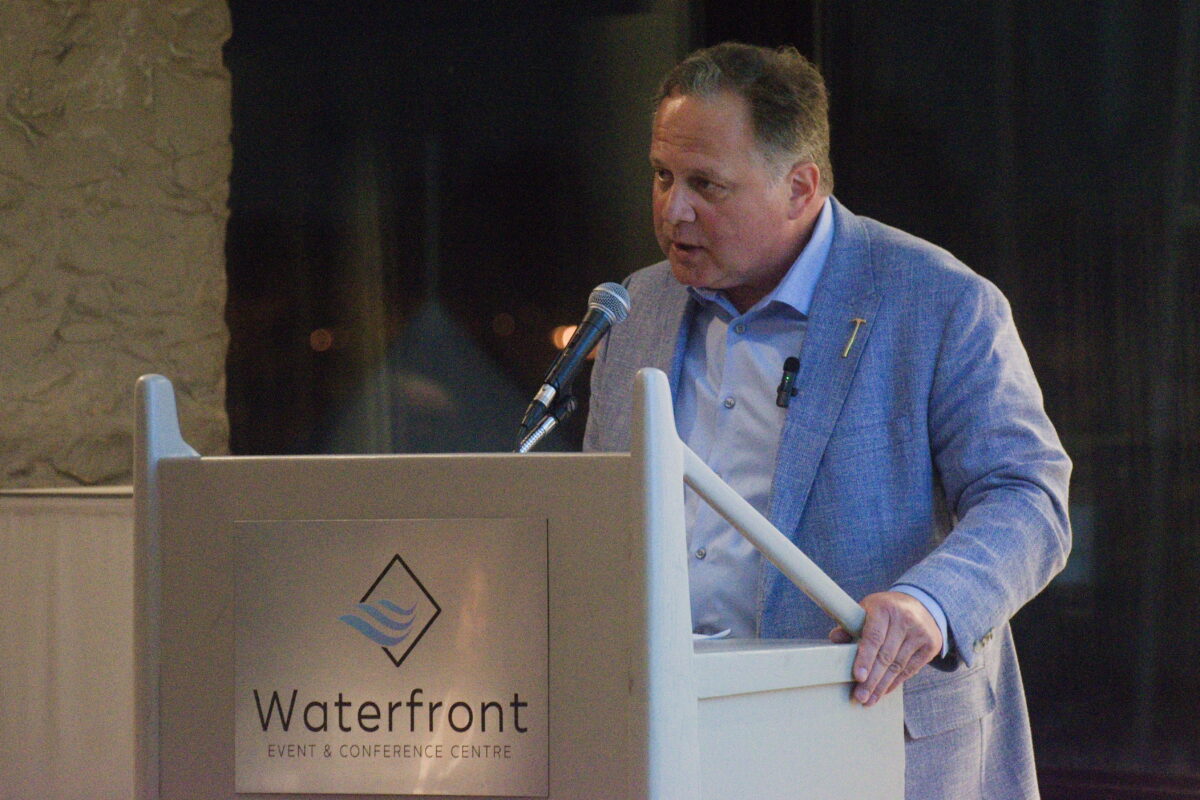
The Hamilton and District Apartment Association invited Hamilton’s leading mayoral candidates to speak at the association’s September 9, 2026, meeting.
Keanin Loomis and Rob Cooper both spoke at the event, and individually took questions. Below is a lightly edited transcript of Cooper’sremarks and response to questions. You can read Loomis’ remarks and responses here.
Cooper’s Remarks
It is great to be with you tonight, as I look around the room, I feel like I am among friends.
As Daniel [Chin] said, I am a lifelong Hamiltonian, and Hamilton has always been home.What I do for a living is I transform organizations. Many people build strategies, build dreams, and can’t deliver them. They call me in to rescue them.
For example, Stelco, when they went through their first bankruptcy protection, I came in and raised a half billion dollars for them in 30 days. And we were able to sustain the pensions, sustain the organization.
I went to TD Bank. TD was struggling with something called Basel, through on credit risk, and they were struggling to get it done through regulators in those accounts. So you know those, they make your life tough. And so what happened there was, not only did we succeed on Basel, discovered a bunch of products that had no markets, and we got rid of those products before the collapse of ’08, was one of the few banks in North America with no layoffs.
I had the opportunity to come back and work at McMaster University as Chief Strategy Officer with Peter George, my mentor, which is a highlight in my career. And we were able to launch sustainability there. Many times you hear about sustainability, all you hear about is high cost and very few outcomes. Well, we’re able to deliver 30 million kilograms of carbon savings and $10 million. So now if you go to McMaster University, the minor we created in sustainability, you can obtain that from any faculty at McMaster to this day. We were able also to launch Risk, which was really a catalyst for us to become the most research-intensive university. And during my stay there, he also launched the Innovation Park.
From there, I went on to Manulife. I was in 15 countries in Asia, Boston, and Toronto. We were putting in the technology strategy to struggle with a new trading platform worldwide. Went to WSIB. We launched something called Public Value. It was a theory at Harvard, nobody had implemented in Canada, and what it did for WSIB, it really dealt with the destruction and devastation of people’s lives. We were able to get people help quicker.
My hobby has always been politics. I love politics. I love to help people get elected. I got a number of friends who got elected, from Tom Jackson, who got me into politics, to Mike Spadafora, to Esther Pauls, on a provincial level, people like Doug Ford and Patrick Brown, federal level, Erin O’Toole.
When the by-election came up last fall, Esther Pauls came to me. She said, “Why don’t you run?” I said, “Well, I help people get elected.” And if any of you know Esther, Esther’s relentless. You can’t say no to Esther. So Esther convinced me, and we jumped in the race. 26 folks, had some big names there: Scott Duvall, Terry Whitehead, Barry Quinn, Sonia Brown. And we knocked on 10,000 doors, 65 volunteers, 850 signs, and we did what nobody thought was possible: we won.
And so I went to City Hall with a mission, that was to deliver on what we promised Ward 8. And so in December, put a motion on the floor: it’s time to cap taxes. We had 23 per cent tax increase over the last 4 years, and many of us find it unaffordable. I heard that right at the door. I put the motion on the floor, cap the tax rate at inflation. I was ruled out of order. They said, “We now have Strong Mayor Powers in Ontario, and only the Strong Mayor can set the tax rate.” So as you know, strong mayor sets the tax rate, sets the budget, sets housing, and also hires and fires. It’s a big responsibility, especially one that you don’t want people learning on the job on.
And so, you know, when you think about it, you need a license to drive a car, you need a license to have a gun, you need a license to be a doctor, but to be a strong mayor, you don’t even have to know how to balance a checkbook. So it becomes very important who you put in that role, that they’re qualified, because this person has—it’s almost like a monarch in our city.
So, you know, it was at that point when they ruled out of order, I decided to run for mayor, and here we are tonight. So, you know, we’re on that journey. And so where have we been in the last four years? 23 per cent tax rate, what do we get for it? Well, we got the worst roads in Ontario. Some would say Canada, but definitely Ontario. We got a level of homelessness that we’ve never seen before: 2,100 people homeless, is a level that is unprecedented in Hamilton. We now have violent crime in all parts of our city. When you start looking at what’s safe, it’s very unsafe, very dangerous.
When you start looking at the city, no financial statements for the last three years. If you had no financial statements in your business for the last three years, you’d probably be called bankrupt. You know, the only thing that sustains us is the 23 per cent taxes. You know, when it comes to planning, worst in the province, 40th of 40. You can’t get any worse. You know, when we did budgeting this year, here’s what budgeting consisted of: no actuals, no benchmarks, no peer data, and we had service levels for 2014. If you took a dartboard and threw a dart at it, it’d be more reliable than what we did. It was a guess.
Your tax rate was a guess this year, okay? When I got elected, the tax rate was 8.9 per cent. I was talking about the idea of capping it. Overnight it dropped to 4.25 per cent. That tells you how real the tax rate in Hamilton is. And then through my colleagues, got it down to 3.87 per cent. That’s the best they could do not having strong mayor powers. Should have been below 2 per cent. So let me tell you what I’m going to do.
These tax increases can’t continue. We had on the books up to about a week ago a 31 per cent tax increase over the next three years. We just had an announcement, it went down to 25.5 per cent. Let me tell you, 23 per cent over four years, now it’s 25.5 per cent for the next three. This isn’t sustainable. It’s structurally unsound. We’re starting to see our credit agencies downgrade us, right? And that’s going to keep on going. When you talk to people on fixed incomes, they can’t afford it. They don’t get this in their pensions, okay? When I look at each and every one of you, are you getting a 25 per cent increase over the next three years? No, you’re not. No, you’re not. And so there’s absolutely no excuse why we can’t cap this at the rate of inflation.
It’s time we start running this city like you run your home. Here’s what we’re going to do. When we talk about accountability, we’re going to start doing monthly financial statements. Not new for you guys, but new for the City. We’re going to start having audited financial statements on time. We’re going to start having tying service levels to a budget. That’s what most people do. We’re going to publicly present that.
In terms of City Hall, we got to start leveraging technology. We got to streamline data processes, and we got to empower our staff. We got to do a culture change. It’s a culture of, what do I call it, hindrance. We got to move to a culture of help. We got to be helping people.
When it comes to your tax dollars, they got to work harder. We have a procurement department that takes the lowest cost, and every change order they take, they turn it into the highest cost. Nobody does that. If you look at the Ontario procurement standards, that applies to every municipality, and it should. I’ve already had that conversation with the provincial government. We need to look at things like lifecycle costs. We don’t even hire local. We don’t even hire local. It’s shameful, actually. We don’t benchmark against other cities, which we’re going to start doing.
When you also think about wasteful spending, the City of Hamilton uses every excuse to tax you. We talk about Vacant Unit Tax, I’ll come back to talk about that. We talk about rental licensing. We talk about a rain tax on our farmers. I talked to a cucumber farmer, he said to me, “You know what? $90,000 is going to double the price of a cucumber.” What do people tell us every day? You go to the grocery store, and you get less in a bag. Our number two sector in Hamilton is agribusiness, and it’s really putting a tariff on ourselves. You talk about Trump, we put a tariff on ourselves. And this is costing us greenhouses jobs. We moved to defer that. In fact, I tried to raise it, they said, “If I hadn’t passed it, I couldn’t raise it.” I asked my fellow council, I said, “Sponsor me.” They said, “There’s no way we’re going to sponsor you in an election year to do that.” So we deferred it. That’s on the table in January. You better find out where people stand on rain tax, because you know what – It’s going to come back up.
Now, since I’ve started talking about it, the province has moved to put a regulation to block it for farmers. Rural Hamiltonians who are on wells and septic beds, they’re going to get charged this tax. They’re going to get charged in January, just another excuse to tax. And for those of you who don’t know, there’s a tree tax coming. So if you cut a tree down in your backyard, the City will want to tax you on that too.
This is about more than balancing books, folks. This is about, eliminating barriers and making changes to really help people.
Let’s talk public safety. Every Hamiltonian should feel safe to go to any part of Hamilton, day or night, and feel safe. Not the case. Not the case right now. If you were to go to downtown Hamilton in the middle of the day, most people tell me they don’t feel safe. Public safety is government’s first, first responsibility. As mayor, my plan will be is around prevention, it’ll be around enforcement, and it’ll be around rehabilitation.
Let’s talk about preventing crime. You know, when we pulled the police out of our schools, the gangs moved in. We got gangs in all our schools, in our suburban rural communities, unacceptable. It’s really time that we take the gangs out of our schools and put the police back in, and really work with, I’ll call it a level of engagement in our schools that’s positive. We need to invest in recreation. We need to invest in sports, mentorship, and community programs. Give the young people alternatives to gangs and crime. When I was in the police station doing the ride-along on the Mountain, all I see is young people. That’s all they have posted. And so, you know, it’s a real problem in Hamilton.
When it comes to enforcement, I’ll do something this Mayor hasn’t, isn’t doing right now, and I’ll sit on the police board. We need to be actively involved. This is not a part-time job. This is, if you’re not actively involved, if you don’t call this as dangerous and unsafe, then you’re not going to be able to address the problem. You got to call it for what it is, and you got to get involved.
What I want to see is I want to really support the police in targeting guns, gangs, and drugs. We got a drug problem in Hamilton, it shows up as violent crime. We got to do proactive enforcement and back to visible policing. I’ll work with the different levels of government to get adequate correction facilities. Everyone knows Barton Street is overflowing. When you go before a judge in Hamilton, you know, you can say Barton Street’s overflowing, and next thing you know, the judge puts you back in front of the library where you’ve been dealing drugs.
When it comes to rehabilitation, we got to support real rehabilitation programs. Let’s break the cycle. We got to build the skills and opportunities for people to choose a better path. And as I said, this comes down to preventing crime, to enforcing the law, and breaking the cycle. I’ll work every day to make families in Hamilton feel safe, to give young people the opportunities they need to succeed, and for criminals to know there’s real consequences in Hamilton. We’re going to get tough on crime. I want to see Hamilton be the safest city in Ontario.
Now let’s talk, a little late discussion, about housing and homelessness. This is both a crisis and, let’s say, we got a housing crisis and a homelessness crisis. First of all, we got to make it easier for Hamiltonians to afford a home. Our federal government has a couple programs put in place that intentionally keeps people out of homes right now. One is called the stress test. A stress test assumes your income never goes up, your principal never goes down, and it linearly guesses at an interest rate. That keeps people out of homes, and nobody’s talking about it.
Now, the other thing we run into is this whole down payment. People chasing it into their 40s and 50s. There’s got to be a different model. My goal is to put people into homes.
When we move on to homelessness, homelessness is both a humanitarian crisis and a public safety challenge. My goal is clear: in four years, end street homelessness in Hamilton. My goal is zero. Yeah, I don’t have a problem saying that. If you don’t have a goal, you’re going to go nowhere. Our goal is zero. We’re going to expand the mental health services, addiction treatment, and supportive housing and recovery programs. We’re going to move people from crisis to stability. We’re going to deal with the root cause, which is addiction, trauma, and mental health issues.
And we’re going to bring accountability to taxpayers’ money. Far too often, we measure homeless programs by how much we spend and not by the outcomes. I’ll tell you right now, people are not getting the outcomes. We’re going to cut them off. We’re going to give it to the organizations who are, because we’re going to get serious focus. This is not about money, this is about delivering results. We want to get people off our streets, we want to love them.
We’re going to, when I think of homelessness and the bad side of the drug crisis, we’re also going to aggressively tackle what I call drug trafficking, which is the supply side. We’re going to break the business model of drugs in Hamilton. Our approach is simple: compassion and accountability. I say this: if you love someone, you’re not going to leave them on the streets. You’re going to love them off the streets, because if you love them, you don’t leave them on the streets.
Investing in critical infrastructure is my next item here. Infrastructure, allows Hamiltonians to spend—we got to really start spending less time in traffic and more time with our families. It’s also critical for economic growth and job creation. So we need to improve how people move across the city. We got the LRT, we studied it for 18 years. We’re Hamiltonians, we love to debate. So we debated it. We took 100 votes on this, a big 51-49 one way or another, we all know that. You know, it’s time to move beyond that. Provincial government is studying it for two more years. You don’t have a plan if you don’t have a date. We need to put a date on it, we need to get shovels in the ground.
And then we need to have the real conversation. The real conversation is about all the other things we haven’t been talking about because we’ve been debating the LRT.
Every city that has an LRT has a perimeter road, a ring road, and ours is congested. When you look at the Red Hill Valley Parkway, Lincoln Alexander Expressway, you guys go on it, you know what I’m talking about. It prevents you from getting home with your family at least a half an hour. And so, you know, I’ve had a conversation with the provincial government, they’re willing to upload it, okay? They’re willing to upload it, you know. And then you look at it, you say, “You know what? Boy, we could sure use another lane on that.” Same with down by the 403. When you look at down by the 403, we’re not touching the escarpment, we got all the room right there. We can just do it. What we need is a vision.
You know, when you start looking at transit around Hamilton, the Hamilton Mountain and the rural communities have no GO transit. It’s one of the biggest areas in Ontario that’s underserved. When I was at McMaster University, we brought GO to McMaster University. We took cars out of the—we had cars parked on lawns. We had cars filling our parking lots. It had such a dramatic impact that not only were the cars off the lawns, we emptied out parking lots, and those parking lots were turned back into wetlands and into a goose paradise.
We have a Metrolinx station at Mohawk College, been paid for. All we have is HSR service. I’ve already talked to the Premier about bringing GO up to the Mountain. Let’s start expanding it. You know, it’s—I personally believe if we brought GO to the Mountain and to the suburbs, we’d have full ridership.
You know, when it comes to HSR, Councillor Jackson and I moved a motion that we want to look at moving free HSR passes from 80 to 65. We got an affordability crisis in our city. Right now, I have 5,000 families in my ward that are on food banks.
So let’s talk about investing in the infrastructure Hamiltonians use every day. I want to build a master road improvement plan. We got deteriorating roads everywhere. You know, we need to prioritize infrastructure projects, use practical, cost-effective planning that avoids expensive duplicate work. We all know what happened on Aberdeen. We know we did a shave and pave last year, we know we’re putting pipes under it next year. Doing roads twice is a very expensive model. We can all pick roads in our city that are just absolutely terrible. It shouldn’t feel like this. We’ve never seen Hamilton like this before.
You know, we also need to invest in parks. I put $2 million into parks in my ward recently because I believe we got to have parks where our kids can go and play. We got to be able to do sports leagues. We just had a nice ceremony down here, the Children’s Games coming to Hamilton in 2028, was a big announcement today. But I see those people up there, they’re the ones that invest in our children in our parks to give them something positive to do. We need to invest in playgrounds, trails, and recreation spaces, and work with senior levels of government to build recreation centers in places like Flamborough, Winona, and Binbrook. Let’s be honest, those rural communities, those farming communities, they’ve been funding the rest of Hamilton. They’ve been neglected, they’ve been overlooked.
I met 200 kids in Binbrook, and they said, “You know what? We’re going to build a rec center for you up here.” I had a 15-year-old say to me, “What’s a rec center?” It’s such an empty promise, nobody knows what it means anymore. It’s like my commitment is to build those by 2030. And that’s working with the federal and provincial governments as well.
The idea here: let’s spend less time in traffic, more time with your family, and build the infrastructure Hamiltonians need to drive economic growth and job creation.
Let’s talk about economic growth and job creation. Hamilton has everything it needs to have the strongest economy in Canada. Yes, Canada, not Ontario, Canada. We have a world-class seaport, we have an international airport, advanced manufacturing, leading healthcare research institutions, skilled workforce, incredible geographical location. We lack vision. We’re not reaching our potential.
Right now, 89 per cent of the tax base in Hamilton is paid by residential taxpayers, that’s all of you. 11 per cent is paid by businesses. Let’s back it up to 2022. It was—I’m sorry, in 2022, it was 86 per cent residential, 14 per cent business. Today, 89 per cent residential, 11 per cent business. That’s three per cent of our businesses have left. I met with some of those guys, I said, “Why’d you leave downtown Hamilton?” They said, “It’s too dangerous, it’s unsafe, okay? We can’t attract employees down here. Nobody wants to go in downtown Hamilton.” When I knocked on the 10,000 doors last election, folks said to me, “I don’t want to go downtown Hamilton. We’ve got this beautiful TD Coliseum, people feel unsafe.” How many people have we seen shot dead? A 14-year-old shoots a 16-year-old dead in our mall. That 14-year-old wasn’t a licensed gun owner, right? Had a bad mentor. And that’s where we have to intervene on this, because we can’t keep doing this. This is standing in the way of economic growth in Hamilton.
So we need to change. You know, really want to build a city where people are comfortable investing and creating jobs. It starts by transforming our city and things like planning and economic development as well. It’s one of the worst in Ontario. We need to remove barriers, streamline approvals, move from a process often measured in years to one measured in weeks and months. You guys know what I’m talking about. You guys go through that department, you know, it takes up to five years. I had people tell me, they could sell the land in Hamilton, they’d leave tomorrow. What’s happened is they can’t sell the land?
When I look at this, you know, I met with the Barrie—the mayor of Barrie’s a friend of mine, Alex Nuttall. He’s got this system he set up. I load all the requirements from the province here, I load the heritage information, someone wants to build something in an area, it loads that information, press a button, you’re sitting here, five minutes later you’re zoned. That takes three years in the City of Hamilton right now, three years!
And that is, when you think about this, we always talk about development charges in Hamilton, right? The development charge we never talk about is land carrying costs. That goes right on the price of a home, that goes right on the price of a building. I was visiting a meat manufacturing company the other day, and they’re telling us how long it took them to build it. It doubled the cost of their building from $7 million to $14 million with the delays from the City.
Who would do business here? Between the homelessness, the violent crime, the infrastructure, and now we got barriers at the city in terms of approvals.
Well, what I want to do is restore the economic vitality downtown by confronting that crime, the homelessness, and addiction we talked about, and making our core a place where people want to live, visit, and invest. I’ll build strong relationships with federal and provincial government and invest in economic opportunities for Hamilton.
There’s a real opportunity to attract thousands of good-paying jobs here, and really that’s where we’re going to grow our commercial base. When you look at Hamilton, there’s no other city in Ontario that has 89 per cent residential taxes, 11 per cent business.
I believe we can transform Hamilton and turn it into Canada’s economic engine. As a matter of fact, I tell people, I said, “You give me Hamilton for four years, you won’t recognize it in a good way.”
Now I want to deal with a few questions I heard around the room here before I open it up to other questions.
Vacant unit tax: I’m clear where I stand, you just need to look at my voting record. I voted against it every time, okay? Why? I asked Director Clayton Pereira at one of the meetings, they like to always talk about money, but not strategic objectives. I said, “What’s your strategic objective in this program?” He said, “You know what? It’s to lower homelessness.” Well, since they started the program, went from 1,600 to 2,100. I said, “Programs failed. Let’s end it.” One of my council colleagues told me a funny, weird story about a piano, and you can get where she’s talking about. And so, you know, I was—and so this is the problem, is that you’re not being represented right now at City Hall.
There are some people that are fighting to represent you, but there’s a whole lot of people aren’t. And as a matter of fact, I would encourage you to get involved. Find out who in your ward represents what, and ask them specifically. If they don’t answer you, that’s because they don’t represent you, okay? And there’s people in every ward that represents people in this room, okay? You’ve got a great selection. There’s like 16 people in some of these wards that are running. You know, just take the time and ask them.
Now, rental licensing: I’m very clear on this one too. I don’t believe in it, okay? I voted against it, okay? Here’s some wards: 1, 8, and 14. 1, 8, and 14, take a look at wards 1, 8, and 14, see what demographics are in those wards.
My colleagues have said this goes against the Human Rights Commission, what we’re doing. There is no plan to roll it out because a plan has a date, there is no date. They’re targeting certain people, highly discriminatory, should never have happened, and yet it continues to happen. There’s a majority of council who has no problem targeting people, and I find it deeply offensive.
As a matter of fact, people say, “Why are rents so high in Hamilton, you know? Why is there an affordability problem in terms of people being able to afford a decent place to rent?” You know what it is? Property taxes. There’s not a magic pot of money under a rainbow somewhere. A property tax is where your rent—you tell me, you guys know, vacant unit tax, where does that go? Right on your rent, you know. Where does rental licensing go? Right on your rent, okay? Why is it so expensive to rent in Hamilton? Comes all back to government policy, okay? That’s the—you have to go no further. The problems in our life come back to government policy. Bad policy ends up becoming bad things on our street in our community.
So on that note, I’m going to open up the questions. Willing to take any question, feel free.
Question and Answer
Question: As somebody who wants to invest or maybe look at you as a candidate, how do I know you’re going to be here for the long haul and not just for this next time period until you move on?
COOPER:
You’re right, I’m not a career politician. I was just like everyone of you in this room last year, nobody knew who I was. Well, my family did, but beyond that, right? And you know, I just ran because I was sick and tired of what I saw. I’m not looking to be a career politician, I’m going to be honest with you. I’m looking to transform Hamilton. My win is not the election, my win is transforming Hamilton. We transform Hamilton, my job is done.
Question: You have a timeframe in mind? You have a four-year plan or a eight-year play, can you lay that out?
COOPER:
Yes, 100 per cent. I would say this, like I said: Give me Hamilton for four years, and you won’t recognize it in a good way. Will we be done in four years? I am not sure, but I’m not looking to break Bob Morrow’s record, let’s be very frank here, Bob Morrow was a great man, he was on here for a long, long time. I’m not looking to be a career politician. I’m looking to come in and transform Hamilton. We know Hamilton has potential, we all see it, we wouldn’t be here, right? And so that’s what I want to achieve. I want to see Hamilton achieve what we all know it can. And that’s what I’m running about. I’m not running to put time in, I’m not looking to break anybody’s record. If you want change, I’m here, vote for me. If you don’t want change, hey, you got lots of selection. So it’s up to you. If you want status quo, 25 per cent taxes next three years, I think it’s unaffordable, but who knows. So I’m just giving people choice. Thank you.
Question: On policing funding, the person closed “We do need to support the police, and you need to sit on the police board and not alien alienate ourselves away from them, working together to clean up the city. So I appreciate that you’ll be on board with them.
ust to comment on that. So the police got 30% more the last four years in their budget, you know. Chief wanted a parking lot paved, he wanted cameras, he wanted more officers, got everything he wanted. You say, “Why are we where we are?” If you don’t have a mayor supporting the police, sitting on that police board, you say, “Well, the mayor supports police.” You got to be tangibly sitting on that police board. You got to be a focus. We got to call it out. If you cannot say that Hamilton is dangerous and unsafe, then how are you ever going to improve it? We can’t mince words on this, right, in terms of where we find our community.
That’s why I’ve been very clear about what we’re talking about here. We’re going to make Hamilton the safest city in Ontario. We want to cap our taxes at rate of inflation. Homelessness in four years will be zero, that’s the goal, okay? So I’ve been very crystal clear. I don’t believe in mincing words. I told people in the by-election, “Hang on to my literature, pull it out. If we don’t deliver, don’t vote for me.” It’s a simple world, right? You know, if I don’t deliver for you in four years, vote for someone else. I’m okay with that. That’s how confident I am.
Question: Statement about financial accountability and transparency. “I certainly would hope that you both would have a greater respect for taxpayer dollars than what we’ve had and endured here over the last few years.“
Great, great point. You know, I think I see things a little differently than most people on Council just because I’m a CPA. So when I look at it, I look at a corporation. I had one councillor tell me one day, he says, “You know, this isn’t a corporation, don’t run it like one.” Well, I did agree we don’t run it like one, okay, but it is a corporation. And if you look at the basic business practices, they’re all missing down there. Nobody does procurement the way [Hamilton] does it. Planning [approval timelines], last in the province. No financial statements. Who runs an organization that way? Service levels, 2014, we don’t even have benchmarks.
That’s why when I get asked the question, “Can you do it in four years?” This is heavy lifting. Now I’ll tell you this: it’s not the kind of job to learn on the job.
Every $13 million mistake is 1 per cent on your taxes. Take the bus garage: that is $147 million. That is 12 per cent. You start looking at where the money went. You can’t learn on this job. If you don’t know what you’re doing, it’s going to be a learning curve that we’re all going to pay for. And we see that learning curve in the 25 per cent for the next three years. It’s absolute nonsense.
People can’t afford it. We can’t pay people to learn on the job as Mayor of Hamilton.
Question: Mortgage Stress Test. “If you were to lower the Stress Test from 2 per cent to 1 per cent, the average Hamilton buyer’s affordability increases by 10 per cent.” Asked Cooper to comment on the issue.
Thank you. I come back to this, as I said earlier: every problem we have relates to government policy. And so you look at this, this was put in place, some would argue it was put in place during COVID and all that stuff. But you know what? The fact of the matter is there’s other ways of doing these things. When you’re guessing at an interest rate, when you’re assuming people’s income doesn’t go up, and they do, when you’re assuming principal doesn’t come down, this is just junk economics. Junk economics.
And you know, some people look at it and say, “You know what? Is the federal government intentionally keeping people out of homes?” How else do you characterize it? I can’t rationalize it. I don’t know why they created it. I mean, if I was there, it wouldn’t be there. Same with the down payment. What’s the down payment? It’s really a assessment of your credit risk. Isn’t there other ways of doing that?
Those two programs keep people out of homes. That’s why people are living in basements of their parents and all that stuff. It’s like, you don’t have to look any further. People like to talk about development charges, this and that. It’s the government policy that’s keeping people out. I say pull those two things and see where we’re going to be. How many people are going to be in the home? And we got to have those conversations, we got to start talking about this publicly, right? It’s bad government policy, it’s the only way to deal with it: put the bright light of sunshine on it.
Question: On Pay Raises for Senior Staff. Specifically, the Chief of Police. “Would you use those special mayoral powers to make cuts at top?”
Thank you. And so I would say this: we have a four-year labor agreement we set in January, okay, with the city. Last time the four-year labour rate, it did not represent what anybody was giving out for an increase. Let’s be honest here. It doesn’t. And you know what? When you start looking at the tax rate, there’s a direct correlation.And so we’ve got more than enough money to treat people well.
When we talk about the senior roles, I don’t know, I heard people say six months ago they cleaned up City Hall. And then I see all these senior people, right? We’ve got three people leaving for the last three or four months. Senior people are gone. I don’t have to say goodbye to anybody, they’re just leaving. Self-selecting, a number of issues coming out. And so I think we have to change the culture of City Hall first and foremost, it’s got to be one that’s more about helping people than hindering people.
And so, you know, I’m not going to go in there and get rid of a whole bunch of people, I’m going to be honest. I’ve met people down there, there’s some very smart people. There’s some very engaged people. And you know what? The people I’ve met, I see all the potential we can turn the city around, people that are down there, to be very honest with you. And you know, there’s a few leadership roles that we need to fill, those are critical roles. Chief Human Resources Officer, I would say it’s the most important job in an organization. That person sets the culture. That person sets a whole bunch of things. That person sets the the wage rate as well.
You know what? I would say this: I’ve met great people at the City of Hamilton. I believe we got the talent to get us where we need to go. I believe in treating people fairly in terms of compensation. I think the compensation should reflect the community, to be very frank about it. And I don’t think we should be outliers either way. And you know, I believe in treating people fairly, but I also want people to be set up in a way they can deliver for Hamilton. And right now we lack that.
You know, it’s very challenging to deliver at City Hall. I could give you a number of examples, but you know, it’s just that it comes back to having the right leadership and empowering people. Giving people the ability to use their skills that we’ve hired them for in a way that’s going to move Hamilton forward. And right now, I think there’s some misalignments there, to be very frank with you. And so I’d like to unleash the potential we have at City Hall and really look at it to bring some very great outcomes in terms of where we want to go as a city.
Exchange with an Audience Member
Audience Member: “This isn’t a question, it’s just my thoughts on this. I’ve lived in Dundas for 25 years. There’s at least half a dozen murders there. There was machine house machine-gunned on Pleasant Avenue, a couple bombs went off. Not once did I ever hear anybody say, ‘Don’t go to Dundas, it’s a terrible place.’ So there’re 300,000 people come to Supercrawl this weekend, and they’re not afraid to go downtown Hamilton. I think we should stop badmouthing our own city.”
Rob Cooper: “Well, you know what? I’m repeating what people are telling me. I knocked on 10,000 doors, that’s exactly what they told me. I’m not going to I’m not going to lie about it. When you knocked on doors, people said, ‘I feel unsafe to go downtown Hamilton.'”
Audience Member: “Because I hear the stories in Dundas. How do you live down there? I said it’s no different than when I lived here. There was murders, there was things going on there.”
Rob Cooper: “Hey, my neighbour got shot dead 5 years ago. Upper James, we had a gun battle on Upper James. A shot dead kid on a bus. I got bullet holes in houses. But I’ll tell you this: since I became councillor, we put a plan in place, there’s been no shootings. So we can do something about it. We don’t have to accept it.”
Audience Member: “But we don’t have to make it look worse than what it is by telling the whole world we’re a terrible city.”
Rob Cooper: “Well, I don’t think we’re making it sound worse than what it is, I think we’re being realistic about it, to be very frank with you. So, we can continue to deny we got a problem here, and we can continue to live with what we got. But you know what? I had people in my ward were afraid to have their kids go out last year, when I was knocking on doors. That’s reality. You go and tell those people that there’s some sort of figment of their imagination, it’s not. You tell them it’s a-okay, they don’t feel that way about it.
And so we have to call it out, and we have to deal with it. When you got people being shot dead downtown Hamilton, and I agree with you, it happens all—we just had it happen on Upper Stoney Creek. That’s a real situation there. I was over with Kingsview Church. And you know what they were telling me about there? About the shooting in their neighbourhood, and how they feel unsafe. That’s not, I’m just reporting the news.
So I think in order for us to address it, we have to call it out. I don’t think we’re telling anybody that they don’t already know. I had a fintech company tell me, a guy says, ‘I came to Hamilton, and I’m leaving because I can’t attract the people I need to Hamilton because they feel it’s unsafe.’ Not my words, his words. I talked to a gentleman downtown, he does commercial buildings. He said, ‘I lost three floors in my building.’ I said, ‘Why?’, he said, ‘People feel unsafe to come downtown Hamilton.’ Not my words, his words.
“So we can stop talking about that, but we’re not going to solve it. If we don’t talk about the elephant in the room, we’re not going to get it solved. So I I respect your point of view, but my point of view is very different. I’m going to call it out, I’m going to be honest about it, we’re going to get a plan. And our goal is to be the safest city in Ontario. We’re not there right now. We’re not there right now. We can talk about we can talk about things like auto thefts, we can talk about things like break-ins. All it takes is one stray bullet.”
– 30 – (There were no further questions.)
Production Details
v. 1.0.0
Published: September 15, 2026
Last updated: September 15, 2026
Author: Joey Coleman
Update Record
v. 1.0.0 original version
Discussion
0 commentsNo comments yet. Be the first to add your perspective.