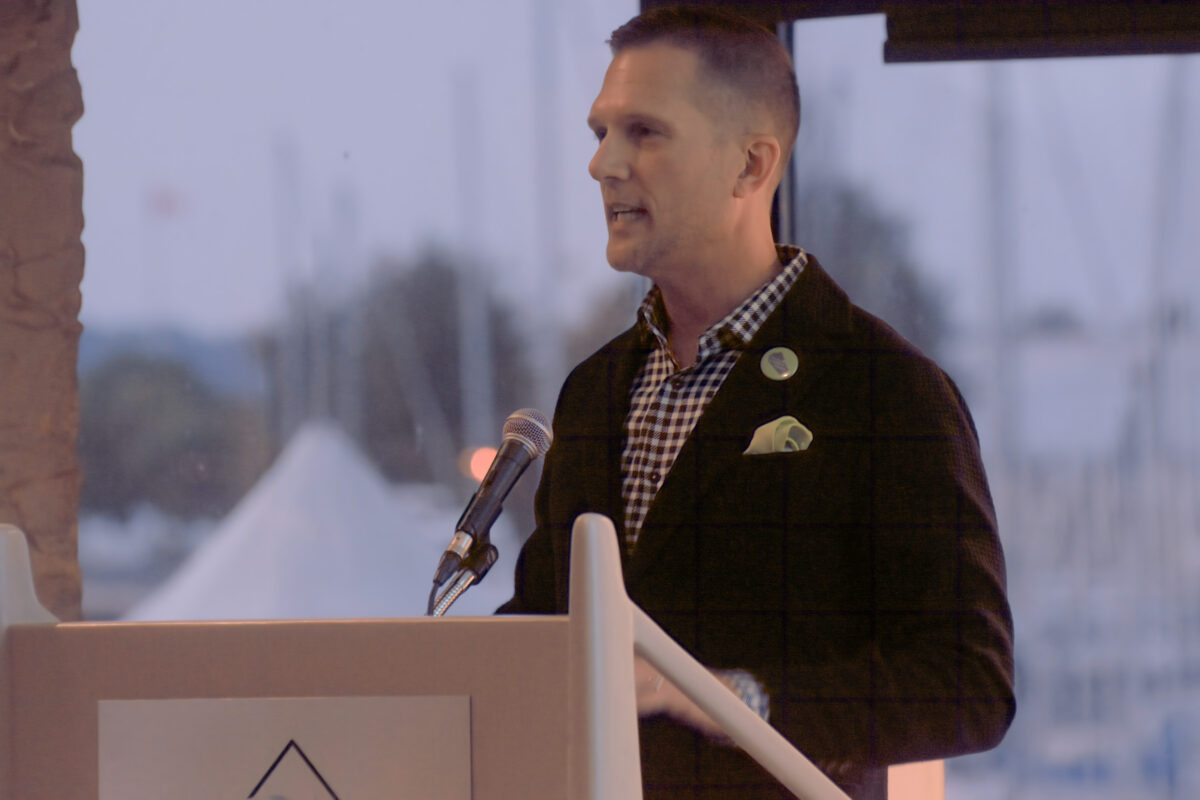
The Hamilton and District Apartment Association invited Hamilton’s leading mayoral candidates to speak at the association’s September 9, 2026, meeting.
Rob Cooper and Keanin Loomis both spoke at the event, and individually took questions. Below is a lightly edited transcript of Loomis’ remarks and response to questions. You can read Cooper’s remarks and responses here.
Loomis’ Remarks
Good evening, folks. Thank you so much for having me here tonight.
I had another event that I just came from; such is my life. As Daniel [Chin] said, I’m seeking the top office. But it was really important for me to be here to speak with you here tonight, to follow up on the meeting that I had with the HDAA board about a month and a half ago as well, where I started to learn what some of the really important issues are for you in this year’s election.
Before I get into my prepared remarks, I just wanted to say, for me, landlords are not the persons to be vilified.
Until about 10 years ago—so I’m 51 now—in my first 40 years, I moved about 27 times in my life. Half of that was being brought up by a single mother. The other half of that was being a student and going on to law school and all the other jobs that are required of doing that. And of those 27 times, all but four of them were in rentals. And I always appreciated having a warm place and a roof over my head. Had a lot of great landlords, some not so great. It was abysmal how my single mother was treated in the early ’80s.
There was also a landlord who really rescued me here in Hamilton when we first arrived here in 2009, as Daniel mentioned. I was practising law in Washington, D.C., and I realized that that was not a sustainable career path for me. We just had our second child. And we decided it was important for us to grow up near our families, for them to grow up near our families.
And so we moved back to Canada. I decided I did not want to raise my kids in the U.S., and every single day since then has justified my decision. We first moved in with my in-laws on the East Mountain into their basement. Then,, I started up Innovation Factory. I was employee number one. Finally got an income, and it was a landlord named Mario. I don’t know if any of you know Mario. Mario owns Wild Orchid here in town. He owns a number of other rental properties along Aberdeen.
So we had two kids. We needed a three-bedroom rental, which, as you know, is really difficult to come by. I saw a sign at 324 Aberdeen for a three-bedroom rental, and I called Mario and met with him the next day, and I told him, ‘Look, I just moved here, and I’m starting over, and I have a young family. I don’t have credit in Canada. I’ve been gone for the last nine years.’ I also, I really don’t actually have a real job because, again, I was starting up Innovation Factory, didn’t have a full letter of employment. I was the first employee, so I was the one that had to issue a letter of employment to prove that I was indeed employed and had an income.’ Mario said, ‘Don’t you worry about that. I like who you are. I’m getting a good feeling.’
And for the first two years after that of our stay here in Hamilton, we did so renting from Mario. He was one of the best landlords I think anybody could ever hope for. And when we finally bought our house, obviously it was a great step for us, and we were very, very happy for it. But the one thing we really missed was Mario. We wished that he could come along with us to our new house.
But I just wanted to share that because I know exactly where you are in people’s journeys, in their life journeys, and what you provide to folks. And it’s really more than just a roof over one’s head or warmth. It’s hope and it’s an opportunity to move further in one’s life.
I spent much of my career working with businesses, deciding where to invest, where to grow, and where to put their next dollar. As Daniel said, I was a lawyer in Washington, D.C. doing construction litigation. I helped start up Innovation Factory, which serves businesses in this community. I became the voice of business for nine years as the head of the Hamilton Chamber of Commerce. I then went on to the Ontario Chamber of Commerce after the last election. For the last two years, I’ve been representing steel fabricators across this country as the CEO of the Canadian Institute of Steel Construction.
And I learned something pretty basic through all of that time, and that’s that investment follows confidence. When I was voice of Hamilton Business, Hamilton was experiencing the renaissance that we all long for these days. Hamilton was, and we’re seeing the fruit of that labour now. The skyline of this community has completely changed. Every time I come down to the 403 to come back home, I’m always struck by how many new towers are in the downtown.
Much of that was due to the comeback of our downtown, which became cool again until, of course, COVID. Much of that was also due to the promise of LRT, which was a major reason for my advocacy for that project as the voice of business in this community. It wasn’t just about transit. It wasn’t just about infrastructure, though those are very important. It was about what type of city we wanted to be as a community.
It’s unfortunate now that we might have the lowest confidence in our city that we have had in decades, and that’s reflected in the thousands of doors that I have knocked on and the thousands of conversations I’ve had at other community events. And people are questioning why they live here. That’s difficult for me to listen to.
I don’t know if you yourself are. I’m sure that always happens when you get the tax bill in the mail every year. But for me, as a father of three raising kids in this community, to question why we live here is disheartening. And there is a lot of demoralization in this community.
Hamilton should be competing for housing investment, not making people think twice about investing or living here in this community. Hamiltonians—and I’ve heard this repeatedly—want this city to aim higher. Hamiltonians want to believe in this city and want to be proud in Hamilton again.
So before I get more specifically into housing, I want to share with you our SMART plan for instilling confidence in City Hall by creating a safer Hamilton, getting the city moving again, leading with accountability, delivering responsive service, and respecting every taxpayer dollar.
First of those letters, S-M-A-R-T, in our SMART plan is safety.
Every Hamiltonian deserves to feel safe regardless of where they live, where they work, or where they spend time in this community. Safety is the foundation of a healthy, vibrant, and prosperous city created through strong neighbourhoods, well-maintained public spaces, safer roads, community partnerships, and practical leadership.
The city where people feel safe is the city where families thrive, businesses invest, and communities grow stronger.
Yesterday, on the first day back to school, we announced an element of our safety plan, which is our Safe Public Spaces Hamilton initiative. We will set clear safety standards, respond faster to hazards, and create safer routes connecting our schools, parks, and our recreation centres.
Today, we announced a revival of the Hamilton Anchor Institution Leadership Group, which I was a big proponent of and participant in as the head of the Hamilton Chamber of Commerce. HAIL is all of the anchor institutions in this community. Think of the universities, the hospitals, the police services, some of the bigger businesses, as well as the Hamilton Community Foundation.
That group was important to getting a lot of initiatives off the ground because those were the types of conversations that needed to happen at that level before there were actions down through those organizations. It’s hard to get anything done in this community without forming those types of partnerships. HAIL was instrumental in the revival of Hamilton. Unfortunately, HAIL hasn’t met in years. As a result, we’re hampered in how we’re able to confront all the challenges that face us as a community.
There will be more announcements to come in safety and then in the other elements of our plan as well over the next coming weeks. I’ll get to the M in SMART, which is mobility. Hamilton is stuck, and we need to bring back the momentum. We need to get the city moving again. So we’re not just talking about transportation.
We’re talking about everything else that we need to do as a community to get unstuck. Hamilton succeeds when people can move freely, businesses can grow confidently, and City Hall works as efficiently as the community that it serves. Instead of putting up barriers, Hamilton should be a city of yes, embracing opportunity and preparing for future growth. Simply put, this is about building a city that works and a city that prospers.
The A in our SMART plan is accountability. Time and time again, I hear that people do not trust City Hall. At the very least, Hamiltonians expect transparency, professionalism, respectful leadership, and measurable outcomes. Residents should never have to wonder how decisions are made, where their tax dollars are going, or whether City Hall is delivering on its promises.
The R in our SMART plan is responsiveness. Here’s a radical concept: City Hall should exist to serve its residents. Taxpayers are all investors in the city, and in return, residents expect clear communications, clear expectations, and a culture that prioritizes service. Residents should not have to learn how City Hall works to receive the services they need. It is the city’s responsibility to make government easier to access, easier to navigate, and easier to trust.
And finally, we get to taxpayer respect. Respecting taxpayers means delivering value, not simply reducing costs. For the amount of money we pay in taxes, citizens expect reasonable stewardship, disciplined decision-making, and long-term financial sustainability. Hamilton residents make careful decisions with their own money every single day, and they deserve a City Hall that demonstrates that same discipline, responsibility, and respect with every taxpayer dollar it spends.
There will be a lot more, as I said, to come over the next couple weeks. And if we are successful in that plan and delivering that over the next four years, people will start believing in Hamilton again, and that means that we will need more homes, and we need to preserve and reinvest in the rental housing that we already have as well. I don’t believe that City Hall’s job is to try to become Hamilton’s housing provider. Its job is to create the conditions for housing to be built, preserved, and improved, and to work with the private and not-for-profit partners, all of you, who can deliver it. That means faster and more predictable approvals, clearer service standards, better coordination, and fewer unnecessary costs and delays.
And before City Hall creates another program, fee, or regulation, we need to ask: Does this solve a real problem? Does it duplicate something that already is being done? And what will it cost? And will it help us build or preserve housing? That’s accountability and taxpayer respect right there, two foundations of my SMART plan. But it’s also about leadership. I believe that you listen before you decide.
As Mayor, responsible housing providers will have a seat at the table alongside tenants and our communities. I will take Anna and Daniel’s calls and the calls of all of you as well and turn to them when it comes to developing rental policy in Hamilton. And each and every single one of you will have the ability to access the Mayor’s office to get help in navigating City Hall.
We won’t always agree. I can’t promise you that I will deliver on all of your priorities, but we will learn from evidence. We will measure results and we’ll focus on what works. And we will do so in a trusting way that allows us to have that back-and-forth and an understanding of why I am taking the position that I am taking. And that’s how we will build more housing, restore confidence in City Hall, and move Hamilton forward together.
Thank you very much.
Question and Answer
Question on homelessness: what is your plan to address addictions and houselessness?
LOOMIS:
I appreciate that question. That’s the foundation to safety and for people to, again, feel safe wherever they are in this community. We know that we face a very, very difficult in our downtown. A lot of that has exploded over the last four years, and we’ve seen we do not have the leadership or the creativity necessary to deal with this problem. Much of it is not for lack of resources. In fact, there’s almost a billion dollars being spent on social services in this community. There’s thousands of people employed to help deal with this issue. There’s absolutely no coordination at all across those social services.
And so, as I said, the HAIL Anchor Institution group is that, to me, that umbrella group that we would all expect leadership from—all of the CEOs of all of the key institutions on all the variety of issues, but helping me deal with that issue in particular. Because that’s where the expertise is, that’s where the resources are, and that’s how you get a lot of that stuff done. We know where some of the areas in the downtown are that need addressing.
Again, these are people who are looking for leadership from this community and not getting any right now. We know of a major issue downtown where there was a plan to move that facility, and that failed because of a lack of leadership.
Conversations that are happening right now about what that plan B looks like and how we can start to action that come November. So we will work on these on a project-by-project sort of basis. And then I think if there are times when we need to go appeal to higher levels of government, support funding mental health or addictions or what have you.
They will only invest when we have a plan, when we have the right stakeholders together on that particular project. And then we can get investment from the federal government.
Question: You mentioned faster approvals if there are necessary costs on housing. And I’m curious, though, what would be one change that you would make?
LOOMIS:
The first thing we need is real leadership at City Hall. I get the opportunity to hire the next City Manager and then the senior leadership within the city as well. And I’m going to ensure that it’s going to be somebody who has that priority, who has that understanding of what we need to do to start to hack away at some of the regulations.
It takes 31 months, as you know, to get an approval done in Hamilton. It’s the worst in the entire country. So we can look at other jurisdictions that have done it better. I know just across the water in Burlington, they have their Pipeline to Permit committee. I’m interested in something like that where we can bring together the real-world experience, folks just like yourselves, and again making sure that HDAA and individuals who understand this better than than I do, and and who are the experts in this community, to really learn from them and do exactly how we do that. But I was part of the city’s Open for Business committee as the head of the Chamber of Commerce. We worked at a lot of these things; I think we were making some some really good progress, but we have obviously backslid over the last number of years. So it’s about tapping into the expertise that is here in this room and elsewhere in this community and looking at best practices across the country.
Question: Lengthy from Landlord Regarding Regulations
Question: So my question to you, there’s two things we need to do, and you had touched on it, that if you create the right environment, that investment will come. The current administration, the way it has gone in the last four years, has chased away investment in multi-residential. No one wants to come here when they face additional rental licensing programs, safe building programs that are redundant, that will cost operators more money and pull more money from their budgets so they have less left over to maintain and beautify the building. So my question to you is, I will also pose to Mr. Cooper, is would you move to cancel these ridiculous, over-the-top municipal housing programs? Secondly, will you consider providing tax relief, reward, or create incentives for those of us that create or maintain investment properties to a higher standard instead of additional programs that will penalize us?
LOOMIS:
Well, I think we obviously need to do an assessment of every single regulation that exists right now. We need to determine where there is duplication.
So in that regard, as I’ve already said, I’m willing to work with you to identify exactly where we need to be looking. This is also part of the job of the next city manager and the next council as well. I’m not running as a dictator. I’m here to work with my senior leadership and with council to make sure that we’re identifying and working with you as well to make sure we’re identifying, again, those regulations that are duplicative, that are unnecessary. And then when it comes to incentives, you know, it won’t surprise you to learn that the cupboard is bare right now in City Hall. But if there’s anything that we can do in terms of, again, speeding up approvals, other types of things that make a meaningful impact in the cost of doing business, because that’s surely a huge part of your calculation, right? As you look to do something new in Hamilton, the carrying costs of having to endure the process is a major impact as well.
So that’s one fee that I can—one carrying cost that I can assure you will come down as we look to do approvals on a quicker timeline. But, you know, again, I’m open to anything that will help us because, as far as I’m concerned, responsible housing providers are part of the solution. And so, willing to listen, open door, and we will address all of your concerns.
As I said, there might be times when we’re not going to be able to agree or we can’t afford a certain type of program. But we’re going to have respectful conversations. And you will have somebody in the mayor’s office, with an ally who wants to see you succeed.
I know there are probably not a lot of non-for-profit housing providers in this room. For me, they’re a huge part of the solution as well. They have thousands of units in the pipeline. They provided a need that is really important, they provide the wraparound supports that are necessary.
It’s not just about the home; it’s about everything else that goes with it. So certainly there are programs like the Build Campus program where we should be going all in as a community and getting those thousands of unit profit housing providers built as well, and then allowing units to do well in your part of the cake layers that is housing.
For me, I’ve seen this in other areas as well, is to cost out what regulations are going to—the impacts that regulations are going to have on housing providers. Again, we can identify things that need to be eliminated and speed up approvals and all of that.
You know, as people start to layer on more and more regulations, we really should be doing a cost-impact assessment on those things to ensure that, you know, we’re not overburdening the housing provider. So I know that that’s one of your top priorities, and I share that.
Question: Was there any one item [in our questionaire] that spoke to you?
The cost assessment [of new regulations]. To me, I think that’s really smart. It’s easy for councillors to put things on the table, to play politics when it comes to certain matters of policy. I know that there are other pressures that they are getting from other community groups, but we need to make sure that with each and every one of these things, we are doing an assessment and working with HDAA and working with all of you to understand what the impacts are going to be.
Question: Vacant Unit Tax, How do you feel about that, are we getting our money’s worth?
Those are all very good questions that I wanted the answer of, and again, that’s, you know, something that should have been answered when we implemented or introduced such a program. We should have actually understood what the cost was going to be.
It isn’t clear, right? There’s a lot of people who are saying that this is bringing in a lot of money for the city, that it’s dedicated to not-for-profit housing. But as you mentioned, we haven’t seen actually a clear return on that. I would like to, at the very least, turn the vacant unit tax into something that you have to declare that you have a vacant unit, instead of putting the burden on every single taxpayer and homeowner across this community to declare that they are occupying their residence, right?
I do not believe it’s a solution for a problem that exists here in Hamilton. It’s a speculative investment. I know that in some communities, the number of Airbnb rentals is really causing distortions in the market. None of those conditions exist for Hamilton. So at the very least, I would like to flip it to ensure that it’s that you have to actively declare that you have a vacant unit. And then we can see what the real costs are and what the real benefits are to the city.
Production Details
v. 1.0.0
Published: September 20, 2026
Last updated: September 20, 2026
Author: Joey Coleman
Update Record
v. 1.0.0 original version
Discussion
0 commentsNo comments yet. Be the first to add your perspective.