
The City of Hamilton has debated the Red Hill Valley Parkway, the location of a new outdoor professional sports stadium, urban boundary expansion, and every other issue under the sun.
None of them have prompted the number of letters that a land severance on the Steelport lands, the former Stelco site, has.
On Thursday morning, June 4, 2026, Hamilton’s Committee of Adjustment (CofA) will vote on a land severance application submitted by Slate Asset Management to carve out a 76-hectare (188-acre) section of the Steelport lands on harbour industrial property to permit a joint-venture application to construct federally funded data centres.
As of publication, late Wednesday evening, the City of Hamilton has posted 1,209 letters regarding the matter and is continuing to process submissions that arrived before the noon deadline on June 2.
This represents the largest number of letters for a single agenda item ever. While the vast majority use an identical form letter template, others are original submissions—some brief expressions of opposition, others sharing personal experiences.
No business or industrial groups submitted comments. The Six Nations of the Grand River Elected Council was the only large organization to file a response.
A human review of the three posted PDF documents, totalling over 2,500 pages, identified only one letter of support.
Below is a selection of four notable submissions: one from Six Nations, the sole letter of support, concerns expressed by an associate professor who specializes in Great Lakes environmental issues, a submission from a data centre professional, plus an example of the form letter used by over 1,000 residents.
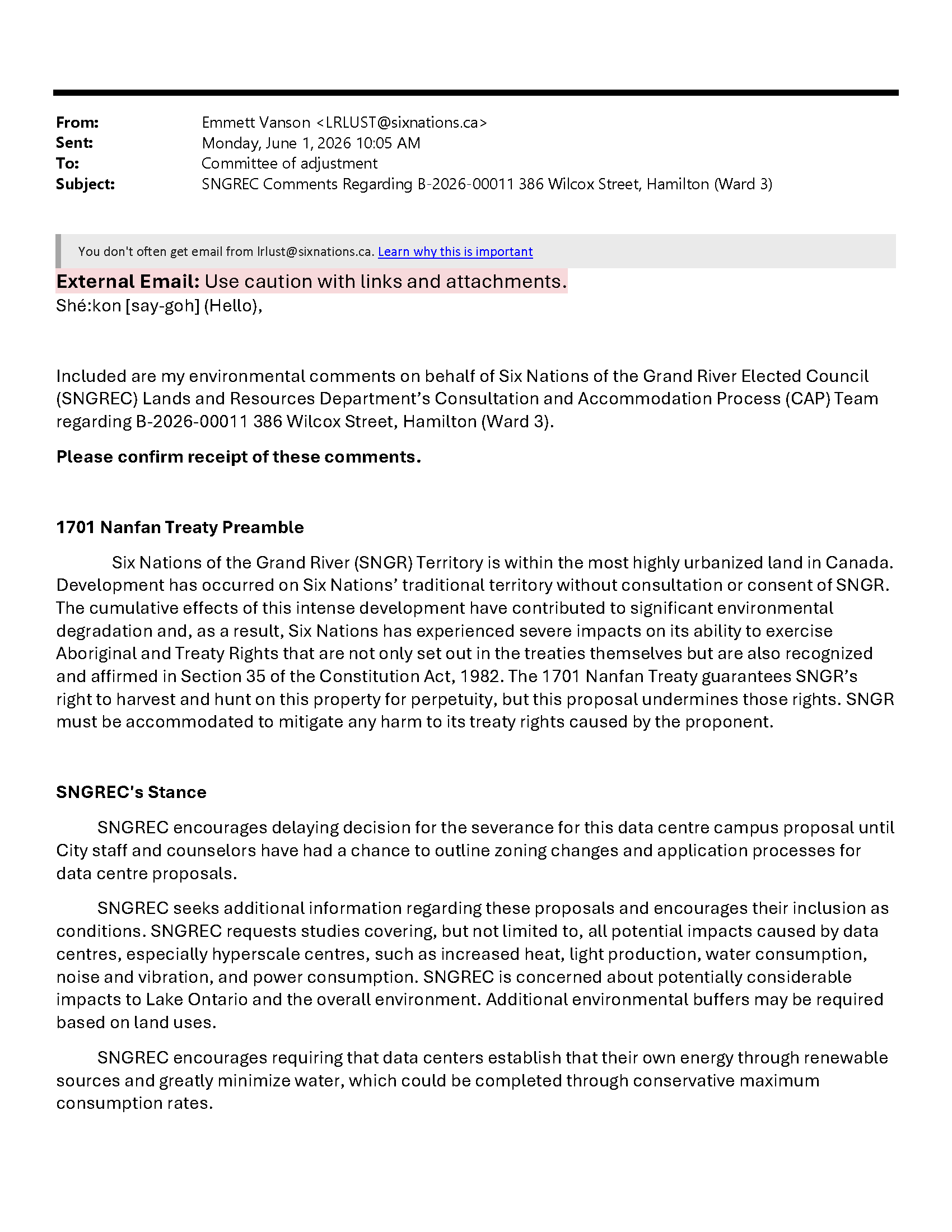
Six Nations of the Grand River Elected Council
CLICK TO VIEW THE PAGE Credit: HANDOUT / City of Hamilton

CLICK TO VIEW THE PAGE Credit: HANDOUT / City of Hamilton
The Lands and Resources Department for Six Nations of the Grand River Elected Council requested that the CofA defer the severance application until Ward 3 City Councillor Nrinder Nann’s motion requesting the City of Hamilton review its processes for approving data centres is considered by City Council.
Six Nations also raised concerns regarding their perpetual harvesting and hunting rights as guaranteed by the 1701 Nanfan Treaty.
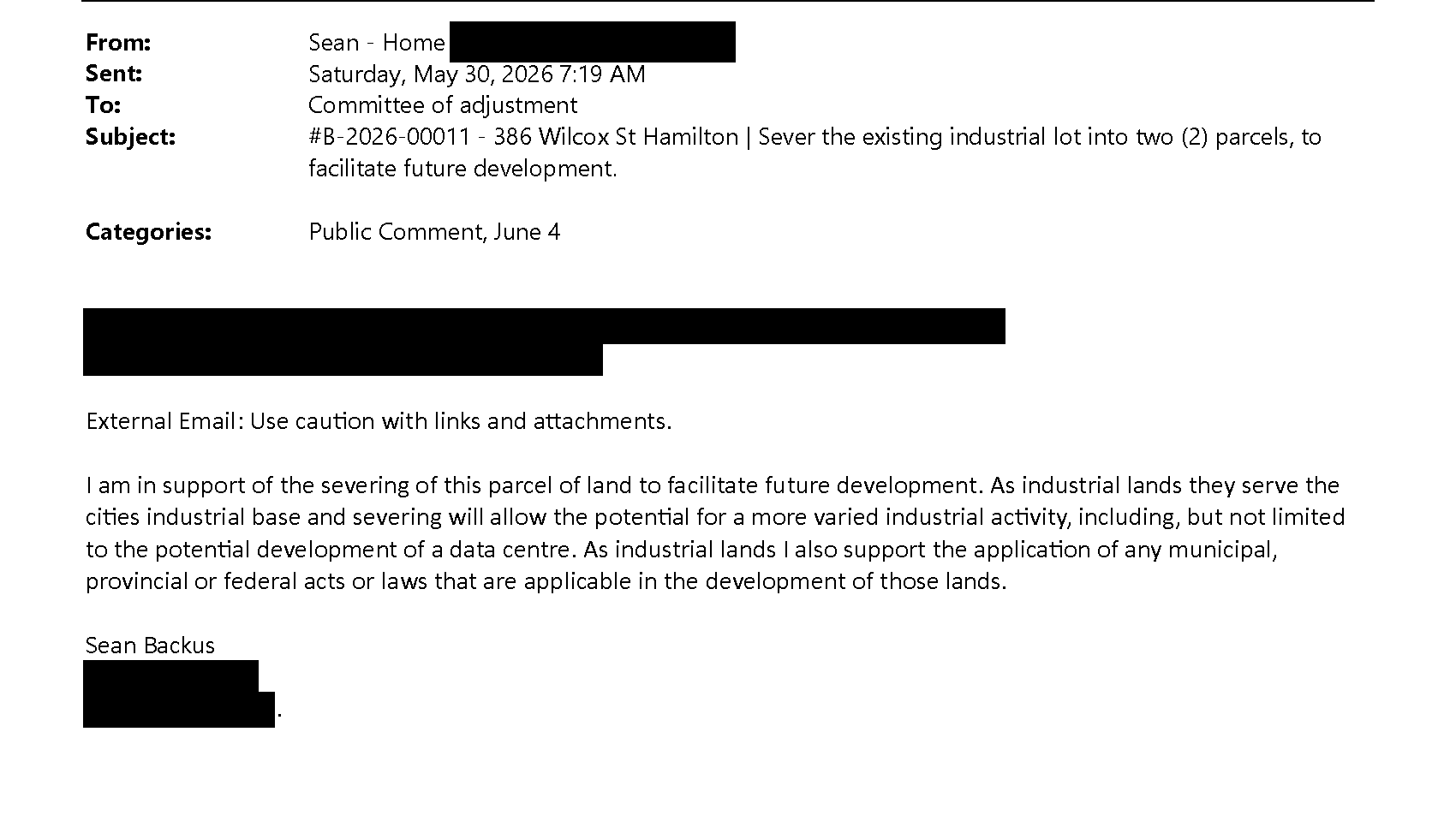
The Letter of Support
In a rushed review of the submissions, conducted due to the sheer volume submitted, this publication identified only one letter of support.
Resident Sean Backus encouraged the CofA to approve the severance, arguing that “severing will allow the potential for a more varied industrial activity.”
CLICK TO VIEW THE FULL LETTER Credit: HANDOUT / City of Hamilton
The Professor’s Concerns
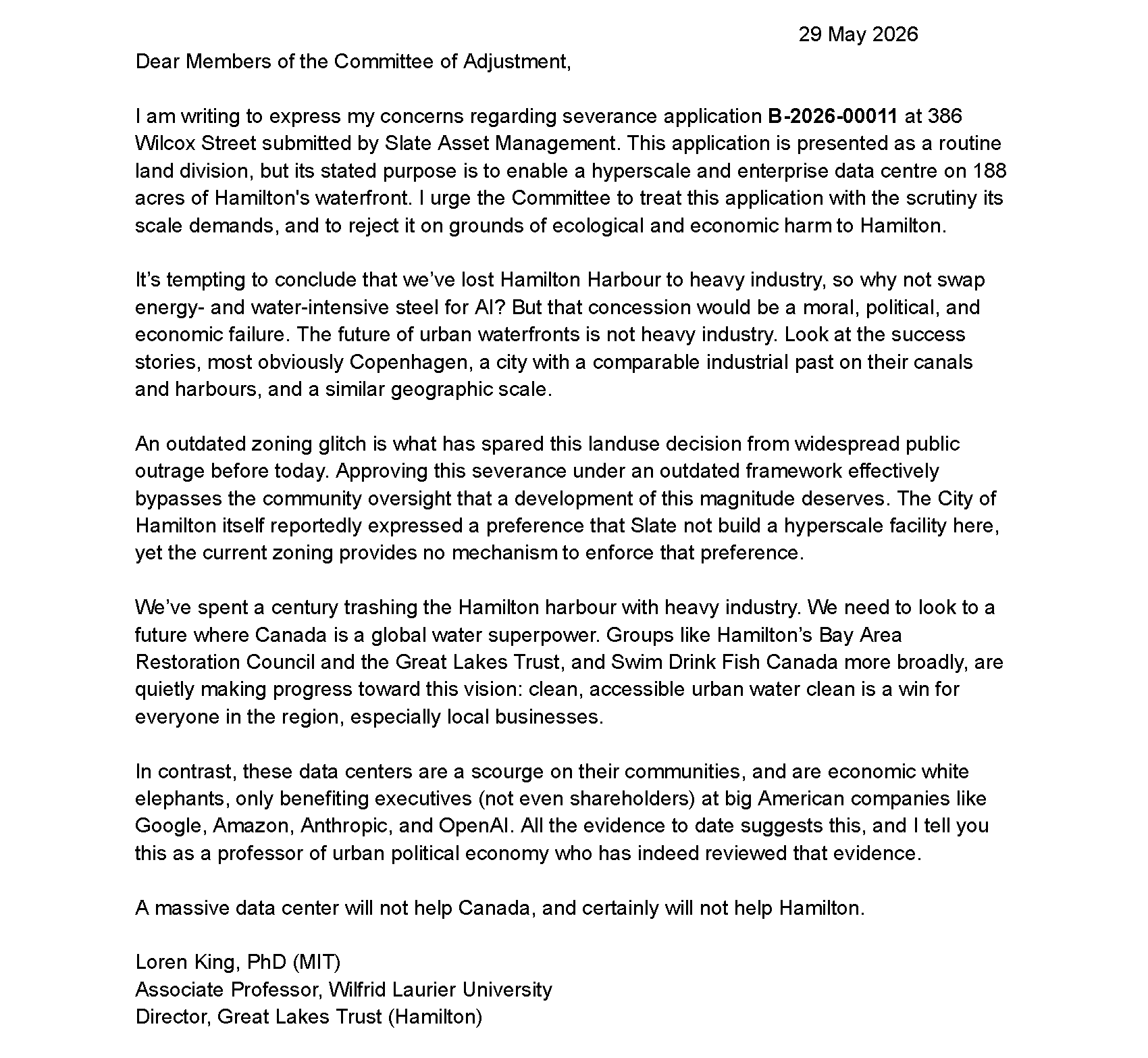
Dr. Loren King, an associate professor of urban political economy at Wilfrid Laurier University and director of the Great Lakes Trust, submitted a letter opposing the application. King argued that processing the severance under an outdated planning framework bypasses necessary community oversight for a project of this scale.
In his submission, King characterizes hyperscale data centres as “economic white elephants” that fail to benefit local economies or generate significant employment.
CLICK TO VIEW THE FULL LETTER Credit: HANDOUT / City of Hamilton
The Data Centre Administrator’s Submission
CLICK TO VIEW THE PAGE Credit: HANDOUT / City of Hamilton
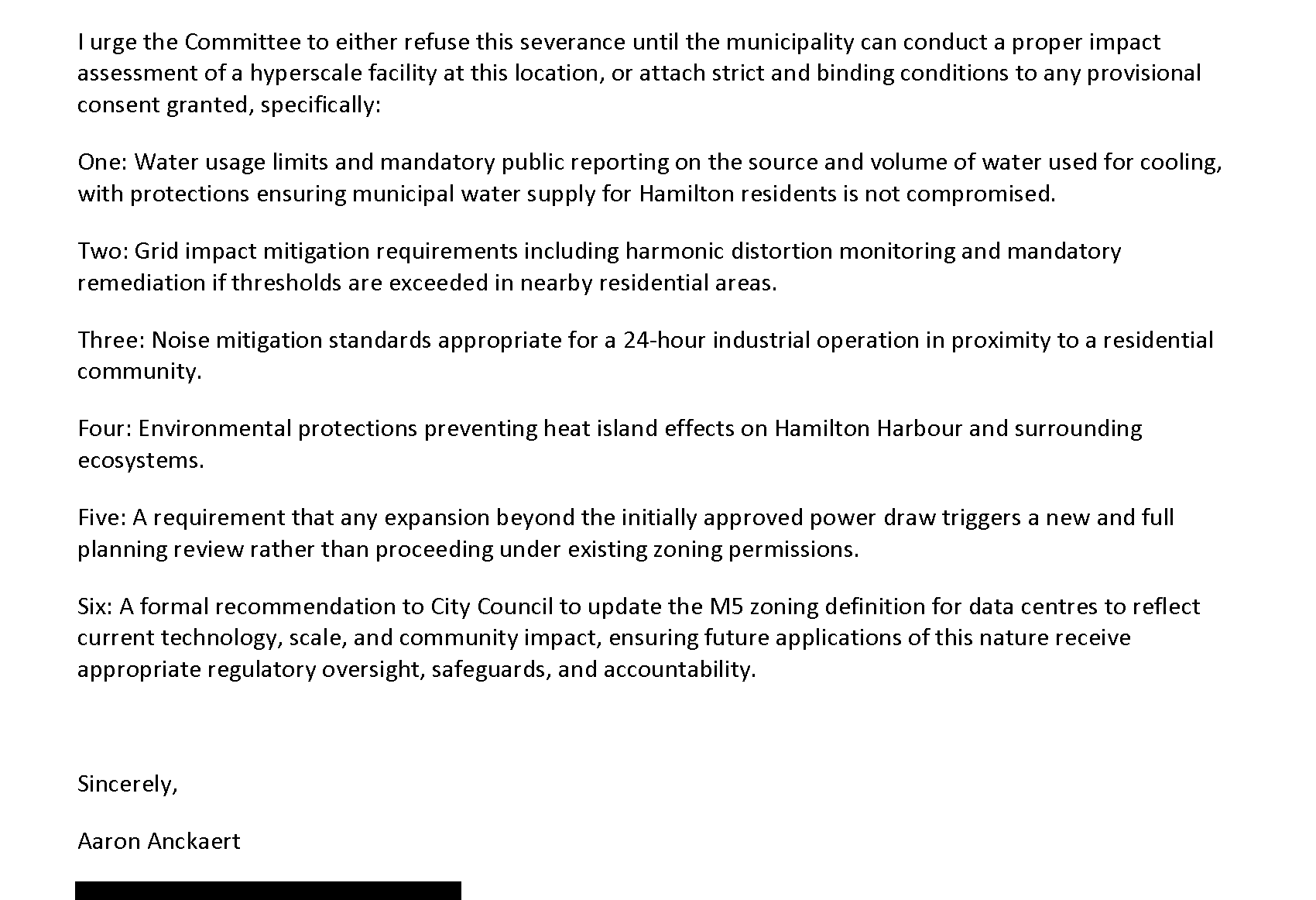
CLICK HERE TO VIEW THE PAGE Credit: HANDOUT / City of Hamilton
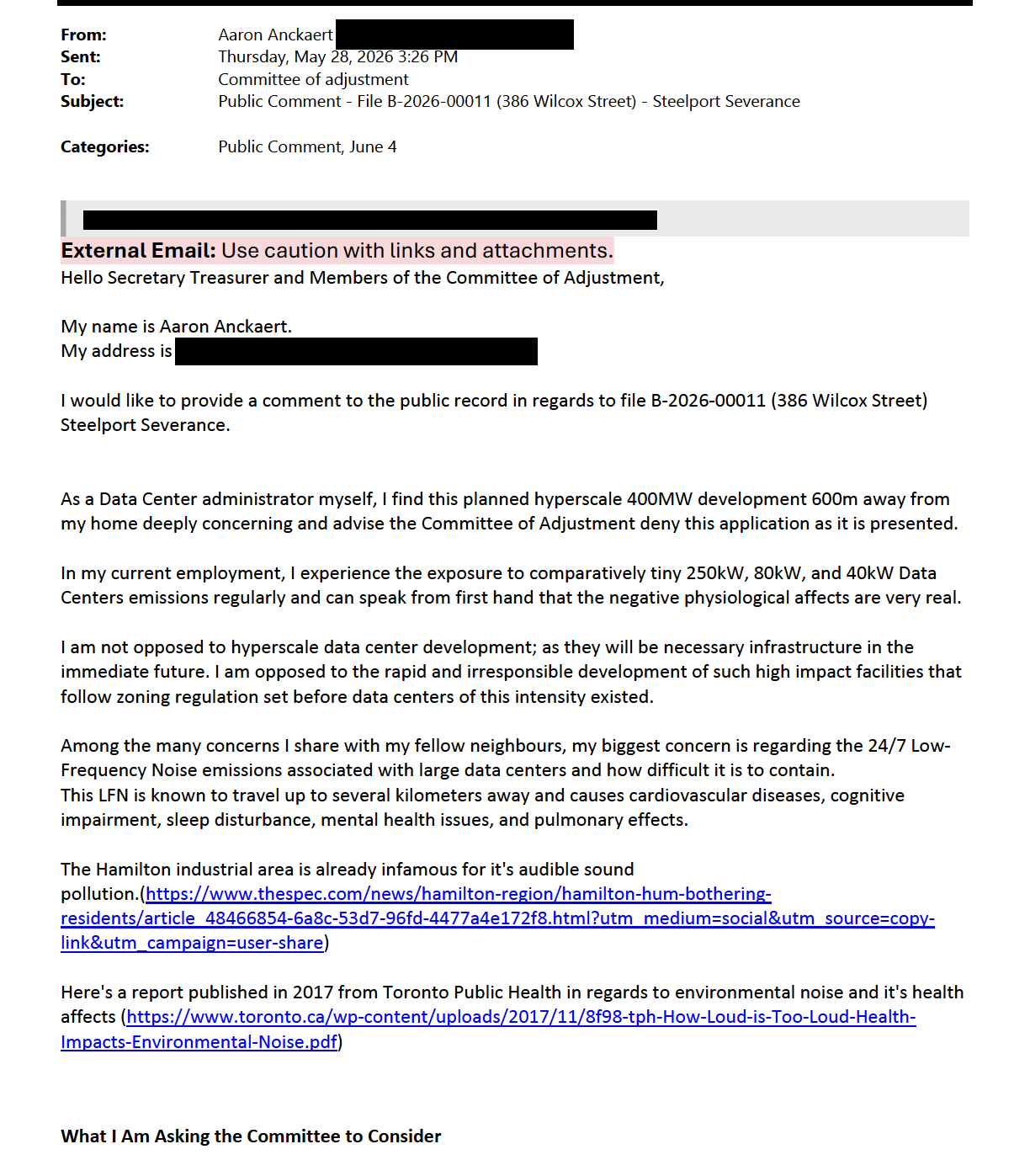
Ward 3 resident Aaron Anckaert, who works as a data centre administrator, submitted comments to the CofA expressing concerns regarding potential physiological impacts of a full buildout of data centre operations.
According to his submission, his work requires him to regularly enter “comparatively tiny 250kW, 80kW, and 40 kW data centres,” and he “can speak from first hand that the negative physiological affects are very real.”
Anckaert stated that he is “not opposed to hyperscale data centre deployment” but opposes the proposal until zoning regulations are reviewed.
Anckaert’s submission then follows the structure of the template letter used by the majority of respondents.
The Opposition Template
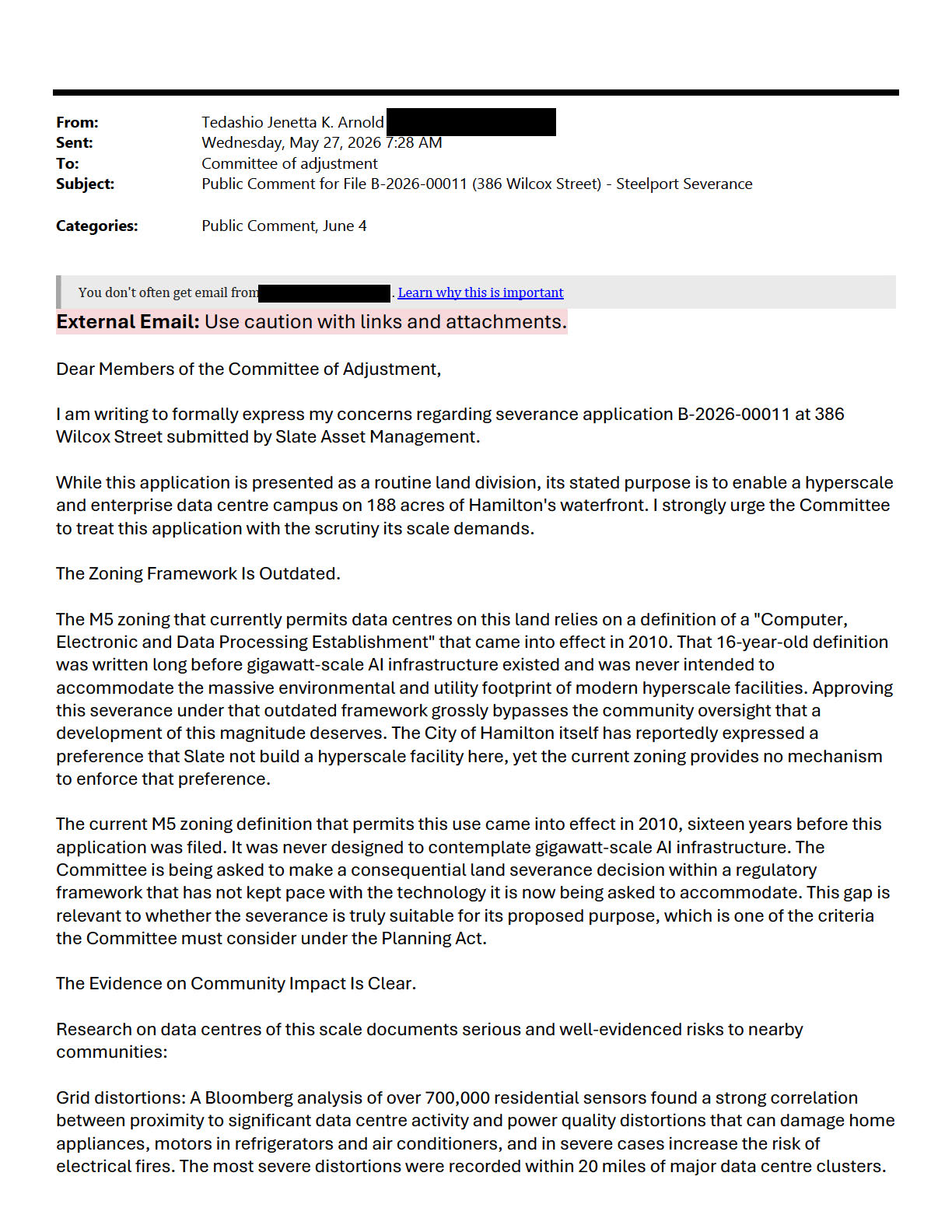
CLICK TO READ THE PAGE Credit: HANDOUT / City of Hamilton
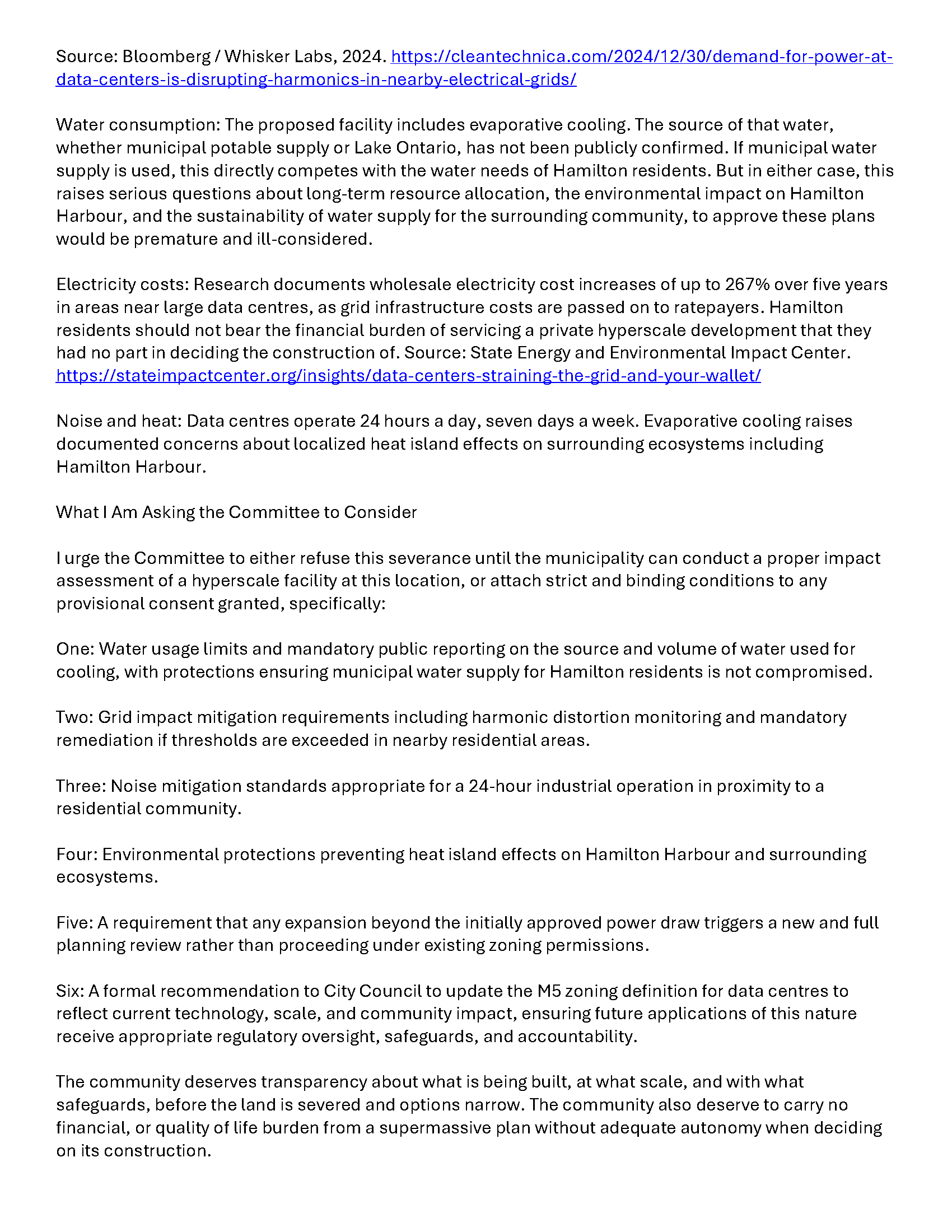
Over 1,000 residents submitted identical form letters to the CofA.
The template argues there is a regulatory gap in Hamilton’s current M5 zoning, which relies on an outdated 2010 definition of a “Computer, Electronic and Data Processing Establishment.” The authors contend that this sixteen-year-old framework was never intended to regulate modern, gigawatt-scale artificial intelligence infrastructure or its intense environmental and utility demands.
The template lists concerns based on events that have occurred in poorly regulated jurisdictions in the United States. These include power grid harmonic distortions that can damage household appliances and increase electrical fire hazards, sharp increases in wholesale electricity costs, localized heat island effects, and water pollution impacts.
The submissions urge the CofA to refuse the severances until new regulatory frameworks are created. Alternatively, they request that the CofA impose conditions on future development.
Production Details
v. 1.0.0
Published: June 3, 2026
Last updated: June 3, 2026
Author: Joey Coleman
Update Record
v. 1.0.0 original version
Discussion
0 commentsComments are closed on this story.