
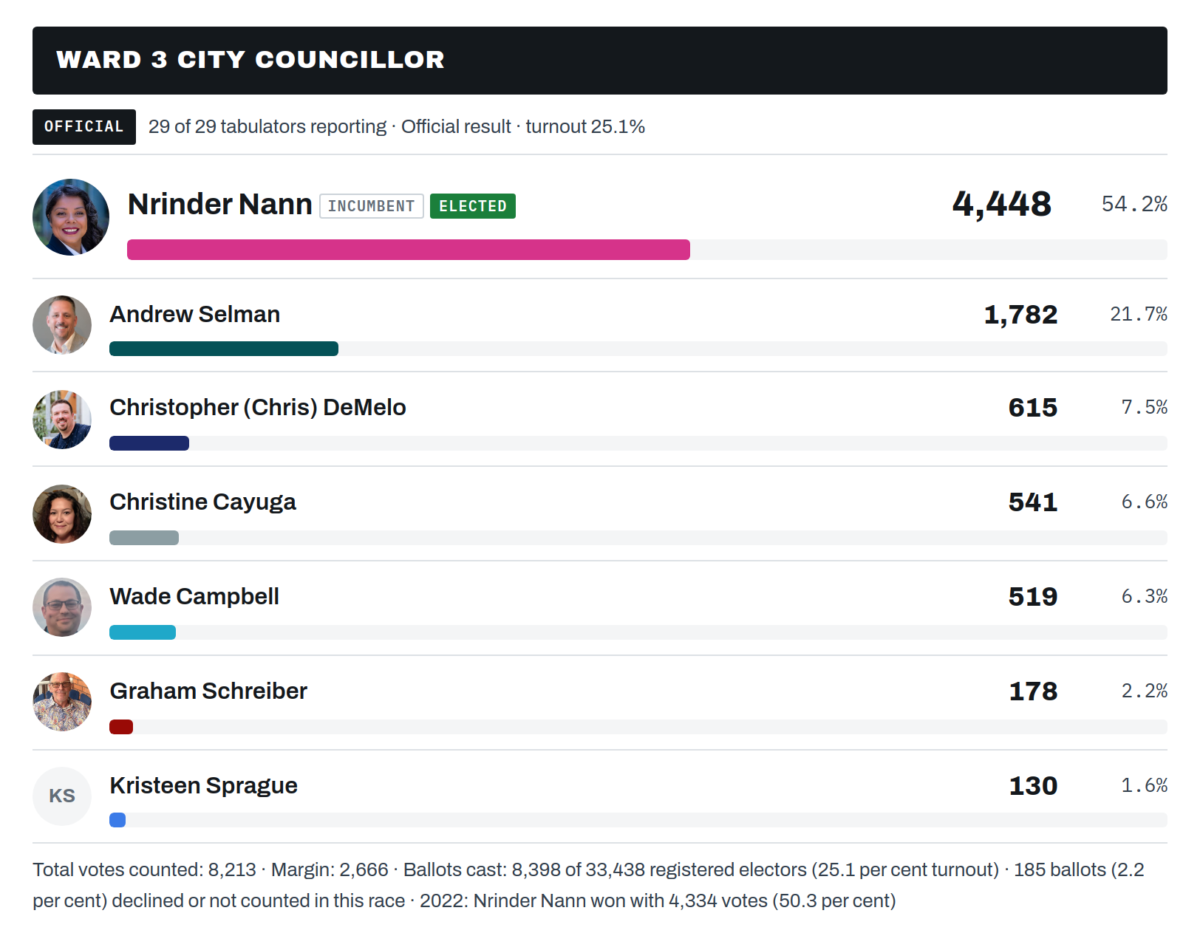
Ward 3 Councillor Nrinder Nann won re-election with 54.2 per cent of the vote, finishing 32.5 percentage points ahead of challenger Andrew Selman after focusing her campaign on opposition to data centres and AI more broadly.
Nann secured 4,448 votes this election, up from 4,334 in 2022. Selman’s 1,782 votes put him a distant second in the race with 21.7 per cent. Nann convincingly won all regular advance and election-day polling stations to secure a third term on Hamilton City Council.
Nann entered the year facing criticism over the delay in building Brightside Park near the stadium, the lack of enforcement towards unsafe vacant buildings in the ward, her past support of the encampment protocol, and citywide frustration with property tax increases. Punditry suggested she was one of the most vulnerable incumbents on Council.
When nominations opened on May 1st, Selman was at the front of the line. Following years of social media posts, countless delegations to Council, and direct action on vacant buildings, Selman appeared to be the challenger would might defeat Nann.
Nann recognized her electoral vulnerability. Around the halfway point of the 2022 to 2026 term, she pivoted. She went from a proponent of Hamilton’s encampment protocol – which permitted encampments in some parks – to voting against the protocol in early 2025. Enforcement of property standards against derelict buildings became a newfound priority.
By the middle of 2026, Nann began to vocally oppose social service agency moves and expansion, even putting up opposition to a proposal for 15 supportive housing units operated by Canadian Mental Health Association at 700 Main Street East.
Then came the moment, the issue that changed everything. It was on Tuesday, May 19, 2026 inside Council Chambers at Hamilton City Hall. The Committee of Adjustment was set to hear a minor variance application to permit the Salvation Army to relocate its men’s emergency shelter from Downtown Hamilton to 337 Gage Avenue North.
Nann was seated in the public gallery, alongside residents opposed to the move. As they waited together for the Salvation Army hearing, Registered Professional Planner Gerry Tchisler stood at the podium to address the Committee of Adjustment regarding an administratively routine land severance for the Steelport lands. Tchisler requested a deferral of the item for two weeks to allow him, as agent for Slate Asset Management, to finalize severance conditions with City staff.
There was no opposition present, and nobody else spoke to the issue. The Committee of Adjustment approved the deferral.
A resident in the gallery then asked Nann about the Steelport matter. She said the severance was part of a planned data center on the former Stelco lands. The resident responded they were opposed to the Steelport plan. Nann told the resident she would help them organize against the land severance.
During the two weeks that followed, over 1,200 letters of opposition were sent to City Hall, and on June 4, hundreds of people packed into City Hall in the largest mobilization ever for a Committee of Adjustment matter. The CofA denied the Steelport land severance.
Nann had an issue – something to run against – and as an added bonus for her broader political ambitions, she became the first municipal councillor in Canada to move an interim control bylaw motion (ICB) to block AI data centres.
Nann’s ICB motion was defeated at Council, but it was a winner for her politically.
Data Centres Were the Focus, But Campaign Organization Wins Elections
AI became the issue of debate, but campaigns are ultimately about organization. Winning candidates need to canvass their wards effectively and repeatedly. Effective canvassing needs groups of five or more volunteers to go out with the candidate.
Nann canvassed with larger groups of volunteers, and this gave her a decisive advantage. . Selman’s campaign team was too small to defeat an incumbent.
Leading up to the election, Selman posted a lot on social media. He frequently delegated at Council committee meetings. He showed up at events. But ultimately, that wasn’t enough. Elections are won in real life, not on social media.
There are some parallels to other past first-time candidates who built up their online profile, but under-performed the expectations that came with that.
Following the election, Selman posted to his social media accounts that he plans to remain active in the community. Returning challengers tend to fare better in Hamilton’s municipal elections than first-time candidates. Jeff Beattie, Cameron Kroetsch, and Judi Partridge all became councillors on their second attempt.
During the coming four years, Nann will have the opportunity to shore up her position in the community. Brightside Park should get built during the upcoming Council term, Barton Street is finally being repaved, and enforcement against vacant buildings continues.
Ward 3 had the lowest voter turnout in Hamilton, with only 25.1 per cent of registered voters casting a ballot.
No matter who runs in 2030, there is already an obvious pathway to victory – figuring out how to reach and mobilize the 75 per cent of Ward 3 electors who didn’t vote.
Production Details
v. 1.0.0
Published: November 13, 2026
Last updated: November 13, 2026
Author: Joey Coleman
Update Record
v. 1.0.0 original version
Discussion
0 commentsNo comments yet. Be the first to add your perspective.