
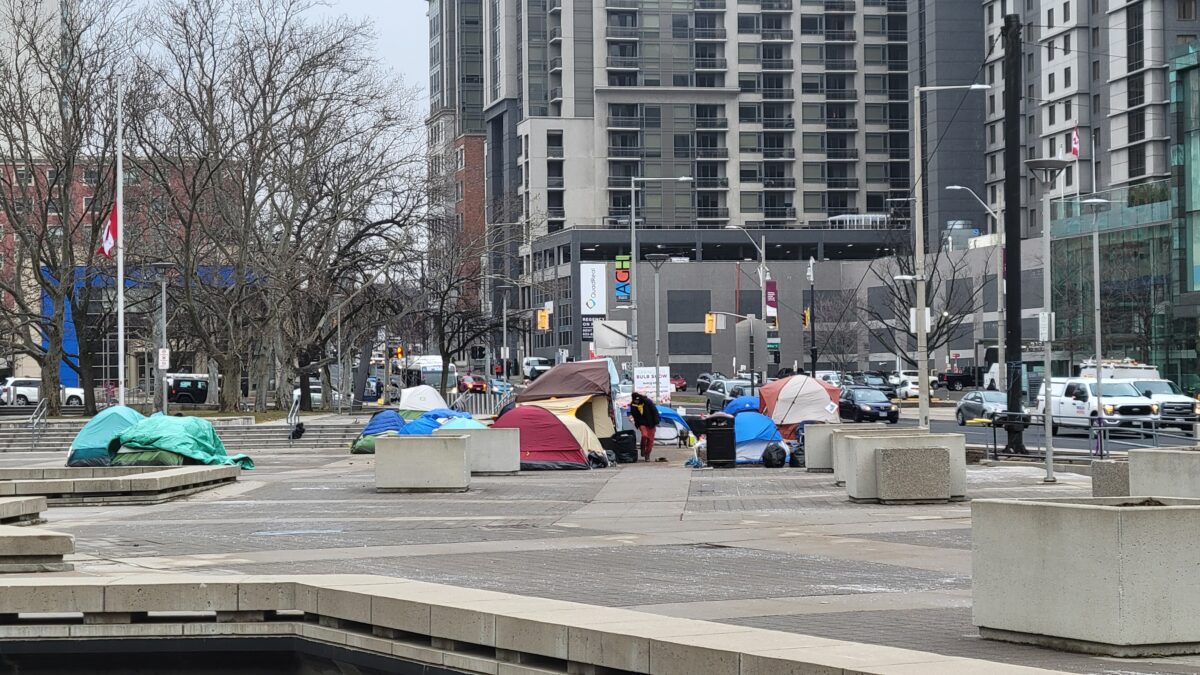
The Court of Appeal for Ontario has set aside the December 2024 ruling that dismissed a Charter challenge to Hamilton’s encampment by-law and ordered the case reheard by a different Superior Court judge.
In the December 2024 decision, Superior Court Justice James A. Ramsay found that none of the 14 appellants was evicted from a park at night. That finding was fundamental to his conclusion that the City of Hamilton did not breach Section 7 of the Charter of Rights and Freedoms. The Court of Appeal said he reached it without analyzing the evidence and by relying on “myths and stereotypes” about mental illness and addiction.
Writing for a unanimous panel of three Court of Appeal justices, Justice Lise G. Favreau writes that Justice Ramsay “made a series of errors” in his December 2024 decision, and “given the errors made by the application judge, it would be inappropriate for this court to decide the issues … or to provide general guidance beyond the issues that arise in this case.”
Justice Favreau writes that Justice Ramsay’s decision “lacked the depth of analysis that is required when dealing with issues of this significance” and that “for the most part” he “only addressed the key factual and legal issues in brief conclusory paragraphs with little or no analysis.” Justice Ramsay’s reasons ran 14 pages against a 10,000-page record.
Justice Favreau writes that the matter must “unfortunately” be sent “back to the Superior Court to be decided afresh,” because it would not be appropriate for the Court of Appeal “to make the findings of fact and conduct the necessary analysis as though it were the court of first instance.”
The litigation began in July 2020, when encampment residents sought an injunction to stop the City from dismantling encampments during the COVID-19 pandemic. At the time, unhoused individuals set up temporary outdoor shelter and encampments to avoid contracting COVID, which was spreading within Hamilton’s indoor emergency shelters.
Justice Favreau stressed she was “by no means suggesting that the appellants should succeed on their s. 7 challenge.”

Appeal Court Says Justice Ramsay Relied on “Myths and Stereotypes” about Mental Illness and Addiction
The Court of Appeal criticized how Justice Ramsay assessed the appellants’ affidavit and cross-examination evidence because he failed to conduct an “individualized assessment of the appellants’ credibility and reliability.”
Instead Justice Ramsay’s “central rationale” was that all but one of the appellants “lived with mental health conditions and addiction issues which he said can affect perception and memory.”
“It was improper for the application judge to draw broad conclusions about the credibility and reliability of the appellants’ evidence, collectively, simply by asserting that mental illness and addiction can affect perception and memory,” writes Justice Favreau.
Justice Ramsay’s “apparent blanket assumption that the appellants’ evidence was unreliable because of those considerations perpetuates myths and stereotypes about some of the most vulnerable people in our society.”
Appeal Court Declines to Set Framework for Encampment Cases
Justice Favreau writes the Court of Appeal has not yet ruled on whether Ontario courts should follow the British Columbia Court of Appeal’s 2009 Victoria (City) v. Adams encampments decision, which recent Ontario Superior Court decisions have generally followed.
“[T]here may well be a need for some guidance from this court, including on the issue of whether Adams should be followed in this province,” writes Justice Favreau. “But guidance is difficult to provide in the abstract. In the absence of sound factual findings by the application judge and given the brevity of his analysis, it would be premature to endorse or prescribe a specific analytical framework.”
Justice Favreau continues, “[n]o doubt, as cases dealing with these issues reach this court, the court will provide general guidance on the protection that s. 7 of the Charter may offer, including limits on such protection, in these types of circumstances.”
Ontario’s Court of Appeal will be considering an as-of-right appeal filed by the Region of Waterloo and the Province of Ontario regarding the recent Waterloo Region encampment decision, The Regional Municipality of Waterloo v. Named Respondents and Persons Unknown, 2026 ONSC 2971.
Encampment By-law Remains in Force as Case Returns to Superior Court
According to a footnote in the decision, counsel told the court that the by-law’s prohibition on camping in a park without a permit is again in effect.
Today’s Court of Appeal decision contains no order about enforcement of the by-law, and does not address the 2023 encampment protocol, which was rescinded by City Council on March 6, 2025.
Nothing in the decision prevents the appellants from seeking an injunction against enforcement pending the rehearing. A previous injunction motion on the by-law was dismissed in November 2021 in Poff v. City of Hamilton, 2021 ONSC 7224.
The Court of Appeal did note that “the conduct the [encampment litigants] have sought to challenge seems to be a moving target.” and it is unclear whether they are attacking the by-law, the City’s 2021 encampment process or the evictions themselves, adding that before the rehearing, the appellants “must be clear about what they seek to challenge.”
Hamilton’s civic trial coordinators will need to review court schedules, and the Regional Senior Justice will need to assign a new judge to the matter.
Production Details
v. 2.0.0
Published: October 9, 2026
Last updated: October 9, 2026
Author: Joey Coleman
Update Record
v. 1.0.0 original version (12:09 p.m.)
v. 1.1.0 added two paragraphs with more quotations from ONCA ruling regarding why matter is being remitted. (12:20 p.m.)
v. 2.0.0 extensive analysis and full summary of the decision. (2:30 p.m.)
Discussion
0 commentsNo comments yet. Be the first to add your perspective.