
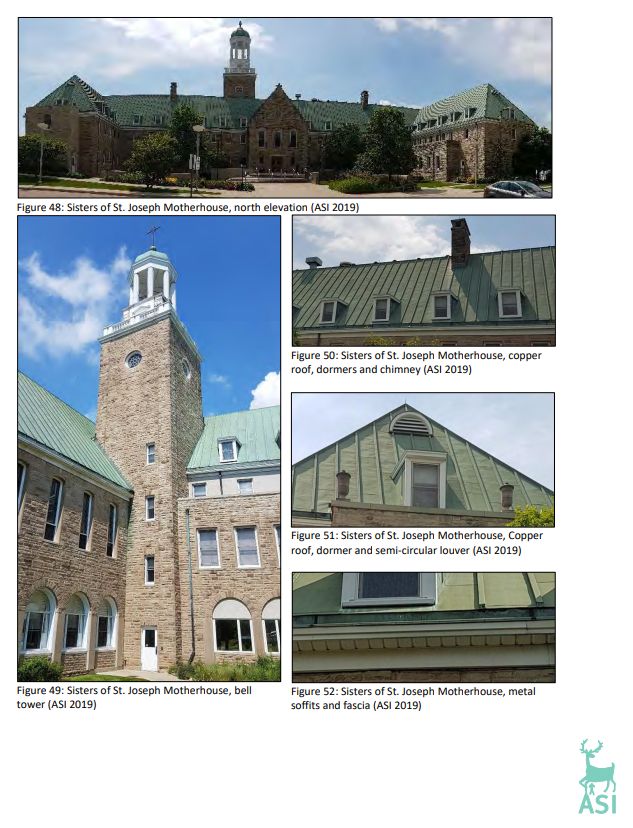
A five-day Ontario Land Tribunal hearing was held during the first week of June to determine whether Columbia International College’s proposal to convert the former Sisters of St. Joseph convent into a 1,000-student private high school constitutes an “urban use” under the Niagara Escarpment Plan.
In the hearing, the OLT is acting as the hearing office under the Niagara Escarpment Planning and Development Act, and provides a recommendation to the Niagara Escarpment Commission (NEC) regarding whether the proposal constitutes an “urban use” for the purposes of the Niagara Escarpment Plan (NEP).
If the OLT determines it is an urban use, and the NEC accepts the recommendation, Columbia’s application will have to wait for the next comprehensive review of the NEP. New urban uses can only be approved during comprehensive reviews of the NEP, which occur once every decade. The next review is scheduled for 2027.
If the OLT determines the school is not an urban use, and is a use that fits within the NEP, the Tribunal then needs to make a recommendation regarding whether the proposed private school represents “good land use planning and is in the public interest.”
Columbia International College’s campus is the former motherhouse of the Sisters of St. Joseph at 574 Northcliffe Avenue in Dundas, overlooking Highway 403 south of Highway 6. Built between 1949 and 1951, the 8,712-square-metre, four-storey stone structure, constructed in the French Chateau style, was originally built to house 100 nuns in a dormitory style of living.
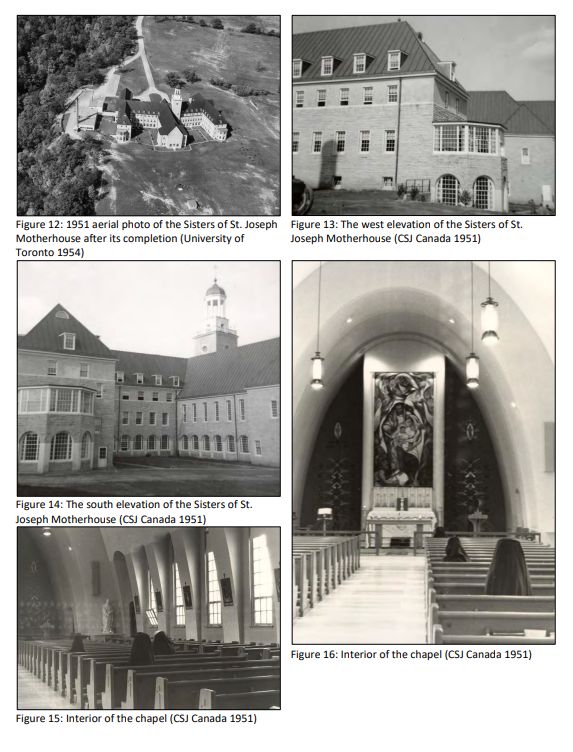
Eventually, the number of nuns living in the facility decreased. By 2019, 12 remained. The Sisters sold the campus to Columbia College for approximately $15-million, funds they put into ongoing charitable works.
More than a half-decade later, on Monday, June 1, 2026, the Tribunal began its five-day hearing into the future of the campus.
The Pleasant View Protection Corporation (PVPC), an incorporated neighbourhood group, is opposing the project. They are a Party in the hearing. The City of Hamilton is also a Party; however, City Council has officially taken a position of neutrality on the project.
The first day of the scheduled five-day hearing began with a lengthy discussion of procedural matters.
OLT Member Daniel Best dealt with numerous procedural issues, many of them involving efforts by PVPC representative Nancy McKeil to add documents and recordings into hearing evidence. McKeil is not a lawyer, and the PVPC has elected not to retain a registered professional planner to provide evidence.
McKeil sought to enter a recording of a Niagara Escarpment Commission meeting at which submissions were being made regarding the proposal. Specifically, she sought to enter the submissions of Columbia College’s legal counsel at the NEC hearing. This was denied, as lawyers’ oral arguments are not evidence but arguments, and case law prohibits their use in this manner.
McKeil also sought to enter City of Hamilton budget documents into the record. This was denied on procedural grounds.
OLT Member Best balanced the procedural requirements of the Tribunal and flexibility of process to support McKeil as a self-represented party.
Scott Snider, lawyer for Columbia College, reminded the OLT that the PVPC has lost both its judicial review application and a subsequent motion for leave to appeal to the Court of Appeal for Ontario. The PVPC has been ordered to pay $17,000 in legal costs by the Divisional Court, and an additional $10,000 by the Court of Appeal. The PVPC has not paid those costs, an issue that was noted during the hearing. The OLT does not have jurisdiction to review this area of dispute.
The PVPC’s legal actions delayed this hearing by approximately two years.
Following 90 minutes of procedural matters, Snider began his case for approval with opening statements. Snider noted that the proposed use is only for a day school, that there will be no overnight accommodation, and that Columbia College is taking full responsibility for the maintenance of the historic structures on the property.
Columbia College will maintain present levels of public access to the property, and is prepared to meet City conditions and requests for maintaining the buildings.
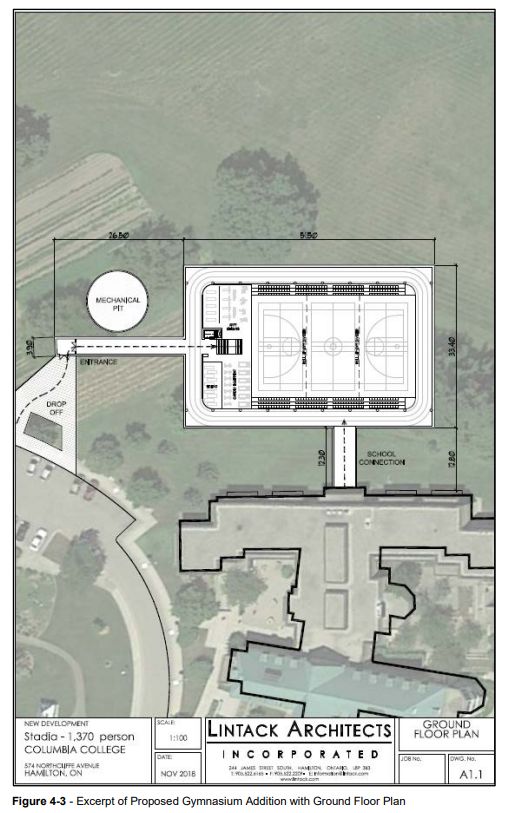
To facilitate the day high school use, Columbia is planning to build a 1,370-person-capacity gymnasium building. Community opposition has focused on this proposal to argue the entire project is an urban use.
City of Hamilton lawyer Melanie Benedict focused the City’s early arguments on traffic impacts. The City submitted that any increase in neighbourhood traffic would be unacceptable.
Columbia College has submitted traffic studies stating that the high school use will generate approximately 120 new vehicle trips during each of the AM and PM peak periods when the school day begins and ends.
All students will arrive on school buses, with the approximately 80 staff and faculty expected to arrive in their own vehicles.
The transportation study does not include any estimates for gymnasium traffic, instead stating “It is assumed that the gymnasium will be for school related uses only, therefore this facility is not expected to contribute to any additional trips in/out of the subject site during the study area’s weekday road traffic peak hours.”
Both PVPC and the City disagreed with this approach, arguing a school is not an appropriate use for the site. Neither party advanced proposals for feasible alternative uses of the property.
Snider noted that the building needs a use, that the grounds are expensive to maintain, and that any economically viable alternative would generate even more traffic.
The OLT wrapped up the five-day hearing on June 5. A decision is pending. This publication will continue to monitor both the OLT and NEC for updates.
OLT Details:
Case Number: OLT-23-000388
Production Details
v. 1.0.0
Published: June 13, 2026
Last updated: June 13, 2026
Author: Joey Coleman
Update Record
v. 1.0.0 original version
EDITORS NOTE: Publication of this story was delayed due to the need for this publication to cover the June 4 Committee of Adjustment hearing regarding the Steelport land severance.