
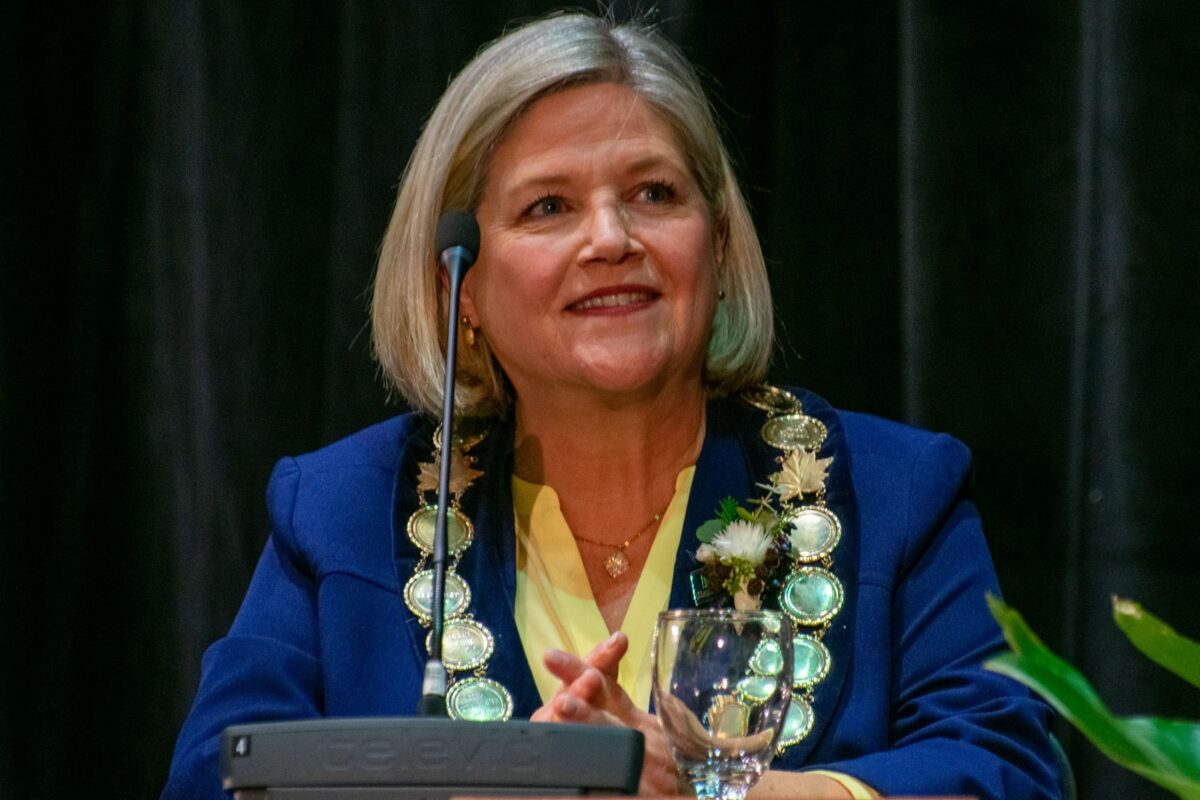
Mayor Andrea Horwath issued the following statement at 2:05 p.m.:
HAMILTON, ON- Today, Mayor Andrea Horwath issued the following statement.
There is no doubt that the Greenbelt should be protected as a vital element of our environmental and agricultural resources. Today’s Auditor General report supports the City of Hamilton’s position that the proposed development of the Greenbelt is an unnecessary, ineffective, and misguided measure that will not contribute to meeting Hamilton’s housing needs.
I am calling on the Province of Ontario to abandon its plan to develop the Greenbelt and will be working with my Council colleagues and City staff to review the report and its implications for our continued advocacy against this provincial approach.
The City of Hamilton provided insights and information to Auditor General Bonnie Lysyk in the course of her investigation, and her findings notably reference the following in regard to Hamilton parcels of the Greenbelt:
- “Greenbelt land was not needed to meet the current housing targets assigned to them by the Housing Ministry.”
- “Land sites removed from the Greenbelt in December 2022 were largely not serviced, were not in their servicing plans, and that many of the land sites would be challenging to prioritize and service in the near future, with some taking potentially 10 or more years to accomplish.”
- “Some of these sites would require considerable infrastructure to prepare them for housing development. In addition, the City of Hamilton noted that one of the sites—Book Road (Site #4), which accounted for nearly 25% of all land removed from the Greenbelt in 2022—is located in an area partially restricted from residential development because of its proximity to the Hamilton International Airport.”
I commend AG Lysyk for her work and extend my thanks to all Hamilton residents and elected officials who spoke out against the removal of Greenbelt lands.
We will continue our efforts to address Hamilton’s urgent housing needs while prioritizing intensification, affordability and our commitments to conservation, Reconciliation, and slowing the impacts of our climate crisis
Discussion
3 commentsIf new housing development is focused on densification within existing city boundaries, particularly the lower wards, this results in increased land values. How does this create affordable housing in the lower income wards? It certainly isn’t affordable to the residents of the lower city and it is doubtful anyone from the mountain will downsize from the 2,000 l+ sq ft home on the escarpment to a 400 sq ft condo in the lower city. Densification will also result in higher property taxes for the lower wards which are already paying a higher percentage of their household incomes towards operating this city.
Hi Paul,
Affordable housing must be built (or significantly funded) by the government.
The problem facing land values is speculation. With one-off zoning decisions, land values are unpredictable and based upon what someone speculates can be built.
Whereas, if we legalized walk-up apartments (three storey six-unit) across the lower city, the value of land becomes known. We also enable smaller contractors and homeowners to build multi-unit.
Multi-unit is very tax efficient, improving the efficiency of our city will help to manage municipal costs and decrease tax increases for existing rateholders.
Hi Joey:
I just saw your comments and apologize for not responding earlier.
I agree ‘affordable housing must be built (or significantly funded) by the government’. However Freeland just announced $20B Canada Mortgage Bond issue to fund the construction of 30,000 purpose built apartments. Back of the napkin calculations indicate a cost per unit of $667K. Even if these units are amortized over 40 years at 0% interest the rents would need to be $1,400 just to cover the financing cost. It is highly unlikely the mortgages in these units will be discounted to 0% so financing costs will be higher. Then there is property taxes (currently running at 20% of rents) heating, hydro, water and maintenance. Another 20% would be a conservative estimate. So rents end up at best $2,400 or so. This isn’t affordable. If no more than 30% of gross income going to rent is considered affordable a tenant household would need an income of about$96K per annum. The median household income in 2020 in Hamilton according to Stats Can was $86K. The indicates more than half the household in Hamilton could not afford one of these apartments. And so it appears no amount of supply can create affordable housing in Canada. Time to shift the conversation from supply and demand to real change.
I also agree there is a problem with land value and speculation. However, there doesn’t seem to be any concern over the flipping of properties along transit routes.
A policy to legalize walk up apartments across the lower city only increases land values and benefits speculators. Yet, again, this doesn’t appear to be a concern.
Given the higher land values I have serious doubts small contractors have the resources to build multi-unit buildings. I do agree though that there would be some. But the larger issue is all these towers that are radically changing the landscape both physical and cultural, of Hamilton.
You stated, ‘Multi-unit is very tax efficient, improving the efficiency of our city will help to manage municipal costs…’ this is a well known fact. However the beneficiaries of these efficiencies is not the tenants living in the lower wards. As you stated, it ‘decrease[s] tax increases for existing rateholders.’
How is this equitable for tenants in the lower wards who are paying a significantly higher property tax rate which results in a significantly higher portion of their household incomes going to the operation of the city?
Personally, I would like to see you interview councillors in the lower wards (I suspect that also includes our Mayor who wouldn’t be mayor if it wasn’t for the voters in the lower wards) and ask them what they intend to do about this inequity for current and future tenants in Hamilton.
Comments are closed on this story.