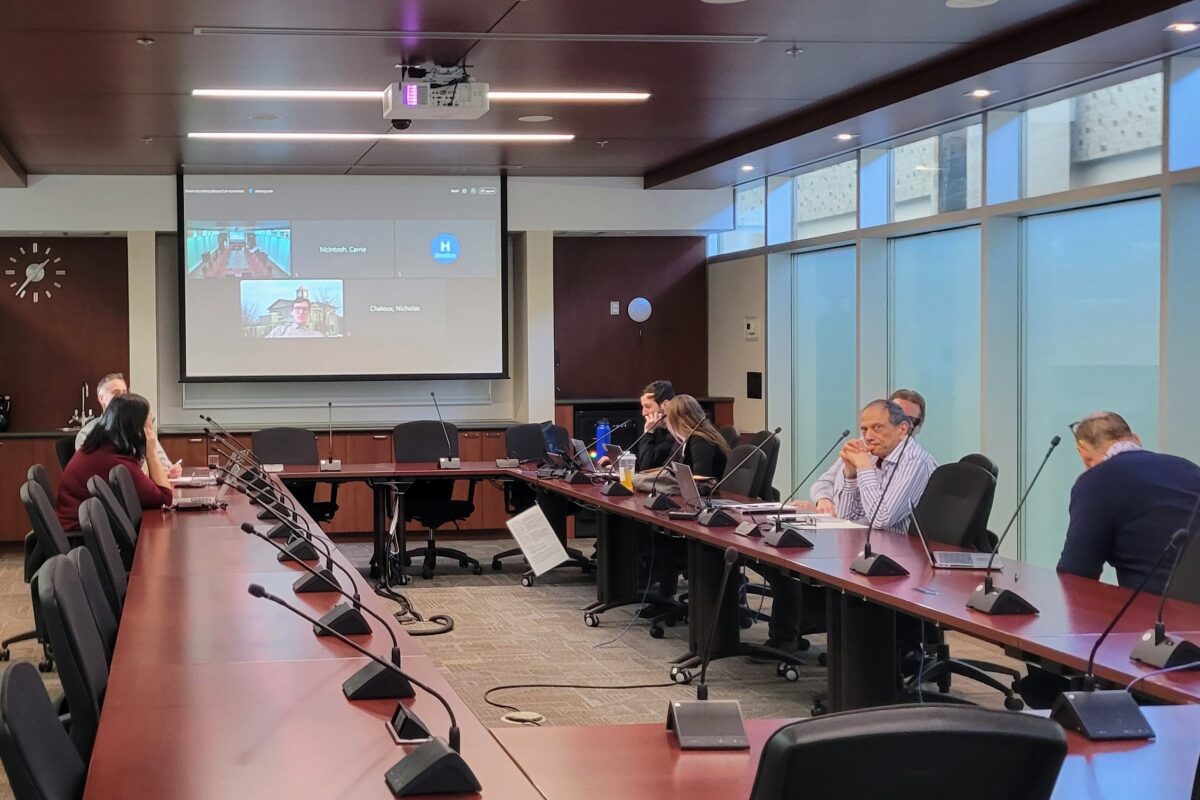
Not enough members of Hamilton City Council showed up today for the first meeting in nearly two years of the Transit Area-Rating Review Committee. Only two of the six council members showed up at City Hall: Ward 4 Councillor Tammy Hwang and Ward 12 Councillor Craig Cassar, with a third, Ward 13 Councillor Alex Wilson, logging into the meeting on a laptop from another location. Ward 9 Councillor Brad Clark, Ward 11 Councillor Mark Tadeson, and Ward 15 Councillor Ted McMeekin were absent.
The committee last met in April 2024.
Failure to make quorum is a new type of delay on an issue that, over years and successive Hamilton city council terms, has gone unaddressed: how Hamilton funds its municipal public transit system.
Area-Rating, a “temporary” taxation formula implemented in 2001 at the amalgamation of the six Wentworth County municipalities in the new City of Hamilton, was created to smooth the cost of expanding full urban municipal services into the former suburban municipalities. It was supposed to be phased out within four years. It was not.
In 2011, Area-Rating was eliminated for most municipal services. However, instead of lowering taxes in the former City of Hamilton wards, Council voted to divert Area-Rating savings into new councillor “Area-Rated” slush funds. In 2022, Area-Rating of recreation, sidewalks, and streetlighting began being phased out.
Twenty-five years later, in 2026, all of Hamilton’s core services are taxed based on whether a property is urban or rural, and whether it has full-time, composite, or volunteer fire response services. Public transit stands as the sole exception.
Today’s meeting was supposed to review a proposal to end transit Area-Rating and consider two options: a city-wide transit levy or an urban-only transit levy.
If councillors were to adopt changes, past decisions on Area-Rating have favoured charging only urban areas for urban services.
Hamilton’s transit tax levy is expected to grow from $96.7 million in 2025 to $183.3 million by 2033, an 89.4 per cent increase. Under the current Area-Rated system, old City of Hamilton property ratepayers bear approximately 77 per cent of the cost of transit operations.
An illustrative example of the difference can be seen in the homes on Neil Avenue on the Hamilton and Stoney Creek boundary. The owner of 100 Neil Street pays a Hamilton transit levy rate that is triple the rate of their neighbour at 98 Neil Street, who pays a Stoney Creek transit levy. Both receive the same transit service.
The political challenge is that equalizing the urban transit levy would lower the cost share for old City of Hamilton residents and increase the cost share in the urban areas of Ancaster, Dundas, Flamborough, Glanbrook, and Stoney Creek.
Using the 2025 transit tax levy, an average old Hamilton property would experience reductions in their tax bills of between $110 to $195, calculated using ward-level average property values, whereas urban properties in the former suburbs would pay $201 to $407 more.
No date for a rescheduled meeting has been announced.
The cancellation of today’s meeting will likely push this issue beyond the October municipal election.
Quorum Issues During the Past Year
This is the first meeting cancellation due to a lack of quorum in 2026. Numerous meetings were cancelled in 2025 due to poor attendence.
Production Details
v. 1.0.0
Published: March 2, 2026
Last updated: March 2, 2026
Author: Joey Coleman

Update Record
v. 1.0.0 original version
Discussion
1 commentI am really pissed off with these councillors who are on commitees and are no shows! Is this not part of their job? I am sure glad that there is going to be an election this year!
Comments are closed on this story.