
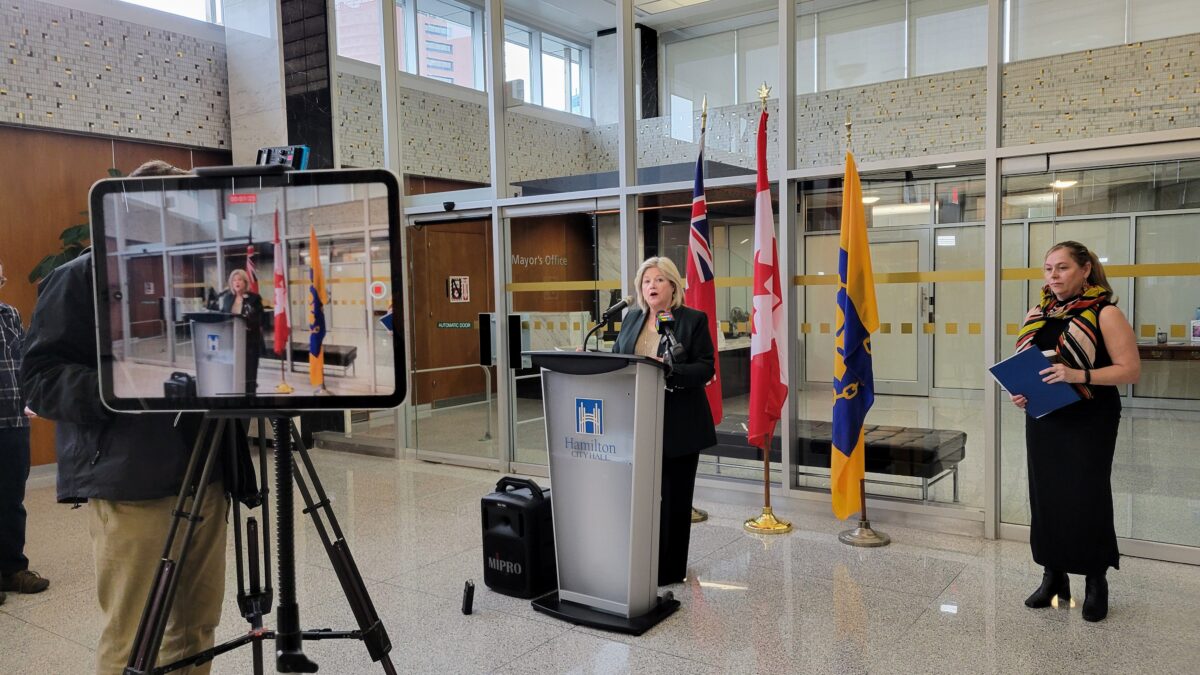
Hamilton Mayor Andrea Horwath held a press conference on Tuesday, January 22, 2026 to unveil her 2026 Mayor’s budget for the City of Hamilton.
The Mayor did not answer questions from TPR. Asked to share three changes resulting from the budget engagement process, she stated she did not wish to speak to specifics. Asked three cost-saving measures included in her budget, Mayor Horwath declined to answer.
Mayor Horwath cited the police budget as one of the primary pressures in the budget, adding, “I cannot change the police budget.” Horwath resigned from the Police Board, citing time constraints and a desire to focus her time on other matters. [The Mayor did not state what those other matters are.]
Asked about her police board resignation, and position on the police budget, the Mayor’s communications coordinator Amanda Kinnaird intervened and the Mayor refused to answer. [Mayor Horwath also cancelled her regular post-Council meeting on Wednesday.]
Full audio of the press conference can be listened to here:
FULL TRANSCRIPT
Opening Remarks
Amanda Kinnaird (City of Hamilton):
[00:00:00] Hey, everyone. Thanks for joining us. Once the mayor is finished speaking, we’ll do questions and answers. One question follow up, and then we’ll go back around and I’ll just point to everyone. Okay.
Mayor Andrea Horwath:
[00:00:11] Well, good afternoon, everyone, and thank you so much for being here. Hamilton is experiencing a period of strong momentum in our economy, in housing and in the confidence people have in our city. We’re attracting investment, supporting local small businesses, creating jobs, building homes. My commitment is to keep that momentum going even as we face some real challenges.
[00:00:36] Today, I’m releasing the City of Hamilton’s proposed 2026 budget. This budget reflects targeted adjustments to the staff proposal on December 12th [2025], and delivers on the commitment I made to Hamiltonians to deliver a hold the line budget, one that protects the services people rely on and continues responsible investments in our city’s infrastructure while keeping affordability top of mind. We’re living in very uncertain times. Uncertain, I think, is a mild word. Some folks would say chaotic. But what that means locally is we see what’s happening to families. Costs are rising, families are feeling the pressure, and communities everywhere, in fact, are having to make careful choices. That reality shaped this budget from the very beginning, Hamiltonians were very clear.
[00:01:36] They told us affordability is top of mind. They told us core services must be protected. They told us we need to keep investing in infrastructure but at a more realistic pace. And that safe neighborhoods and thriving communities matter to them. This proposed budget reflects what I heard. It sets an increase of 4.25 per cent and it focuses on the essentials that residents rely on every day fixing roads and potholes. renewing aging infrastructure, investing in transit, and supporting community safety.
[00:02:16] Hamilton is both an aging city and a growing city. That means we have to take care of what we already have while also preparing for the future. Supporting housing, economic development and growth in a responsible way. At the same time as families are stretching every dollar, the city must do the same. That means working smarter, finding efficiencies, reducing unnecessary costs, and making sure every tax dollar is invested where it has the greatest impact. This is the first year that I put a budget number forward based on what I heard from Hamiltonians. The proposed budget sets clear limits and provides council with a strong, disciplined starting point, one that balances affordability with the need to maintain services and prepare responsibly for the future.
Mayor Andrea Horwath:
[00:03:13] I also want to take a moment here to thank city staff. A tremendous amount of work went into this budget. Staff undertook a line by line review to identify efficiencies, manage spending and streamline operations, all while continuing to deliver essential services to our community. The budget is clear about the pressures we’re facing, inflation, growing service demands for a growing city, and significant infrastructure needs both from past and upcoming so residents understand where investments are needed and why. That’s why that information is important.
[00:03:54] Key priorities in this proposed budget include maintaining essential city services, investing in infrastructure renewal and state of good repair. Supporting transit and transportation improvements, strengthening community safety and emergency services, advancing housing and homelessness supports, modernizing city systems and supporting responsible growth and local employment. So what happens next? The budget now moves to the full Council. Council has thirty days to review the budget that I’m proposing today; hear from staff, propose their own amendments, and deliberate, and vote on those amendments.
[00:04:33] I look forward to the next step in this process, and continuing to work collaboratively with my Council colleagues to deliver a balanced, responsible budget that reflects residents priorities and the best interests of our entire city. Holding the Line doesn’t mean doing less. It means making disciplined, thoughtful choices, choices that meet the needs of today while continuing to fuel Hamilton’s momentum. Thank you, and I’m happy to take any questions you might have. Through Amanda, who’s moderating. Thanks, Amanda. Please go ahead.
Media Questions and Answers
CBC:
[00:05:06] Thank you. When you were here in the fall, you talked about improving the process of doing the budget, not just the outcomes, and you also talked about finding new income streams. Can you talk about what came of those process improvements and what are the new income streams?
Mayor Andrea Horwath:
[00:05:21] Thanks for the question, I appreciate it. Uh, so there’s a few pieces that we did in terms of changing the way we approach the budget. A big part of that was taking the budget out to the public for their feedback and engagement. And that was something that had never been done before in the city. And it was a good opportunity for not only myself, but particularly the Senior Leadership Team, the folks who are actually implementing, uh, the decisions that are made through the budget and providing the services to Hamiltonians to hear directly from Hamiltonians about their perspectives on how things are now and what they want to see in the future. So that was really quite important on the income, the revenue streams. We continue to do that work. It never stops.
[00:06:00] So it’s everything from what you’ll see in the budget, some of the potential changes in fees. Of course, these are some of the things that councillors have raised as well. And I think it’s important to acknowledge that one of the other things that I committed to doing in terms of the process was to listen to the feedback that councillors provided and build that in to this time around, which is exactly what I’ve done. So some of the suggestions that they had provided already, some of the work around, uh, you know, what they were concerned about in terms of identifying appropriately the process, how they make an impact, how they have their amendments brought forward, what they need to do to make sure that they have the opportunity to engage in the process with the way that it sits right now.
CBC:
[00:06:49] Can I ask a follow up? So you mentioned fees. Changes to fees are one of the income streams. Are there others that you can mention right now?
Mayor Andrea Horwath:
[00:06:57] Well, so there’s always the work that’s done with the financials in terms of, you know, where are our dollars sitting? Are we making sure that we’re getting the best return in terms of where some of our reserves sit? ET cetera. ET cetera. You’ll see some of that as well. You’ll also see that there was real thoughtfulness around the balance between the core services that people need and the affordability challenges that people are facing. And so that’s always a balancing point, especially now when things are quite difficult for folks. So it’s not just a matter of the number in terms of the proposed budget and holding the line on that, but it’s not building in too much, um, difficulty in terms of challenges for residents because they are they’re facing some tough times. And we’ve heard that loud and clear. I’ve heard that loud and clear.
TheSpec:
[00:07:52] From December. That’s a further 1.2 per cent. Where does that come from? And that, from my understanding, from working with staff, what other specific items that have been changed as a result?
Mayor Andrea Horwath:
[00:08:02] Sure. And respectfully, the budget is going to be released after this press conference or media availability occurs. And so I’m going to give the councilors the opportunity to respectfully have a look at it before I start kind of talking about it more publicly. So I’m happy to have those conversations a little later. But I really think that the council deserves a chance to have a look at the details that took us from where we were to where we are today. And I can tell you that, as I said earlier, it was a lot of focus. The staff put a lot of focus into, you know, where are the things that can bring us down to the target that I set.
[00:08:43] And at the end of the day, as I said in my remarks, I set a target for a reason, because that’s, I think, what people were expecting and we were able to deliver that again. We’re at the beginning, not the end. Still, believe it or not, it’s a long process, but we still will go through the process of amendments that the counselors will bring forward. And that’s why I want to give them that respect.
TheSpec:
[00:09:06] In terms of the process, though, to get here. How did we get from that point in December to now?
Mayor Andrea Horwath:
[00:09:13] A lot of meetings, a lot of meetings, a lot of pencil sharpening, a lot of discussion, a lot of review and a lot of going back. I mean, to the credit of the staff, going back to the various people, leaders, if you will, the various department heads, etc. That’s how granular it got. They did a lot of hard work.
CHCH:
[00:09:43] So bring that back down to the four point two five percent that hold the line budget. Is this a re-election bid? Looking at October election, this is a much lower percentage of a tax increase than we’ve seen in the past several years of your term.
Mayor Andrea Horwath:
[00:09:55] Not at all. In fact, what this does is reflect what we heard from the people who engaged with us in the discussion around the budget back in the fall. And it was I mean, I spoke about the public meetings, but there were all kinds of other tools that were utilized. Some had already been utilized and others were being launched for the first time. And so it was an amalgam of all of the input that we’ve received. And I think it’s important that’s identified as it’s not a matter of not listening. If you’re going to engage, you have to pay attention to what people expect.
[00:10:31] So that’s why I put a number out this time, and that’s why I indicated that we needed to have a hold the line budget, especially considering some of the challenges that people are facing that the cities are facing, while also making sure that we’re meeting the needs that the service needs that people expect of their city.
CHCH:
[00:10:49] I don’t go line by line or item by item through what exactly was taken out or moved or delayed to get down to that 4.25 per cent. But can you speak to some of the priorities and what was need to be kept? What was maybe being able to be delayed? And are any of those inclusive of sort of the other groups that are included in the budget, like police?
Mayor Andrea Horwath:
[00:11:07] So I’ll start with the last question, because it’s very clear in the legislation that I have no, I cannot change the police budget. And so I included the ask of the police service board in the budget that I’m presenting today. So I’ve already it’s already included. It has to be there’s no change that can happen there. The boards and agencies. I had made a request formally for them to stay to the four point two five percent. Uh, I’ve had conversations with them from December until now to let them know that’s an expectation that I continue to maintain and is going to be reflected in my budget. And yes, I’ve made that clear in terms of the specific pieces.
[00:11:51] Again, I think what this budget reflects is a real balancing act, frankly, it is absolutely about trying to hold the line, trying to keep affordability top of mind, but it’s also making sure that we’re investing responsibly and with at the proper pace when it comes to infrastructure. One of the things we heard, for example, is that people want us to continue to invest in infrastructure, but they wanted to have a hard look at the extent to which that the pace was right. And so the staff went away and had those discussions about the pacing of the actual delivery of some of the infrastructure and whether that matches with the funding plan. And so that’s one of the specifics that we did look at.
[00:12:41] There are other similar to that again. Um, what I asked the staff to do is to really drill down as much as possible to try to find not only savings in those regards, but also to protect the public services that people rely on to make sure that things like community safety are addressed, to make sure that our progress on housing and housing services and homelessness supports are not eroded. To make sure our investments in transit continue to provide a great service for families and residents. These are some of the things that were shared with me during the process and that were shared on the with the other tools. In terms of getting to a budget that we have here at four point two five.
TheSpec:
[00:13:27] Again, respecting your comment about you’ll talk to council first, but.
Mayor Andrea Horwath:
[00:13:31] I’m going to be releasing. Yeah.
TheSpec:
[00:13:33] But broadly where most of the amount that was down from the 5.5 to this. Was it broadly in cuts that you found, or is it in reserves that are being tapped or fees that are being added?
Mayor Andrea Horwath:
[00:13:44] Where we took a in fact, we took a broad brush approach. I didn’t say to the staff, find cuts and find them here. I said, have another hard look. Look at our processes. Look at are there vacancies? Look at our these are things that councillors ask for as well right. Look at vacancies. Look at uh are there investments that need to be made right now or should they be maybe postponed until next year or the year after the year? So these are the kinds of things.
[00:14:14] So no, there was no specific um, here’s where I want to see it, because they are the ones that understand very, very clearly the impacts of all the changes that will come forward. They’re going to do the same thing for councillors, and they already are. Councillors are thinking about this, which is great. They’re thinking about what they might be bringing forward, and they’re asking staff for the ramifications of those details, which is the way it should be.
TheSpec:
[00:14:40] You mentioned about, for the first time, putting a number and saying, come in at this. If you’re standing here next year or someone else is, has this process been a better way? Would you want to do it this way again by putting a number? Or would you tell someone who’s standing there, do it this way as opposed to how it has been before?
Mayor Andrea Horwath:
[00:14:57] I thank you for that question. It’s a really important one because it’s a learning process. And what I can tell you is that by setting a firmer target, it was I was able to then work with the staff to have like, a goalpost to get over. Um, it was clear to me that the addition of this step created some focus that perhaps wasn’t as clear last time, the last couple of times around.
[00:15:30] And so I was trying to figure out, how do we how do we change to get an outcome that’s more reflective of what the expectations that were set by the public in our process in the fall. And that’s what my conclusion was to set some something that was reasonable. But it’s also important, I think, to note that I didn’t pick the number out of the air. I see what’s happening in our community and other communities. I see the pressures we know, and that’s the information I spoke about in the that’s in the budget, that’s there in terms of what some of the pressures are that we face as a city and what all cities are facing in terms of pressures.
[00:16:09] And so it’s a from my perspective, I set the number that I thought would be responsible, that I thought would be achievable, and that I thought would be reflective of what the community had told me. I think this budget is a disciplined budget. I think it’s a budget that’s balanced in terms of the push and pull and the needs and the wants versus the capacity. And that’s why we ended up where we did today. And again, not the end of the process. The process will still unfold over the next thirty days for those amendments to come forward, for them to be debated and for them to be voted on.
Joey Coleman:
[00:16:49] So you said you met with councillors. What are three specific changes you made?
Mayor Andrea Horwath:
[00:16:53] I did not I’m sorry. That’s not correct.
Joey Coleman:
[00:16:56] You had talks with councillors leading into the budget?
Mayor Andrea Horwath:
[00:16:58] Councillors have been providing input through the public forum all the way along. Some councillors came to speak to me, others did not. But at the end of the day, yes, I’ve taken input all the way along in the process.
Joey Coleman:
[00:17:11] Three specific changes you’ve made based upon that input?
Mayor Andrea Horwath:
[00:17:14] Well, again, I said, I’m not going to be doing the kind of the listing exercise because I want to respect the councillors opportunity to have a look at this amended budget from the initial 5.5 [per cent] that was, I think put forward in December. I mean, the other thing I think to remember, and I can be corrected if I’m not correct, I’m happy to be corrected if I’m not correct. But the request from our councillors was to have the staff bring forward a budget before the end of the year, because they wanted to have more time to sit with the numbers.
[00:17:47] And when that budget came forward, and again, I can be corrected. But when that budget came forward, it was with the proviso that this is the best that they could get to at that point in time. They weren’t it wasn’t from their perspective everything that they needed to do, but they were being respectful of and thoughtful of the request of councillors to have something to take home literally with them over the holiday season. And again, I’m grateful for the staff that they did that. Uh, it was certainly something that had been requested by councillors.
Joey Coleman:
[00:18:19] I’ll ask the question and then I’ll see if you answer. Three removals, not deferrals, but actual removals of spending from the budget of over 250,000 dollars each.
Mayor Andrea Horwath:
[00:18:29] Again, I’ve respectfully responded to your request. And now what the next steps are is for councillors to have a look at the budget that I’m releasing and for them then to undertake their role in finding opportunities that they might seek both, um, well, in whatever way they want, in terms of impacting what this budget’s going to look like. And that will include amendments, voting on the amendments, etc..
CBC:
[00:18:59] Yeah. Um, by the time this is all said and done, then the thirty days from now will be over a month and a half into the year governed by the budget. Has there been any discussions about moving the process earlier so that the budget is set before the actual year it covers begins?
Mayor Andrea Horwath:
[00:19:14] It’s a good question, and I know that there’s a mix around the province in terms of how various municipalities undertake that work. Uh, it has come up a couple of times at this point, what I continue to hear in terms of feedback, what councillors continue to hear, is feedback, and what staff continue to flag is that there are there are pieces of information that are kind of underpinning for the budget that need to be kind of basically daylighted to be able to do appropriate budgeting.
[00:19:48] But I don’t know if I didn’t want to ask staff because this is kind of my press conference here. But if Mike, if you’re interested in responding, you don’t have to, but certainly there is a mix. It happens different ways in different communities. A lot of times it’s when there’s two tier and single tier. The two tiers, the municipalities sometimes end up going sooner than the regions. Right. So you’ll hear a municipal budget and then you’ll realize, oh, that doesn’t include the regional portion of the municipal budget. But Mike has much more experience when it comes to how we got here and the timing in our particular case.
[00:20:26] Mike, I’m sorry to I know, I, I know I didn’t want to ask you to say anything, but that might be an appropriate response.
Mike Zegarac (City of Hamilton General Manager of Finance & Corporate Services):
[00:20:33] Thank you. Mike Zegarac General Manager of Finance & Corporate Services. So we do have two budget processes. Our water budget is delivered, typically in the fall, deliberated on in November and December and approved prior to the end of the calendar year so that we could have effective rates at the start of the upcoming calendar year. Some municipalities do approve budgets prior to the end of the calendar year.
[00:20:57] I’ll say approaching 2027, one of the challenges would be with an election year is the ability for elected staff to have the time to receive information, to take that information in, consider it and debate and approve prior to the end of the calendar year. Uh, I will also add that once our budget is approved, we start the next budget process. There’s very little time in between. Uh, and so, um, in terms of providing information, developing that budget, that budget process for 2027 will start once the 2026 budget is adopted.
Mayor Andrea Horwath:
[00:21:37] Thank you Mike.
TheSpec:
[00:21:40] Just in terms of you mentioned potentially deferring some investments and larger projects, potentially, uh, in the original December proposal, uh, it kind of discussed the balance between those infrastructure needs and affordability. Uh, with this further decrease, are you confident in the infrastructure needs of the city being met with the deficits that we know exist?
Mayor Andrea Horwath:
[00:22:03] No, absolutely. And that’s why I say it’s a budget that is a disciplined budget. but it’s one that takes into consideration the kind of the pressures that we face. And the infrastructure pressures are obvious. You’ll know that people are quite frustrated with the, for example, the state of our roads. We have some catch up that we’re still doing in terms of prior attention to the infrastructure needs of the city. And so we needed to build that in.
[00:22:28] So this is the older city, new city piece. but the decisions that have been made in terms of putting this budget together are very cognizant of and pay attention to both the, um, state of repair and the existing infrastructure as well as preparing for the future because we have population growth. I did talk about housing. Uh, but we also know that all the other services are necessary as well when it comes to serving a larger population.
[00:22:58] The pressure on city services only increases with the increase in population. So we have to plan for that as well. And so that’s everything from actual human services, which we know is always a cost driver, but also things like the future state of neighborhoods and communities. We talk about things like community safety and well-being. Yes, some of that is law enforcement. Some of that is community emergency services. Some of that is community supports that we do through various parts of our organization.
[00:23:30] Some of that is also making sure that there’s green space for kids, right? Some of that is things like Children’s Museum that helps us make sure that we’re a city where you can, where’s the best place to raise a child? So these are some of the things that are considered when we look at how do we fund the necessary infrastructure? And one of the things just on that, again, one of the things I heard, I think we heard it at every community meeting, the town halls, the budget, not town halls, but the budget community meetings was people felt that the infrastructure was important.
[00:24:04] But a constant question was, is this the right pace? And that’s some of the stuff that the staff took back and that we looked at again to make sure that the collection of the funds necessary for the infrastructure work wasn’t so far in advance that infrastructure wouldn’t happen for many, many years to come. So let’s look at what’s realistic in terms of the projects that are going to be coming fairly soon. The plans have been done or they’re well on their way versus ones that were perhaps looking to ensure the funding is available for.
[00:24:44] But they’ve been pushed forward for all kinds of different reasons. Or the planning stages isn’t at the place where the funding is necessary as quickly as had been initially determined.
CHCH:
[00:24:58] To be 4.25 percent. Does this amount of that tax increase sort of push down increases down the line? I know usually there’s with each budget you have a sort of projection for your next several years, and the past several years have come down lower than that. A couple of years ago was predicted to be seven percent, and that ended up being five point something. Does this sort of mean that in the future years we’re going to get higher increases?
Mayor Andrea Horwath:
[00:25:18] Well, it’s interesting. I thank you for that question. When um, so when you when we talk about, uh, a responsible budget, those are the kinds of things that we want to avoid. We want to avoid a situation where we are doing something this year that’s going to just shoot something up next year. That’s not a responsible way to do this work. Having said that, there are things that we do as a city and that we deliver to the people of Hamilton and there are financial tools that we use in order to achieve that. And all of those things are considered when it comes to the process.
[00:25:59] But it would be. Well, let me put it this way. When investments are not made over a number of years, then eventually the paper has to be paid. And I think to some extent that’s one of the challenges that this council is facing. You can keep cutting or you can stop investing or you can reduce the rate at which you fund our infrastructure. I mean, we inherited a 5-billlion dollar infrastructure deficit, really with no plan. Now we have an asset management plan. Now we have necessary investments that we’re being very thoughtful about.
[00:26:43] Um, but we are playing catch up. And so wouldn’t it be terrible then, for us to do the same thing that we got stuck with as a council in terms of trying to make up for things that hadn’t been invested in adequately in previous years, and to have to do that at a time when we were in a post COVID situation, when everybody’s costs are being driven through the roof, everyday families, businesses, small businesses and the city. Um, you know, you have to plan for the eventualities and you have to be responsible. And I think that’s what this budget does. Thank you.
TheSpec:
[00:27:23] I just want to go back to the idea about setting the number.
Mayor Andrea Horwath:
[00:27:28] I know you’re a sports guy and numbers are your thing, so stats tell you that.
TheSpec:
[00:27:32] When you say that, you said that by doing this, it helped staff sharpen the pencil and get more focused. And if you had come in with a lower number, then because this is still higher than the rate of inflation, if you had said, well, it’s not four point two five, it’s three point five or three. Could that have made them sharpen their pencils even more and even come in with a lower number?
Mayor Andrea Horwath:
[00:27:48] Well, it’s interesting because there’s this whole issue about inflation and the basket of goods that this city pays for is not the same as the basket of goods that a household pays for. We have all kinds of infrastructure that we deal with. We have all kinds of fleet that we deal with. We have labor costs that we deal with. We have supply chain issues that we deal with that are not the same as what the consumer price index or inflation rate is for families. So I think that’s important to identify.
[00:28:19] First and foremost, it’s not the same in terms of the measurement. Uh, having said that, the approach, I think that is the responsible approach is the one that we’ve taken, which is to be thoughtful about where we are and what people deserve in terms of the delivery of services and the maintenance of their infrastructure, as well as the investments for the future, while at the same time, not burdening future residents and the services and the infrastructure that we have.
TheSpec:
[00:28:56] So why was 4.25 then?
Mayor Andrea Horwath:
[00:28:58] Well, I looked at what had happened in previous years. I looked at where we were in terms of the driver, which was the point from everyday people who said we have to have a kind of a thought to or the top of mind issue needs to be affordability. And so you balance that, I balance that affordability against the necessity of running a city that has infrastructure needs, that has growth, that has housing pressures, that has all of the things that people want to see addressed, and is able to deliver on those.
[00:29:37] And so that’s why I thought that was a reasonable number. Uh, of course, combined with the fact that the inflation rate for cities is quite different than the inflation rate for everyday people. But no, I know very clearly that the people who pay the freight are everyday people and everyday families and their they’re having a hard time right now.
Joey Coleman:
[00:30:00] So I’m going to turn to how the budget documents were released in December. The City of Hamilton takes its budget documents, puts them in a PDF format that’s not machine readable. The Mayor’s Task Force on Transparency called for open data transparency. These are in non-machine readable formats, not AODA [Accessibility for Ontarians with Disabilities Act] compliant. Why is the City of Hamilton putting the extra effort to convert spreadsheets into images instead of just releasing open data spreadsheets?
Mayor Andrea Horwath:
[00:30:28] Well, that’s a very good question, Joey. And as you know, I’m a governor, not a staff person. And so if that’s a question that you wanted to be asking our staff, that’s fine. But certainly that’s not something that I have the granular detail on. I know we’ve had lots of challenges in terms of our, it et cetera. ET cetera. I don’t know whether that’s part of part of that, but I’d be happy to follow up with you to get a better explanation of exactly what that looks like.
Amanda Kinnaird (City of Hamilton):
[00:30:57] Anybody have any further questions?
TheSpec:
[00:31:01] Just because you had talked about taking the budget talks to the public and hearing from the people, how did that impact on what you did? Because when I look over the rankings of what people want cut or what brought some of them, climate change, housing were high in the things that people said, spend less, invest less. Did you do that or do you adopt that into your decision? How do you bring in the people’s thoughts into what your actual decisions were?
Mayor Andrea Horwath:
[00:31:26] Yeah, well, it’s interesting because there were there were some of that. There were some people that said the opposite. There were some people who said, we want, you know, a better green space and parks for our kids. Some people said we want to see the infrastructure kind of in funded in a more reasonable pace. And so you so this we’re all different people. We all have different priorities.
[00:31:50] And the point of the process was try to get a sense of where’s the divergence of opinions and concerns and wants and needs etc. and direction. And so we took that, I took that information and we took that information and tried to come up with something that was balanced in that. Like, you have to balance the needs and interests of everyone or try to it’s I mean, you can’t you can’t ever really what is that saying? You can’t make everybody happy all the time or something like that.
[00:32:21] But the bottom line is doing your level best being respectful, responsible, disciplined, thoughtful. Those are the things that are expected of a mayor and of a council. And that’s certainly what I’ve tried to do here.
Joey Coleman:
[00:32:34] So you mentioned that you can’t control the police budget, but you left the police board. What’s your position on the police budget?
Amanda Kinnaird (City of Hamilton):
[00:32:41] Yes. Thank you so much, everyone I appreciate it.
Production Details
v. 1.0.0
Published: January 22, 2026
Last updated: January 22, 2026
Author: Joey Coleman

Update Record
v. 1.0.0 original version