
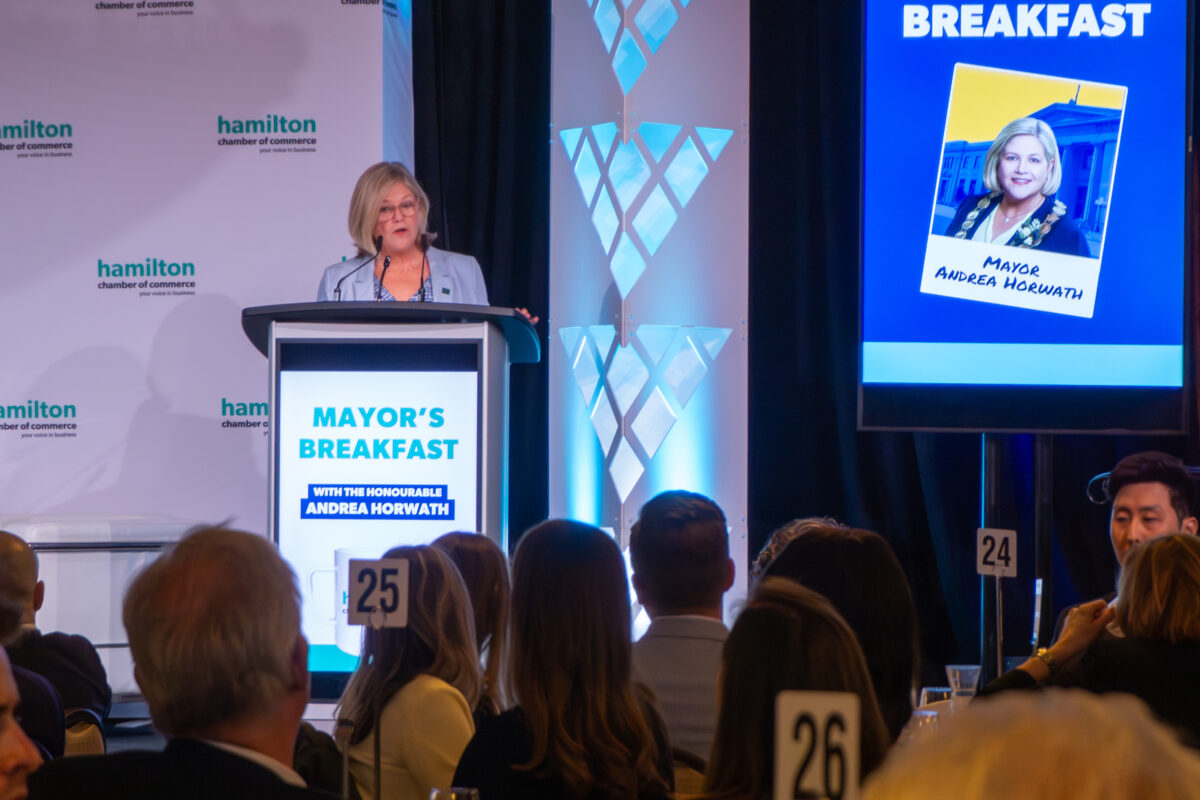
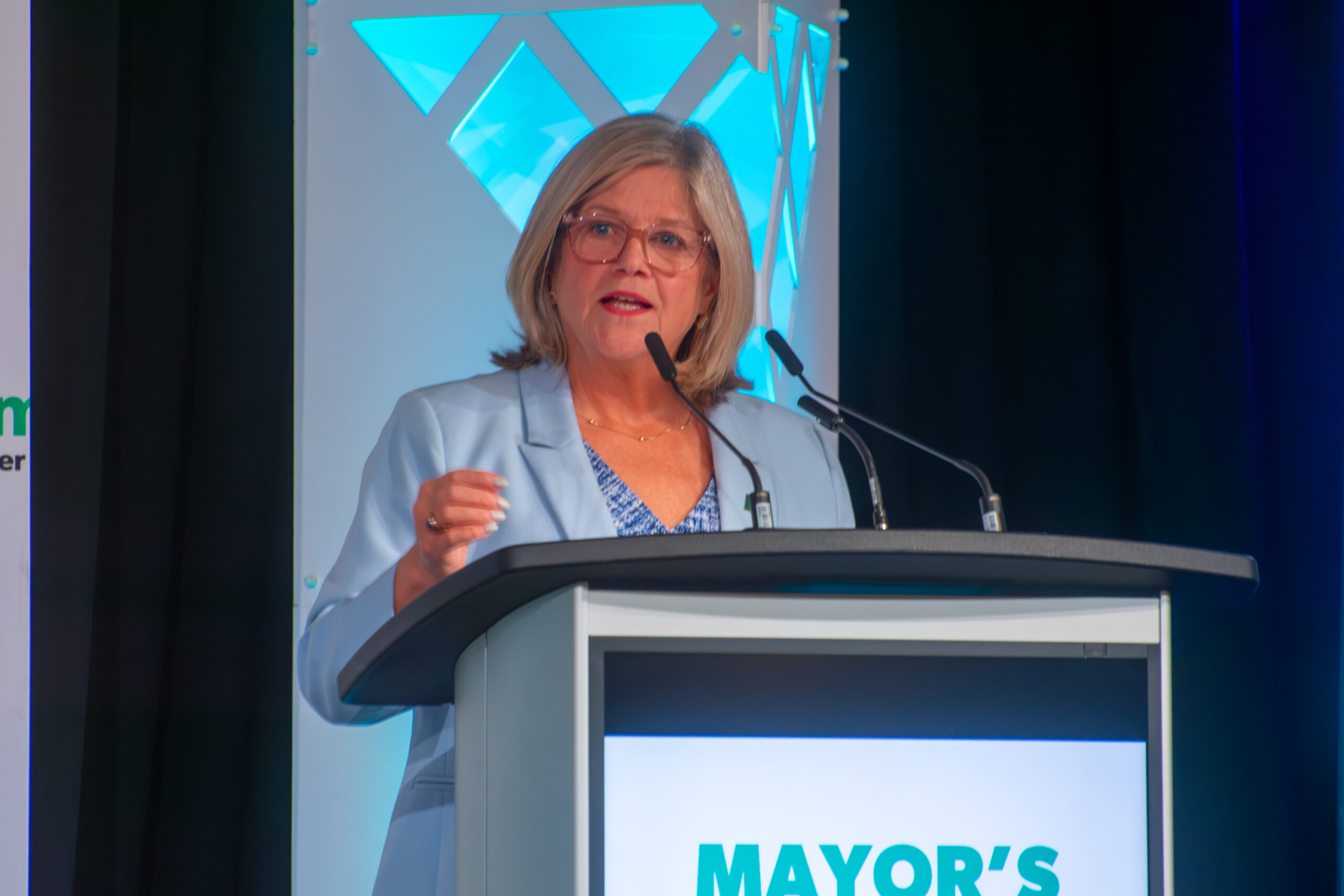
The following is a transcript of Mayor Andrea Horwath’s remarks to a gathering of the Hamilton Chamber of Commerce at the Mayor’s Breakfast on April 28, 2026.
It was generated using Whisper, edited using a custom LLM, and then subject to human review.
Full audio:
Mayor Andrea Horwath’s Address to the Hamilton Chamber of Commerce
(0:00) Well, I want to thank the Chamber of Commerce Board Chair Seher Fazilat, the entire board of directors, and staff, led by President and CEO Greg Dunnett, for bringing us together again for this long-standing tradition. This room every year is a snapshot of Hamilton: the people who build things, the people who finance them, the people who think things up, the people who take risks on them, the people who keep showing up, and who get stuff done.
(0:33) This morning, I wanted to take some time to talk to you about our city: where we’ve been, where we are, and where we’re going. Cities don’t move on their own. People move them. Partnerships move them. Collaboration moves them. Innovation moves them. Investment, public and private, moves them. Creativity, compassion, and confidence move them. That’s how we build momentum.
(1:07) There’s been a notable shift in Hamilton over the past few years. You can hear it in conversations and how people talk about progress — in the willingness to say: yes, yes we can. Yes. Right here. Yes. In the Hammer. Yes. Now. What a great change that is. It wasn’t always the case. For a long time, if we’re honest, Hamilton hasn’t really been that place. But there’s a shift underway — a shift in our collective confidence, perhaps, where we used to be comfortable describing ourselves as a city with potential, an Ambitious City, if you will. We’re now a city on the move, a city with momentum. Make no mistake, that old attitude and reputation is hard to shake. A place where things move too slowly, where projects stalled out, where progress felt harder than it should have. A city that time forgot. I sometimes say over time that kind of seeps in. It shapes how others see you, and how you see yourself.
(2:17) And for our city, it became kind of like a quiet constraint: a constraint on what we expected of ourselves, a constraint on our dreams, indeed, a constraint on our very ambition. What’s changed in the past few years — and I know that everyone in this room can feel it — is that we’ve stopped accepting that version of ourselves. We’re closing the gap between what we say about Hamilton’s potential and what we are. And that didn’t happen by chance.
(2:48) It happened because we refused to keep operating the same way. I made a decision on day one that we were going to do things differently. We had to do things differently. That meant modernization; it meant partnership; it meant collaboration across sectors and across governments. And it meant building a culture that says yes to progress and follows through. One of the first things I did was connect and reach out to all of Hamilton’s federal and provincial representatives: One City, One Team.
(3:21) And what we’ve seen recently is something that, frankly, has been rare in politics: different orders of government, of different political stripes, working together in a sustained way. Some of that’s been driven by economic and trade upheaval. But as they say, crisis creates opportunity. And because of the relationships I was able to bring as your mayor and have fostered since, we’ve used that opportunity to build something strong here in Hamilton. And it’s a big part of why we’re seeing the progress we are today.
(3:52) You can see it in obvious places: in TD Coliseum, open, active, bringing hundreds of thousands of people downtown, bustling sidewalks, full restaurants, real vibrancy — in the JUNO Awards, literally blowing the socks off of folks across the country, and in the return of hockey. Yes, hockey is back. The AHL is back. The Islanders have chosen Hamilton as the new home for their affiliate. And without spilling any beans, I can say I’m pretty confident that there’s more to come.
(4:22) But if that were all it was — events, announcements — we wouldn’t be talking about a shift. What matters is what sits underneath: the less visible work, the way challenges are being addressed inside and outside of City Hall. Take housing and homelessness. There is no version of this conversation anywhere in the country where someone stands up and says, “We’ve solved it.” What has changed here is the level of focus, the alignment around a clear plan, and a willingness to use every tool available: municipal land, targeted funding, and strong partnerships to keep solutions moving forward.
(4:55) In the last year, we expanded shelter capacity by nearly 80 per cent. We opened Tiffany-Barton — yes, Tiffany-Barton — with challenges. But one year in, it is working. And you need to know that. Police and paramedics: hardly ever called. Residents are accessing the care that they’ve gone years without, and 32 former long-term encampment residents are now permanently housed. That speaks to what’s possible when we innovate at the municipal level, just like in the private sector, in science, and in applied research.
(6:01) So at the risk of slipping back into the old ways of thinking, when it comes to the Tiffany-Barton project, I’m asking you to look at it differently — to see the reality. This is a successful innovation. Were there missteps? Yes. Some errors? Absolutely. But the results are real: 32 people now have a future to look forward to. It’s a model responding to a very real and growing human crisis on our streets — a model that can be replicated and scaled. And many communities are coming to learn what we’ve done. It was worth the investment. It was worth the risk. Because without risk, without innovation, and without investment, there is no progress.
(6:32) That same level of innovation and partnership is underway across the housing continuum, because meeting the full scale of housing demanded in this city requires a system that can deliver across the entire market. And that means addressing what many in the industry have been saying for a long time: the system itself has to change. And so another innovation is the Bloomberg All for One pilot. For too long, developers have been chasing their applications across departments, never knowing whose desk it was on or who had the answers at the City. We flipped that. Now, with this pilot, the City takes responsibility. All the right staff are at the table for one purpose: keeping the project moving forward. All for One. What used to take months or years now happens in weeks. This pilot was another innovation success, so we’re scaling it up. It was started in the not-for-profit sector, and we’re scaling it up because it works.
(8:10) That’s momentum: 2.3 billion dollars in construction value in 2025 — the second strongest year in this city’s history. Record levels of intensification. And all of this is happening in a market that has been under pressure for years. Rising material costs, higher interest rates, supply chain pains, a collapse of the condo market, and now growing uncertainty with global economic disruption and worldwide geopolitical unrest has created real pressure across the board.
(8:45) Let’s not let go of the progress that we’re seeing. Let’s not slide back into the quiet constraint of negativity and defeatism. With the input from the very voices in this room, we’ve made real, tangible changes aimed at creating sustainable stability and keeping projects moving in our community: a two-year, 20 per cent reduction in development charges across the board; zero interest for five years. And the fact is, apples to apples, we remain very competitive in DCs. Having said that, we know the Province is bringing forward, in collaboration with the federal government, some new initiatives, and we will be at the table to make sure they work right here in Hamilton.
(9:16) But of course, not every lever sits at the municipal level — but the ones that do, we are using through our housing secretariat and in close partnership with some incredible partners like St. Matthew’s House, Indwell, Kiwanis, the YWCA and YMCA, Sacajawea Non-Profit Housing, and so many others. The City of Hamilton invested $40 million in 2025 to support more than 2,000 new affordable and supportive homes, now moving through the pipeline. Last year alone, 479 Hamiltonians were directly housed through City-funded programs. We’ve also been doing the work to keep people housed through rent supports and subsidies, tenant assistance and protection programs, and our rental licensing framework. We’re helping thousands of Hamiltonians stay in their homes and prevent them from falling into crisis, because prevention is better than homelessness, always.
(10:19) And when you step back and look at all of this — the shelter expansion, the transitional supports, the permanent housing pipeline, and the work being done to keep people housed — the scale of the effort and the success is undeniable. Housing is key to talent retention and keeping brilliant post-secondary students here. Employers know, and they tell us, that housing is critical to maintaining a stable workforce. Housing fuels our economy.
(10:51) So let’s talk about the economy, and let’s start with steel — an industry that has defined Hamilton for generations and that we all know is being severely tested right now. Tariffs, cost pressures, trade uncertainty, shifting demand, and geopolitical upheaval. We are working hard with partners across the industry and with other orders of government to navigate these very uncertain times. As your mayor, I have been, and will continue to be, a strong voice for Hamilton workers, families, and companies at those tables. And I have convened some of those tables myself. I want to give a shout-out right now to ArcelorMittal Dofasco and to Ron Bedard, who couldn’t be here this morning — but Ron last week was named to Prime Minister Carney’s Advisory Committee on Canada–U.S. Economic Relations. Congratulations to Ron. Steel is at the table. Hamilton is at the table.
(11:57) And how about the port? It’s booming. HOPA is growing its capacity, reshaping how goods move and what goods move through this region. Parrish & Heimbecker, for example, adding a third flour mill and additional grain storage. Sucro Can Sourcing siting the biggest sugar refinery in Canada at our port. These investments speak to long-term confidence in Hamilton as a hub for the agri-food production and processing sector. Ontario Shipyards recently partnered with Mohawk College and South Korea’s leading shipbuilder, Hanwha Ocean. Together, they’re laying the groundwork to bring shipbuilding back to Hamilton, with plans that include submarine construction and a new generation of skilled trades. It’s the kind of investment that builds on our industrial roots while pointing clearly towards the future: high-value jobs, specialized training, advanced manufacturing, and a supply chain anchored here in Hamilton — centring this city in the heart of Canada’s economic future once again.
(13:44) With federal commitments to bring Canada Border Services Agency to our port, we’ll be able to move more goods more quickly and efficiently by rail, directly to and from ships right here in Hamilton, giving local industry and businesses easier and less costly access to national and international markets. In just a few piers over, there are exciting irons in the fire that have the potential to completely transform the former Stelco lands into a powerhouse for the future.
(14:16) Up at the airport, that long-awaited lease is paying the dividends — I knew that it would. Porter Airlines has established a strong presence with new routes, expanded service, and long-awaited terminal modernizations to the tune of $17 million so far. Our airport is now starting to reflect the level of excellence that Hamilton travellers deserve, and of course, the cargo business continues to boom.
(14:48) Hamilton has always been an expert in transportation and logistics. Now we’re strengthening that position even more. Companies like AtomVie Global Radiopharma are continuing to expand and invest, shipping life-saving treatments around the world from right here in Hamilton. Thanks to our growing reputation as a global life sciences and radiopharmaceutical hub, this ecosystem and so many others are supported by the strength and innovation of our post-secondary institutions: McMaster University, Mohawk College, Redeemer University, and the largest and most respected hospital networks in the country, Hamilton Health Sciences and St. Joseph’s Healthcare Hamilton, delivering care, advancing research, and translating discovery into real-world impact. This is how you build an economy that leads.
(15:23) But that’s only part of our story. Hamilton’s restaurant scene is diverse, it’s creative, and it’s growing, with chefs and entrepreneurs who are choosing this city because they see the same opportunity and energy that all of you do. And then there’s music. Music has always been a part of Hamilton’s identity across genres, across generations, earning us a reputation as a true City of Music. And that legacy is alive. From TD Coliseum to the Ancaster Memorial Arts Centre and everything in between, venues are filled night after night, week after week, with people connecting through the power of music.
(15:57) It’s no surprise that after hosting the best JUNO Awards ever — and countless other music events and festivals, including a new country music festival coming to Ancaster this summer, courtesy of one of our own McMaster grads — we’re celebrating this year as Hamilton’s Year of Music across the city. You’ll find an arts and culture community that is deeply rooted and constantly evolving, from visual art to theatre, dance, and digital media. Hamilton is home to creators working across every art form, telling stories that reflect the diversity, the creativity, and the very character of this community.
(16:27) We’re home to the National Centre for New Musicals at Theatre Aquarius, where original productions are brought to life on stage now — in fact, it’s A Good Life If You Don’t Weaken, set to the music of The Tragically Hip. So go get your tickets. Our Art Gallery of Hamilton has a permanent collection considered one of the finest in Canada, and a bold new vision for the future that combines art, housing, and community. It’s the kind of innovative thinking that fuels momentum in our city.
(17:38) Our downtown reflects that as well. Downtown is our beating heart, but it’s also our front door. It’s the economic and cultural engine of the entire city. And right now, there’s a lot to be confident about. More than 40 events at TD Coliseum, bringing over 300,000 people through our downtown as of last month. The economic uplift is undeniable. And just wait until we get to the final JUNO Awards numbers — my understanding is that those numbers are going to blow our estimates right out of the water. New businesses are opening; new residents are moving in.
(18:49) And just this month, Council approved the ten-year Downtown Revitalization Strategy — a plan to build that energy and keep that momentum going, because we know that a strong downtown doesn’t happen by accident. It takes focus. It takes coordination. It also takes a willingness to confront the challenges directly. And one of those challenges — one we hear about often — is safety. Last November, I hosted a community safety summit exploring issues like hate, gun violence, and our growing concern about youth crime. And we’ve been doing exactly that: dealing with those issues in a sustained and coordinated way through our Community Safety and Well-Being Plan.
(19:21) Two years ago, I convened a table of senior management from all City departments and our Hamilton Police Service. With the City department leads and the Hamilton Police Service, we got to a table to focus on safety, cleanliness, and improving the day-to-day experience of being downtown. We continue to meet regularly. As a result, we have a beefed-up police presence, increased cleaning and maintenance service levels, and stronger coordination between City services. And we’re hearing back from businesses, from BIAs, from residents — that things are improving. That kind of progress builds confidence. And confidence in our downtown is foundational to everything else we’re building.
(19:53) And it’s also what allows us to move forward with the kinds of investments that shape a city for generations. Yes, I’m talking LRT. A generational investment that will modernize our entire transit system and bring hundreds of millions of dollars in infrastructure renewal to our city. I know that for a long time, LRT in Hamilton felt like a whole lot of promise and not a lot of delivery. That’s changing, too, and you’ll see very, very soon.
(21:36) Now, while we’re on the topic of infrastructure — for all the progress we’re making, there are still parts of the city that tell a very different story, and people notice — your cars notice. For too long, this city did not invest enough in its infrastructure. Necessary decisions, expensive decisions, were delayed. Short-term politics, perhaps, won out over long-term responsibility. And today, Hamiltonians are paying for that in more ways than one. You see it and feel it when you drive down Barton Street, Fiddler’s Green Road, Carlisle Road, Hatt Street, Fennell Avenue, and Main Street. The list goes on. When a water main breaks on your street for the third time in a single winter, when your local rec centre has an unexpected and prolonged closure because the roof is leaking or because it’s structurally unsound — there’s nothing acceptable about that. But catching up will not be easy. It didn’t happen overnight, and it won’t be fixed overnight.
(22:38) It will take time and about $5.3 billion. But we’ve started. Last year, we increased road repair investments by more than 50 per cent. And that’s continuing. We’re building water systems pipe by pipe — rebuilding them. You can see that happening right now on Main and King streets. We’re making long-overdue upgrades. But infrastructure isn’t just what you see; it’s not only roads, bridges, and pipes. It’s also the systems and services that people rely on. And just like our physical infrastructure, those systems didn’t receive timely and necessary attention. The cyber-attack made that abundantly clear. But again, through crisis comes opportunity. Losing critical systems forced us to rebuild stronger, more modern, and better aligned with what our residents and businesses need and deserve.
(23:42) Better customer service. The launch of my.hamilton.ca is part of that: a single, consistent place for residents to access services, submit requests, report problems, and track progress. None of this happens, though, without people, and I want to take a moment to recognize the team that has made this possible. City staff, led by our City Manager, Marnie Cluckie, who has been a driving force behind the changes we’ve made, helping build a culture that is more responsive, more collaborative, and more focused on getting things done. From senior leadership to frontline employees, there has been a real shift. Change wasn’t optional. We needed a team willing to think differently, act differently, and move this city forward.
(24:15) And I do want to take a moment to recognize someone in particular: our Director of Economic Development, Norm Schleehahn. Norm is going to be retiring this June after — wait for it — 35 years within the City of Hamilton. Congratulations, Norm! Norm has been a steady and respected leader through decades of change in this city and a driving force behind so much of the growth and investment that we’re seeing today. Norm, thank you so much for your service, for your leadership, and for your commitment to Hamilton.
(25:41) I also want to acknowledge my Council colleagues who are here with us today — thank you for your work and for your ongoing engagement on the many important issues facing our city. They put in long hours; they work hard. They do a lot for this community. And I’m very, very grateful for that. Finally, I want to thank my office staff as well: Sarah, Haley, Amanda, Wynne, Ashada, James, Nathan, and the tireless woman behind it all, Uzma Qureshi. Thank you for the long hours and the commitment to this work.
(26:18) When you look at everything that I’ve talked about today — housing, economic growth, infrastructure investment, innovation, downtown revitalization, a modernized City Hall — you see a city that is moving in a very different way than it did just a few years ago. But here’s the thing about momentum: it’s powerful, and it’s fragile. Cities don’t stand still. You either keep moving forward or you fall behind. And right now, we are competing not just with our neighbours, but with cities around the world for talent, for investment, and for opportunity. We spent the last few years getting this city unstuck. The work now is to keep it moving.
(27:00) And I know we can, because we’re building something stronger than any one project, or policy, or industry. We’re building a way of working, a way of partnering and collaborating, a way of believing in this city and in each other. Hamilton is a city that welcomes people — a city that doesn’t divide but brings people together. A city where everyone, no matter where they come from, has the opportunity to build a good life, to start a family, to start a business, to make ground-breaking discoveries and cutting-edge inventions, to break records, to reach new milestones, to change the world. That’s who we are.
(27:31) For some time, my ask of you in this room was simple: believe in Hamilton. Invest here, build here, take a chance here. And you did. That’s not my ask anymore, because belief in our city is no longer the issue. The opportunity is now something else. It’s to make sure that what is happening here — what you see, what you all are a part of — is understood beyond this room. And so my ask is this: tell Hamilton’s story today. Tell it to your colleagues, your partners, your investors, and your networks beyond this city and around the world. Tell it right here at home to your family, your neighbours, and the other parents at baseball practice. Because how we talk about this city shapes what it becomes.
(28:39) Hamilton is no longer a place defined by what it was or what it could be. It’s a place increasingly defined by what it is doing and where it is going. And every one of you in this room has the power to amplify that, to be ambassadors for the city, to make sure the story being told about Hamilton finally matches the reality we’re building together. Because Hamilton is no longer a city waiting for its moment. We are in it. It’s in rooms like this that great cities are built. So thank you.
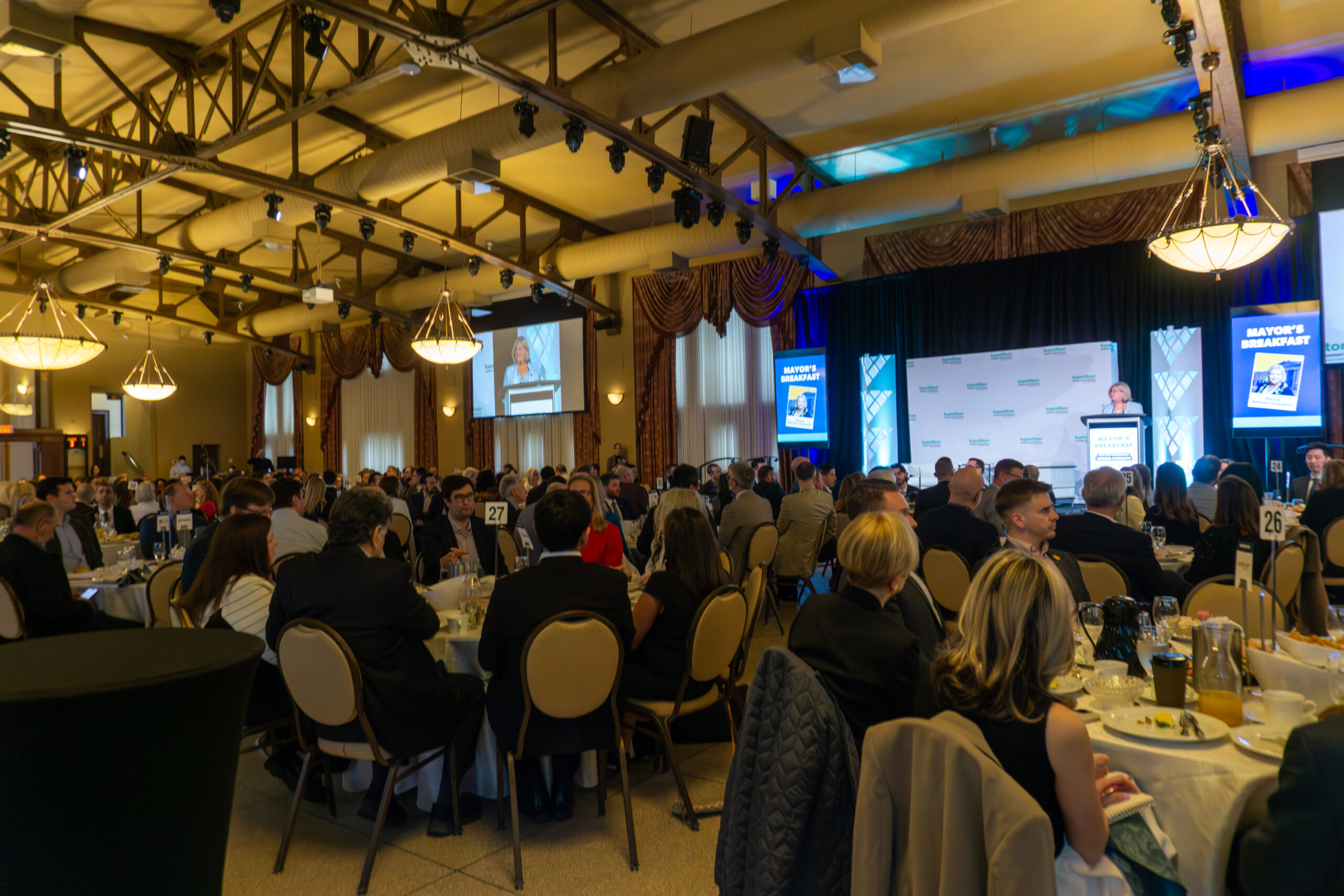
“Fireside Chat”
The following is an edited transcript of the Q&A discussion with moderator Steve Foxcroft, Vice-President of Fluke Transportation Group.
Looking back on your first term, what decisions or initiatives are you most proud of, and where do you feel things may have come up short?
(30:48) You know, it’s been a journey. There’s no doubt. Some of the initial decisions were recognizing that there were things we had to figure out how to fix — getting the City unstuck on things like development processes. Yeah, it’s taking some time, but we are really getting somewhere with that. But it took some work. You can’t make changes like that overnight. But we’re in it, and we’re working hard on it. Things like contracts and other pieces that were kind of not going where they needed to go — the airport lease and the coliseum were hitting a bit of a snag. So it was really clear that there were some big things that would really push the city forward that needed to be addressed. The things that not so much — we still have challenges, there’s no doubt about it. But we are trying to change a culture, and that’s hard to do. But the culture is changing, and the people of this city that work for this city are hardworking. They care about the city, they love the city, and they’re all in for making a positive change going forward.
What surprised you most about the role?
(32:36) What I wasn’t really expecting, and I should have been, is that I was coming in on the heels of COVID-19. Everybody remembers what that was like. So there is some trauma there, really, at the administrative level. And I wasn’t necessarily expecting that — but we worked through it. Only in reflection do I recognize that that’s what was going on to some extent. And then the other piece would be coming into the role with such a change in terms of new voices around the table, new Councillors — learning the ropes, if you will, trying to build the relationships, and making sure that we had what we needed to move the city forward.
Hamilton has been navigating pressures around affordability, public safety, and downtown vitality. How would you assess the progress made so far, and what priorities remain going into the next term?
(33:59) The thing that I think is clear is that we are making progress. And so I want to thank all of those folks that have been sitting around a table for two years on the details, because the details count; the details matter. The details are part of the experience that people have in our downtown. City leadership, but also managers who could make decisions, who could make things happen. And the Hamilton Police Service — not just the Chief, but superintendents responsible for the downtown. Decision-makers. Starting to put the solutions to the details into action was really great. But look, it’s not over yet. It’s never over when it comes to a downtown. You always have to be pushing forward.
(35:02) Having said that, we do still have crises that are beyond the City’s sole ability to solve — things like the homelessness crisis, the mental health and addictions crisis, and affordable, supportive, and transitional housing. We spend $200 million a year on housing and homelessness, and two-thirds of that doesn’t belong at the municipal order of government. It’s a huge burden. We have two-thirds of $200 million that don’t belong on your tax base at the municipal level. So myself and other Mayors across Ontario are working with the other orders of government to get that resolved.
Where do you see the greatest opportunity for the City to support economic growth?
(36:56) I think it’s in the kinds of things that we do on two levels: one, supporting the business decision-makers that need help from the City on permitting, on building, on all those things — from the small business and entrepreneur working with our Small Business Centre right up to major companies looking for support with other orders of government. But it’s also looking at not just where we are now, but where we’re headed. This is why those leases were so important for me. We have to recognize what the future economy looks like, not just today. And so being ready for those kinds of changes is important. The City needs to be a partner in that. And I think that if we work together and find the way forward together, we’re unstoppable. That’s a shift we’re starting to make, and one that needed to be made: collaboration, innovation, partnership, and supporting one another.
What keeps you up at night?
(38:47) Oh, the list is long. But the interesting thing about this dynamic city is that it’s not always the same thing. Sometimes it’s a crisis, like what happened on Friday downtown — with the loss of life of a 16-year-old at the hands of a 14-year-old. That keeps me up at night. Sometimes it’s seeing what the new, horrible, additional toxic drugs on our sidewalks are doing to human beings. Sometimes it’s the library struggling. Sometimes it’s whether we’re finding the right answers to development pressures, or how we solve some of the big infrastructure problems that we have. Because they’re big and they’re really expensive. And because we’re a very old city but also a growing city, we have the old infrastructure and the new. I’m not being kept up at night about the LRT announcement anymore — because it’s coming soon.
Is there a challenge or opportunity that deserves more attention than it’s currently getting?
(40:49) I go back to my previous response, actually. I think the big challenge we have is our infrastructure deficit. It’s serious now. The good news is we have taken stock of that — we have an Asset Management Plan, which we didn’t have before. So we have the roadmap. It’s how you fund the roadmap. And I know there are innovative ideas that the Provincial and Federal governments are thinking about — the Build Canada Strong, Build Ontario Strong infrastructure priorities that they’re putting out there. We have to be there to get a good share of those resources. And the good news is that while I’m a little bit noisy when it comes to the other orders of government, they know we are here. I’m looking forward to getting some help on that one.
The YWCA Hamilton asks: access to high-quality child care is essential for parents, and particularly women, to fully participate in our economy. Given the ongoing uncertainty from the provincial funding side, is there something the City can do to reduce child care waitlists?
(43:02) That’s a really great question. Our City has great resources and staff when it comes to supporting the child care sector. In fact, we were one of the highest in terms of percentages of communities taking up the offer of the Canada-Wide Early Learning and Child Care program to reduce the cost of child care for families — well over 90 per cent of our providers signed on to that program to reduce costs. We are also seeing expansion right now. Almost two years ago, we were at Queen’s Park pushing for the government to reinstate close to 300 spaces that they had withdrawn funding from — and we were successful. Can I say we can pick up every single dollar that might be lost when it comes to provincial funding? I cannot make that promise at this point because I don’t know what that looks like. What I can tell you, though, is that we will do everything we can to prevent the loss of further child care and to continue to grow the sector. And I want to say a couple of things: thank you to school boards and to some Councillors who have done some work with their ward budgets; but also to the hard-working people in the child care sector. These folks are underpaid and underappreciated. And finally, to the YWCA Hamilton: thank you for everything that you’re doing in our community.
On the topic of recreation facilities, how can we ensure that in these challenging times, Hamilton will still provide the next Shai Gilgeous-Alexander, Kia Nurse, Laura Fortino, and Matthew Schaefer?
(45:16) They are part of our Asset Management Plan, and we do have a Sports and Recreation Master Plan that has identified where investment needs to happen. But you know, when we look at sport — and people who are involved in sport know this — we can’t have sport without volunteers. But one of the things that I think is our responsibility is to acknowledge and recognize that engagement in sport is not just about athletics. It’s about leadership. It’s about commitment. It’s about understanding how to be part of a team. It’s about confidence building. It’s about getting out from the basement, off of the video game, and into real life with real people. The more kids that we can help do that, the more families that we can encourage to put their kids into sport — and into other activities, too. That’s why we have great recreation centres with arts and other activities. But these are the things that really are important: recognizing the reach of things like sport and recreation, because it speaks to that issue around mental health and well-being of our youth, and about how we solve some of our other issues when it comes to the crisis that youth are facing right now.
Rapid Questions Segment
To close the morning’s event, Foxcroft put Mayor Andrea Horwath on the clock for a rapid-fire round.
Foxcroft: I’m going to put 60 seconds on the clock. I’ve got ten quick-hitter questions for the Mayor. Clock won’t start until I’m done reading the first question. Okay. Family Feud style. Okay. Your order at Tim Hortons.
Horwath: Uh, medium double — just double cream, no sugar.
Foxcroft: Have you ever been to Port Dover for Friday the 13th?
Horwath: I have not, but my partner’s used to ride a motorcycle. I’m sure he’s been there many times over his years.
Foxcroft: Where did you go to high school?
Horwath: Uh, Cardinal Newman, which is now — which is now, um, uh, St. John Henry Newman.
Foxcroft: Like the Centennial Parkway Cardinal Newman. That’s where you went. Yeah.
Horwath: Yeah, that’s the one. We did great in basketball, too, back then.
Foxcroft: A good watch on Netflix is…
Horwath: Um, I’ve been watching Scarpetta. I don’t know if anybody’s seen that. It’s pretty gruesome, but, um, I quite like it.
Foxcroft: Scarpetta. Ozark — what about Ozark?
Horwath: No, this is — no, this.
Foxcroft: Okay. I’m a Lincoln Lawyer guy. Any Lincoln Lawyer fans? Yeah.
Horwath: Okay, now I’m going to have to start to binge on that one.
Foxcroft: Do you use emojis when you text?
Horwath: Yes.
Foxcroft: Oh, that’s a good one. I like it. What is something on your bucket list?
Horwath: Uh, my bucket list. I would say to — to travel more. I really don’t have a lot of time to travel in — you know, around the world, if you will. Uh, I have to say, I did have the privilege of travelling a lot in Ontario and got to see parts of this province and communities in this province that a lot of people will not and have not. But seeing more of the world would be a big, big one for me.
Foxcroft: You didn’t take a private jet when you travelled Ontario, did you?
Horwath: No, but wait until the next budget if I’m fortunate enough to get re-elected. Okay.
Foxcroft: Um, sorry, 11 questions now. That was an extra one. What was the make of your first car?
Horwath: A Ford Pinto. My dad worked at Ford in Oakville, and we always had Fords. I wish it was a Mustang, but no, it was a Ford Pinto for me and my sister.
Foxcroft: Pinto. And that’s because your dad worked in the Oakville plant? That’s right. That’s awesome. I love it. Did he teach you how to drive?
Horwath: He did. He taught us all how to drive. He taught us how to change a tire. Uh, he used the jack the whole night. My sister and I — my sister’s elder, older than I, and myself — we learned all the things my dad taught us. He used to do all his oil changes, spark plug changes — he used to get frustrated with that one — all by himself, like in our — in our garage.
Foxcroft: Did it have a clutch?
Horwath: No.
Foxcroft: Okay. That’s good. Um, did you learn at Eastgate Square? Did you go to Eastgate Square to drive?
Horwath: Yes, we did.
Foxcroft: Yeah. Okay. Yeah. Um, have you played pickleball?
Horwath: I have not yet, but I went to the ribbon cutting of the new Gretzky pickleball facility that’s going to be hosting the Special Olympics pickleball tournament here in Hamilton last week, and I made a commitment there. So you’re hearing it now, uh, that I’m going to try pickleball. I will, I’ll find the time.
Foxcroft: Awesome. I love pickleball.
Horwath: Pickleball fans.
Foxcroft: Um, what was your first concert?
Horwath: Um, you know, I think my first real concert was when I was still in high school. Don’t judge me. But it was the Hamilton Philharmonic with some — with one of my friends who was interested in going. I said, “Yeah, I’ll go with you.”
Foxcroft: Awesome. Mine was Trooper at Hamilton Place. I think Norm was there. Okay. Last one. Hamilton is: blank.
Horwath: Amazing. Hamilton is amazing. Awesome. Because of all of you.
Foxcroft: Yeah. And because of you. Thank you to the Mayor for doing this morning. Really great to have you. Thanks.
Production Details
v. 1.0.0
Published: April 28, 2026
Last updated: April 28, 2026
Author: Joey Coleman

Update Record
v. 1.0.0 original version