

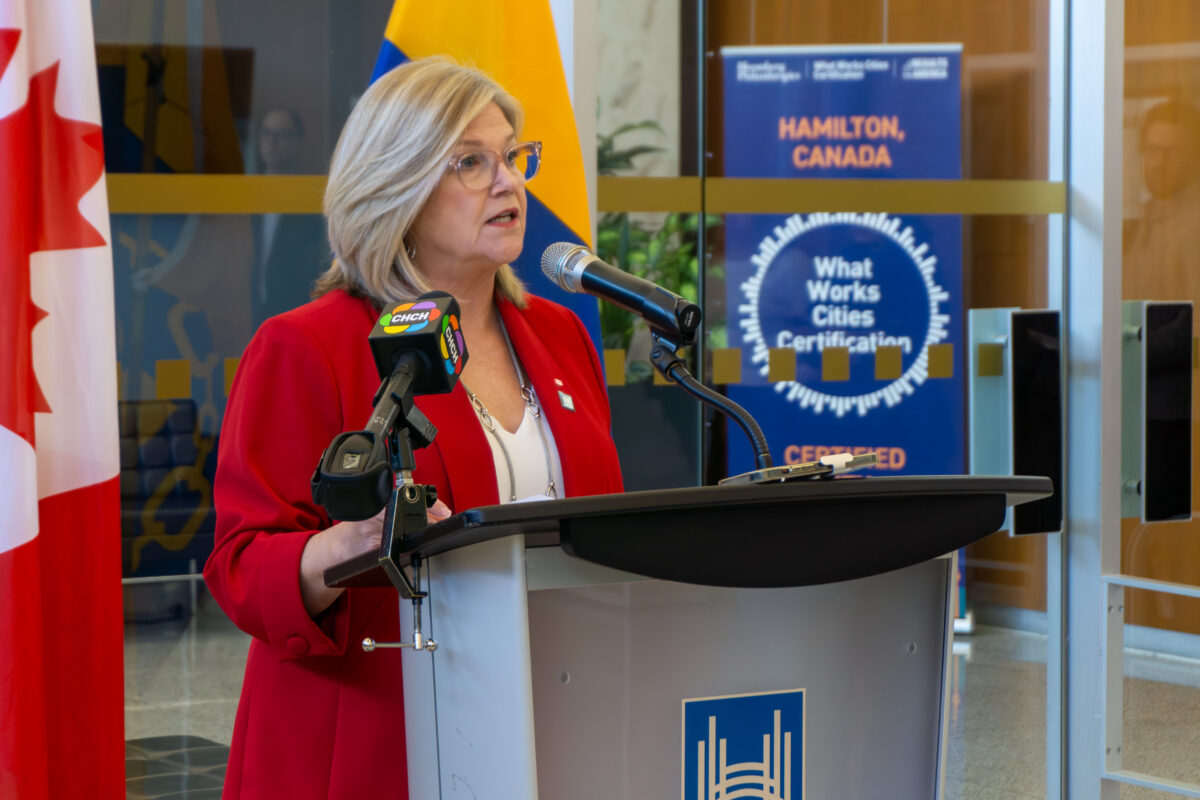
Hamilton Mayor Andrea Horwath announced the finalization of her 2026 City of Hamilton budget during an availability on Tuesday, February 26, 2026.
The following is a transcript of the availability. CHCH broadcast it live on YouTube.
Mayor Andrea Horwath:
Good afternoon everyone and thank you for joining us. I want to begin by thanking Budget Chair Councillor Maureen Wilson and Vice-Chair Councillor Craig Cassar for their thoughtful leadership throughout this entire process. Thank you as well to my council colleagues for their work in bringing forward amendments as we worked through this budget process as set out in the Ontario Municipal Act. And my sincere thanks to city staff for their expertise and tireless efforts behind the scenes, as well as my staff who’ve supported me and our team throughout the process.
Today marks an important step in our 2026 tax budget process. From the outset, I was clear about the approach I would take: Hamilton families are feeling real financial pressure and making difficult choices at kitchen tables across our city. Seniors on fixed incomes are watching every dollar. Small businesses are navigating rising costs.
So, I set a clear direction: hold the line, protect essential services, invest responsibly in infrastructure, and deliver real value for taxpayers. That direction shaped this budget from day one. I asked departments to identify efficiencies; I asked them to scrutinize spending and focus on what matters most to residents: affordability, safe neighbourhoods, reliable services, and maintaining infrastructure like roads and transit, and long-term sustainability for our city.
Council has completed its review of the proposed budget and brought forward amendments through the established process. After carefully considering the amendments voted on and approved by Council last week, I’ve decided not to veto any of them and have issued a formal decision to shorten the 10-day veto period effective today. Accordingly, the amendments approved by Council are confirmed and the 2026 tax budget is adopted. This decision allows us to move forward together and deliver for Hamiltonians without delay.
And importantly, the final result of 3.87 per cent is below the hold-the-line maximum target that I set – and that’s good news! This budget reflects a balancing act… and that balance matters. It balances infrastructure renewal with affordability. It balances urgent needs with long-term planning. It balances compassion with fiscal discipline.
So, what does this budget deliver for Hamiltonians?
Infrastructure: $106 million this year alone to maintain roads, fixing those potholes and sidewalks and bridges. Additionally, $152 million in total capital investment in roads infrastructure.
Child Care: $22-a-day child care is protected, saving families roughly ten thousand six hundred and forty dollars per child annually to help parents afford to go to work.
Food Security: $1.25 million to strengthen food security programs, helping thousands of households to put food on their tables.
Recreation: Funding to ensure kids can join rec programs, seniors can stay active, and families stay connected through our city rec centres, parks, and programs. Upgrades to our recreation facilities like the Waterdown Pool, Victoria Park Outdoor Pool, Chedoke Twin Pad, and setting aside funds for Glambrook’s future facility community, giving Hamiltonians modern, accessible spaces to stay active, engaged, and connected to their communities.
Transit: $116 million to keep buses reliable, help workers get to their jobs, students to school, and residents to services like doctor’s appointments and other errands.
Emergency Services: Adding 10 paramedics to keep up with rising call volumes because in an emergency every single minute counts.
Long-Term Care: Moving steadily forward with the Macassar Lodge redevelopment, modernizing long-term care and adding new beds so that our seniors receive care in safe, dignified environments.
Housing: Investing $209 million in affordable housing, housing stability, and homelessness supports. That’s real support to help people get back on their feet.
Economic Development: Supporting local businesses and revitalizing our commercial districts – strengthening jobs and our local economy.
Digital Services: Investing $17.1 million to modernize city services: online permitting, digital payments, better customer service, improved cyber security, and strong financial systems. Residents expect modern, accessible services from their city and that’s what this budget delivers.
The budget also includes $42.6 million in operational efficiencies across departments. That is not abstract. That is disciplined management of taxpayers’ dollars. We’re improving processes, strengthening procurement oversight, and modernizing antiquated systems.
Budgets are statements of priorities; that’s what they are. This budget says we will protect core services, we will invest in community safety and infrastructure, we will plan responsibly for the future, and we respect the affordability crunch that Hamiltonians are facing. No budget satisfies every request, no budget eliminates every pressure, but leadership means making difficult decisions, maintaining stability, and moving forward in uncertain times.
Hamilton is a growing city with real challenges and also enormous opportunity. This 2026 budget positions us to continue to strengthen neighbourhoods, improve community safety, support families, and build a city that is resilient and sustainable for the long term. It moves us forward together. Thanks very much.
Q&A
Mac Christie, TheSpec: So, since Thursday, what went into your decision-making to not veto anything? And are there any things that you did consider vetoing?
Mayor Horwath: I took that role really seriously because there was some debate on some of the issues and it’s important to listen to what people brought to the table in those discussions. At the end of the day, the votes were pretty clear on most of the issues; there wasn’t like a tie vote in any of them. So, I considered that; I considered what councillors brought to the table in terms of the conversation, the discussion. I paid attention to a lot of the collaboration that went into some of those decisions that got made at the council table and thought the responsible thing to do was to basically say to the councillors, “Thank you for the work that you’ve done.”
Thank you for putting some effort into the amendments, working together to come up with suggestions and recommendations, amending some of those at the actual council table, which I thought was really important as well. And that’s what I contemplated over the last couple of days and decided the best thing to do, the most collaborative and important thing to do. Seeing all that work that was put in and in gratitude to the councillors to say everything will go forward as they’ve decided.
Mac Christie: The one vote that was closer, when you voted and spoke about the library possibly looking at reserves to deal with its funding, did you… was that a consideration?
Mayor Horwath: No, not at all. You know, at the end of the day, my understanding was that that’s what was on the table when this suggestion of more resources came forward. Because that is not something that the library wanted, but it was clear that councillors did want to see that money come from a different source – it’s not about the money itself. I think it’s very clear that the library needs our support; they are struggling in many ways right now, but more where the money came from, and so it was a matter of six of one, half a dozen of the other; ultimately, it all lands on the tax base. And so that’s why I was not at all considering vetoing that decision.
Scott Radley, TheSpec: For much of the last three years, “investment” has been one of the words that has been used a lot; this year it became “affordability.” What changed?
Mayor Horwath: Well, I don’t know if you’re watching the news, but boy, things have changed. We are in a very fraught moment in time. I think that started with, of course, the election of the President down south; we’ve seen the impacts of the chaotic way that he’s governing and what that’s doing to us as not only physically closest neighbour but also economically most closely tied with the United States.
We’ve seen the impact on our steel industry, on our manufacturing sector, on our agri-food sector. We’ve seen a lot of impacts; in fact, if I’m not mistaken, Hamilton is the eighth most impacted tariff-wise in terms of these decisions that have been made down south. We’ve also, of course, seen the impacts of the global disruption on global trade in terms of rising prices and costs for everyday families, as well as for organizations, businesses, and cities.
And so all of those things have made it a budget year like no other, I would say. And so I’m very proud of the work that our staff did to take all of those factors into consideration and to try to find a way forward that held on to the most important pieces around our infrastructure investments, around our core city services, around safety and affordability. Around making sure that we are not abandoning our responsibilities to build the city for the future and managed to do that in a way that was, I think, very attuned to the fiscal pressures that families are facing and their businesses are facing.
Scott Radley: So, just to be clear, affordability is much worse now than it was last year or the year before? Is that correct?
Mayor Horwath: I would say it’s not just affordability; I would say it’s also uncertainty. So, it is the affordability, which has been climbing. The cost of housing, for example—the rents going up and everything increasing—has been with us for a little while now, post-COVID frankly, but what we see now are significant instabilities. We don’t know what will come next down the pike and people are feeling very nervous about that, and rightfully so. And so I think that’s the added pressure… the added peace that is, from my perspective, facing our city, facing our province, facing our country.
Teviah Moro, TheSpec: Hi Mayor, I wanted to just ask a question about the library.
I think the $300,000 or so that they’re looking to reduce to meet the target is not quite there yet. It had more to do with finding savings in other areas rather than, say, social work and mental health and security components, but to your point that this all went hard, is there any discussion about whether the city should remove the mental health and social work component – those programs which the library is paying for? Should it be removed as a library-wide item and become a city one?
Mayor Horwath: That’s not a conversation I’ve had, so I respect the fact that it’s an idea you’re bringing forward, but that’s not something that I’ve had any discussions with the board or the library folks either. So thank you for bringing it forward, and it’s not something that’s, from my perspective, on the table right now.
Teviah Moro: There has been a lot of pressure on Hamilton to give greater development incentives and I think last week you mentioned the West End meeting where it was brought to different levels of government this campaign; do you believe there is something more that Hamilton should do?
Mayor Horwath: Hamilton has stepped up when it comes to this particular matter, and I thank you for the question. You’ll know that we’ve reduced the development charge by 20 per cent and not just for residential – so much of the conversation is about spurring on home starts, right, housing starts – but we’ve also reduced it by twenty per cent to industrial and commercial as well because, yes, we want to see more housing, but we also want to make sure that we’re incentivizing investment in terms of jobs because we want to be a community not just where people live, but a community where people work and live and play.
And so I think that… we’ve been responsible in our decisions. I can tell you that there were some things that occurred recently that were concerning around new processes that staff recommended that we charge fees for – you might recall this. That was not approved by Council; I think that was an error. When we have new applications coming in for secondary plans that are being prepared by developers for urban boundary expansions – that’s a whole new animal for us and it creates a lot of pressure on our staff, so like most of what happens in planning and economic development – and I can be corrected if I’m incorrect – but most of what happens is fee-based services.
And so, if a developer wants to open up the urban boundary and go to the Ontario Land Tribunal with a secondary plan, then Hamilton taxpayers should not be paying the burden of reviewing those secondary plans and being able to respond to the Ontario Land Tribunal. So it’s a little bit complicated in terms of my description; I apologize for that. It’s not something probably people kind of have a handle on generally, but what it does say is where there are fees required to make sure that the costs are being covered of new processes that are being required to be undertaken by the municipality, the municipality shouldn’t bear that cost.
We already bear a great deal of cost in that regard, and some of the changes that have been made in terms of development charges writ large by the province of Ontario, it is negatively affecting our capacity as a municipality. All municipalities feel the same way when it comes to putting aside the resources necessary to fund growth and development. So on one hand, we have pressure – we want more housing, we want more growth, we want more development. On the other hand, we want you to pick up more of the costs of providing those things. The math doesn’t work out for the municipalities.
Al Sweeney, CHCH News: Just one question: you kept the tax increase, but a lot of people wanted zero.
Mayor Horwath: Sure. Well, I mean, and I guess it depends on what number they want to pull out of the air to say, “I want this number,” and then you have to talk about doing the math. Then you have to look at what services are going to be cut to get to that number and that’s the bottom line. We’re a city that’s actually growing. We’re a city that’s actually aging at the same time, and so there’s no silver bullet to get us to zero; if you wanted a silver bullet to get us to a zero, that silver bullet’s going to include deep cuts to services.
We couldn’t even get efficiencies passed through this budget that were brought forward by staff based on requests to find efficiencies in grass cutting – we couldn’t even get that through. So, who is going to be significantly reducing services and programs to our community and to our residents to get to a 0 per cent? It’s not going to happen. So it’s easy to say, a little harder to do, and certainly I can guarantee you that those kinds of deep cuts would never pass that council table by the same people that bring them forward, by the way.
Cara Nickerson, FlamboroughToday: You mentioned there was 106 million coming in infrastructure and road projects. I guess, is there kind of a breakdown of how that will affect rural roads? I know there was a look at a rural road task force to kind of just go down the concession.
Mayor Horwath: So, I don’t have the detail in my notes right here on those specific projects. I see Jackie Kennedy is here, our general manager of public works. I don’t know if it’s too specific of a drill down for you, but are you interested in perhaps providing some clarity there?
Jackie Kennedy, General Manager of Public Works: I think I can take that away and get back to you with some more specifics on some of the highlights of that program.
Mayor Horwath: I know there are a couple things that were mentioned in my more detailed notes, but I’m not sure that the specifics as you identify them around rural roads versus other roads are here and I don’t see them. And so we will make that happen though; we’ll make that happen. Apologies for that.
Joey Coleman: So City of Hamilton still does not have the 2023 complete; we have no idea what those city books look like right now. When is that audit actually going to be completed and when will citizens again be able to see the state of City finances?
Mayor Horwath: Yeah, and I’m going to just start by saying I know it’s very frustrating! I know it’s frustrating for the media because it’s an issue of information and transparency. I know it’s an issue for residents because it’s an issue of accountability – to be able to look at past audited books versus, you know, through those years that we don’t have. One of the things I did say though very clearly, and it’s definitely the case, is that we need to rebuild our financial systems. Literally, we had – the cyber security attack was something that impacted our financial systems significantly, and so it’s not like we don’t want to have the data. It’s not like we don’t want to have the audited reports. We do; we need them. We all need them. So I just want to make it clear this is not something that we’re being lackadaisical about; it’s directly related to the cyber security attack and our financial systems being significantly impacted.
Mike Zegarac, General Manager of Finance and Corporate Services: Thank you, Madam Mayor. Mike Zegarac, General Manager of Finance and Corporate Services. And while our 2023 audited financial statements are outstanding, just to note, we did produce to Council a 2023 year-end unaudited variance report, as well as a 2025 forecasted variance report. So, there has been some reporting to Council with respect to 2023–2025. Our external auditors are on-site; they’ve been on-site since the fall completing the 2023 audited statements. They were before committee and Council in late fall with respect to their work plan.
I expect an update from the external auditors – I can’t rush them as it relates to their work, so we’ll give them the time they need – I expect an update in the next week or two with respect to the timing of 2023 audited statements; then I would expect them in the next quarter.
Joey Coleman: Turning to the next budget, which will come after the next election: we don’t know what the result’s going to be. I believe it’s fair to say your responsibility is to prepare for multiple possibilities and transitions; what steps are you taking to prepare for a transition? I’m hearing from three of the campaigns that their number one priority on finances is going to be bringing in a balanced budget with no use of reserves. How do you prepare knowing that you have several candidates in advance of November 15th when you have a potentially new mayor?
Mike Zegarac: So, I’ll say I’ve had the privilege of now delivering 14 municipal budgets here at the City of Hamilton. And then I will say the approach has not changed; we do multi-year budgeting and we present that information as we have in 2026. We have a multi-year forecast that’s available to the public as it relates to what we see in terms of pressures, as well as opportunities, and we would present that information to this term of Council leading up to the election as well as to the next term with Council. That’s typically complemented with an outlook report that is normally delivered in the summer and early fall. And so at that time, we’ll look forward to 2027 and provide this Council what our forecast is for 2027, and again, that’s available to the public and will be available to the next term of Council.
Mayor Horwath: Can I just say it’s interesting because in this particular budget process we had a reserve strategy to reduce our reserves – our reliance on reserves – in this budget cycle. Decisions that were made at the council table actually pushed it further out, so just so that you know, we had a reserve strategy that was a little bit more evened off, if you will, to try and get away from that reliance more quickly. Decisions were made at the council table in amendments to actually push that out even further.
Now, I might be misspeaking, but that’s my understanding of what we went through. So, it’s easy for people to say, “We’re going to not rely on reserves”; every – many, many municipalities this time around, and you’ll probably know this, did the same thing. A lot of the strategies that the City of Hamilton utilized have been utilized and are being utilized by other municipalities because we are all facing the same pressures.
And some of that is simply trying to make sure that we are doing what we’re doing in a responsible way, and in a way that doesn’t push too far out the pressure that we’re feeling today to future taxpayers. So, again, what’s important, I think, is to acknowledge it’s easy to say we’ll stop using reserves right now, but you have to make those up with cuts to services. And as I said earlier, we couldn’t even have efficiencies in grass cutting this time around because “efficiencies” – although it’s a good word and people think that they want them – when they’re put in front of them, it’s going to affect their ward and so that’s not something that easily passes the council table.
And I’m not trying to be overly critical, but as I said in my remarks, budgeting is not easy. And the decisions are not easy; they’re hard decisions. And those decisions are getting harder because of the fiscal capacity that municipalities are facing versus the pressures that we’re under – both in terms of the broader pressures that we talked about, but also some of the crises that we’re facing when it comes to the most vulnerable folks in our communities and that’s around the province. So I appreciate that.
Scott Radley: When you mentioned pushing things out, I think in the last budget meeting you had, at least a couple of councillors talked about what’s coming next year and the year after. They talked about big numbers that are looming…
Mayor Horwath: Well, we’ll see some of that detailed in the outlook that comes forward in a couple of months’ time, but this is when we talk about big numbers – this is why we try to keep a handle on what we’re taking from reserves. But you’ll know that there were a number of items that got pushed to reserves, so they increased the reliance on reserves in the amendments; they didn’t decrease them. They pushed things out for the next couple of years and so, yeah, that’s going to mean that 2027 is going to be tough – possibly tougher – and we don’t know what looms in 2027 or even as we get through the rest of this year to set the kind of stage, if you will, for the global environment and the trade environment.
And those things for a city that makes things – and that’s a hard-working city – have big impacts on us in terms of jobs and economic sustainability.
Teviah Moro: Yeah, Mayor, in 2023 there was a decision made, I think in the 2024 budget year, of a three-year commitment for $31 million for supportive housing that ends this year. Um, there wasn’t any talk about renewing such a commitment – a multi-year commitment – in this last budget cycle. Is that on your mind?
Mayor Horwath: Oh, it’s absolutely on my mind and it’ll certainly be in the mix in terms of the conversations that are going to be happening between now and the budget outlook. I’m sure that there will be folks that are going to be advocating for that; I think that it’s important. I also know that we need to see more commitment from the federal and provincial governments. Now, there are new housing plans and visions that have been put forward, particularly nationally. We are doing our utmost to be ready and we are ready, and we’re engaging with the federal government in terms of what our needs are. That will make a big difference for us if we get what Hamilton needs in terms of the housing dollars that are available now through these national and provincial programs. It’s a lot of money on the table.
And one of the benefits that we have is with “Hamilton is Home” and with our kind of coalition of providers of affordable housing, we know what they have in their pipelines and the Housing Secretariat has really helped us as a city to focus that attention on that space. And so we are very well positioned to bring our case to the federal government for significant amounts of resources for housing.
Al Sweeney: Mayor, sorry – it’s okay, I can’t resist the question. Now we’re going into potholes season; we’re going into it—
Mayor Horwath: —we’re in it. Yeah, we’re in the potholes.
Al Sweeney: The freeze-thaw cycle, and first thing to hear from people is Barton and Aberdeen – where $106 million are going at the moment – when will good come again?
Mayor Horwath: Well, so as you see, the temperature is again very cold today and in a couple of days bit warmer again. So, this particular season has been quite remarkable in terms of the deep, deep freeze and then very quickly the thaw to high temperatures – like surprisingly warmer temperatures. And so the boomerang effect has happened over and over again this time with this particular season. Now, I’m not an engineer and I don’t know – the person that does that for a living, but I also live in Hamilton and I’ve seen the impact on our roads.
In fact, I’m not going to tell you which intersection, but I recently said to one of my team members: “Can you just let the staff… 546-CITY, by the way, this is an important piece.” Our staff know that there are problems out there. And I know that there are problems; our councillors know there are problems; Hamiltonians know that there are problems in terms of the conditions of the roads because of the potholes that we are seeing.
If you have a pothole like almost a sinkhole not too far from here that I noticed and sent in the information. We call the same people – 546-CITY – to report a pothole because they can be very dangerous; they’re quite significant. And I think everybody knows that, so 546-CITY, if you can identify kind of whereabouts on the road? So it’s better to say, for example, the intersection of here and there, on the west-side curb lane. Huge pothole! I got my measuring tape out, you know? You don’t have to get your measuring tape, but the more specific your description of the pothole that you’re reporting, or the area of roadway that you’re reporting, the easier it is for our staff to send out crews or teams to address it.
We’re a big city and we all drive different parts of the city, different roads; we have different routines, etc. I want to encourage people: you’re not complaining; you are helping provide data and information that will help us get the resources out there to fix them.
Oh, I’m hoping for it, honestly; we’re working on it. I think our roads maintenance budget was about half last year of what it is this year, if I’m not mistaken? I thought it was 53-ish million last year; it’s 106 this year. Am I right or wrong?
Jackie Kennedy: $152 million in that capital outlay.
Mayor Horwath: This is Jackie Kennedy. Sorry, Jackie – if you don’t want to, you do not have to, but just you’re better at it than I am because you know it up here.
Jackie Kennedy: Thank you, Mayor. Okay, hi, Jackie Kennedy, General Manager of Public Works. The budget includes $152 million to invest in our roads infrastructure, including bridges as well. So, we’ve got a big program lined up to invest and continue to improve the quality of the roads. There were two motions passed yesterday to do some resurfacing on Barton Street coming up for 2026; so that work is planned, we’ll be tendering it in the spring and rolling that out in 2026.
Some investment was made on Aberdeen last year as well to do some resurfacing, and the longer-term upgrades on Aberdeen are underway and that work is planned for construction – not yet in 2026; we’re working on the design for that, which will take some time. But the longer-term investments into Aberdeen are moving along, and we expect that to happen in 2027 or 2028.
Al Sweeney: So, two or three years to get them off the worst roads list?
Jackie Kennedy: I can’t comment on how the roads list is put together, but I can tell you that we are investing in those roads and the quality of drivability on them is improving, and we’ve got plans to continue that work. Thank you.
Mayor Horwath: Thanks, Jackie. Sorry to put you on the spot.
Marnie Cluckie, City Manager: Sure. And I just want to add to that, thanks, Jackie and Mayor. So there’s no confusion, the 106 million that was referenced earlier relates to the regular wear and tear of the maintenance kind of work that’s done; so those potholes that you’re identifying. There’s the additional budget that relates to growth-enabling – so those major investments when you’re doing a complete replacement or significant repairs. So just don’t want to cause any confusion on that; our team does a great job.
In terms of lots of work to be done, but there’s 6,500 lane kilometres of road and 2,500 lane kilometres of sidewalk. So, very significant in this time of year when you’re seeing those potholes and things – as the mayor said, when you let us know about it, the teams get out there as soon as possible because with the freeze-thaw cycle, there is always in any municipality that work that needs to be done. But we’re committed to making those changes and committed to making sure that the roads are the roads that Hamiltonians expect and deserve. Thanks. I’m not doing your math right now, but 106 million was related to the maintenance and wear-and-tear – that life cycle renewal and the additional amount is related to those growth-enabling projects and/or those significant investments, major repairs, and such.
Joey Coleman: So, interestingly enough, we’re exactly two years into the cyber security failure; today is the two-year anniversary. I walked here, and the clocks in the bus terminal are still not fixed. They’re still, 2 years later, not fixed. We still don’t have your clocks internally operating to the real time; what is the timeline for this cyber security incident to be resolved and no longer hear the excuse at council that something hasn’t got done because of cyber?
Mayor Horwath: Well, a big part of it is the investment, to be honest with you, and there’s a big investment in this budget just to address some of those pieces. These things were significant, and it’s not something that a city can turn around on a dime. It takes not only the plan, but then the resources to implement the plan, and those resources are significant, as I said, and they are budgeted for in this budget. There was some in the last budget; a lot of analysis has been undertaken, but they’re still…
Look, you know what I have said a lot of times: our systems were not in good shape. Our systems were vulnerable, and that’s what happened. Investments should have happened in a different timeframe and, because they didn’t—and the Auditor General identified them as well, as you probably know—because they didn’t, we were left, as the former Councillor once said, with our pants around our ankles. And that’s causing significant problems.
The challenge is the pants aren’t there anymore. We have to buy new fabric and cut out a new pattern and sew the pants and then put them back on. How do you like that analogy? Is that good or what? But I’m serious, though: it’s not to make light of it. It’s a big undertaking and it’s frustrating. In terms of the clocks, I don’t have the immediate answer for that, and I don’t know whether the City Manager wants to give you some more kind of detail around expectations when it comes to some of these systems, whether she is even able to provide that at this point off the cuff. But certainly, we do get updated reports and some of that happened during our budget process. As you know, if my desire was fulfilled—if I had my druthers—we could just flip a switch and it would all be better. But that’s not realistic, and that’s not where we are. But City Manager Cluckie, if you don’t mind?
Marnie Cluckie: Thanks for the question. And I didn’t actually realize we’d hit the two-year anniversary; certainly, it was a significant event for this municipality and perhaps one of the most significant cyber security incidents for Canada so far in a municipality. So yes, it does take time to rebuild from that. And there are steady investments being made and steady changes being made as it is safe and secure to do so, so we’re rebuilding our cyber security resilience one step at a time; it has gone leagues in that realm.
And we’re rebuilding systems. As you will know, at least 21 core systems for the municipality have to be rebuilt, including our financial system, our records, and documents. Some fire systems, museum records—there’s a whole host of things that need to be done and we take that very seriously. It can be frustrating for the community and for staff as well, but it’s important that we rebuild in that steady way and that we rebuild in a way that meets the needs of the community today and into the future. That’s been our commitment and that’s what we’ve been doing so far.
This is going to be a multi-year project and some of them will be completed in ’27 and ’28. As you know, though, we got those systems up and going rapidly and most of the systems are working in some capacity now; it’s time to rebuild in a way that addresses the customer service issues that have been identified and that is responsive to Hamiltonians and their needs. So, multi-year project: each year you’ll see an investment, but each year you’ll see us rebuild systems in a way that better meets the needs of Hamiltonians.
Production Details
v. 1.0.0
Published: February 26, 2026
Last updated: February 26, 2026
Author: Joey Coleman

Update Record
v. 1.0.0 original version
I look forward to Mayor Loomis’ budget proposals in the fall.
Good job Andrea, you kept taxes down to a reasonable amount. Let’s hope we can make a dent into the homeless problem you have been fighting for.