
I’m at the Hamilton West-Ancaster-Dundas Town Hall on Electoral Reform hosted by Liberal M.P. Filomena Tassi. The event started at 6:30pm at the Innovation Park in West Hamilton.
I’m using a liveblogging format to cover this meeting. Follow along for updates and observations.
Full Replay
August 23, 2016 at 6:48 PM: The format of tonight’s discussion is four academic speakers expressing viewpoints on electoral reform, and a series of discussion questions for the audience.
6:51 PM: “Politicians should not decide how politicians are elected”
First speaker is criticizing the federal Liberals for creating a partisan political committee in the Parliament with a predetermined outcome in mind for changing the electoral system to their advantage.
6:53 PM: Opening speaker closes, room gives him a healthy applause.
6:57 PM: Second speaker is calling for the government to clearly define the problem with the electoral system which they seek to solve. He is a professor at York University in communications.
6:59 PM: Second speaker calls for a system that is better representative of diverse views. Says we should seek minority governments to get better governance and democratic decision making.
7:03 PM: Second speaker was Derek Hrynyshyn of York’s Department of Communications Studies.
7:04 PM: I’m getting a list of speaker names from Tassi’s staff after the meeting, will update the live posts. (I didn’t expect this to be a discussion, was expecting a traditional town hall)
Third speaker is noting the mandate of the committee in her remarks:
http://news.gc.ca/web/article-en.do?crtr.sj1D=22&crtr.mnthndVl=6&mthd=advSrch&crtr.dpt1D=2100&nid=1063799&crtr.lc1D=&crtr.tp1D=&crtr.yrStrtVl=2014&crtr.kw=&crtr.dyStrtVl=19&crtr.aud1D=&crtr.mnthStrtVl=3&crtr.page=1&crtr.yrndVl=2050&crtr.dyndVl=17
Guiding Principles
The Government is proposing five principles that would be used to
guide the parliamentary committee’s study and act as a framework for the
Government’s eventual policy decisions:
- Restore the effectiveness and legitimacy of the voting system by reducing distortions and strengthening the link between voter intention and the electoral result;
- Encourage greater engagement and participation in
the democratic process, including by fostering civility and consensus
building in politics and social cohesion; - Support accessibility and inclusiveness for all eligible voters, including by avoiding undue complexity in the voting process;
- Safeguard the integrity of our voting system; and,
- Take into consideration the accountability of local representation.
The principles do not prejudge an outcome but help encourage
Canadians and parliamentarians to engage in a thoughtful, substantive
debate on changes to our voting system.
7:07 PM: She is noting that of the five guiding principles, four can be achieved without changing the electoral service. Only 1 requires a change.
(Reminder, these are academics, they will challenge statements to test their validity)
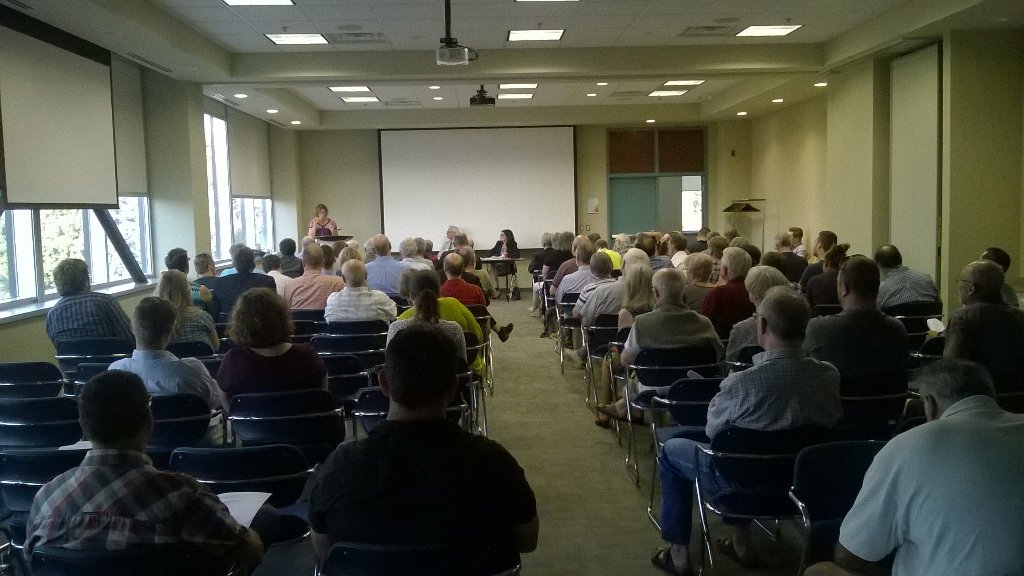
7:10 PM: Approximately 100 people are in attendance tonight. Of the 100, I believe 50% are not politically affiliated to the Liberal Party. (Which is good for a public meeting, they are usually politically homogeneous)
7:11 PM: Third speaker now speaking about the various forms of proportion representative system.
7:12 PM: Third speaker was a fellow in Australia, suggests people ask her about that during question and answer.
7:19 PM: Spicer keeps his remarks short, noting that speakers are over their allocated time,
7:20 PM: I decided to speak as a citizen to start the public discussion.
I called for the lowering of the voting age to 16, noting that our young people take their civic responsibilities seriously.
“We complain that young people are not engaged, yet we disenfranchise them and wonder why they are not participating?”
7:23 PM: The second resident speaker is calling for electronic voting system which is a mixture of all three: first past the post, proportional representation, and ranked balloting.
He says his system will require every candidate to be a member of a political party.
“We don’t want a system like in the past where the Bloc Quebecois became the official opposition … a party committed to breaking up Canada”
Says parties should be required to have candidates in three parties.
7:25 PM: Third resident was a volunteer in the last campaign. Says he was shocked by how much vitriol was delivered between campaigns.
Says the advance poll system takes too long due to manual processes.
Here’s the speakers list from earlier tonight, courtesy of M.P. Tassi’s office.
Hi Joey, Here is the first four speakers for tonight: Frank Attardo Derek Hrynyshyn Karen Bird Zac Spicer
7:29 PM: Third resident has been going on and on and on, someone in the front cuts him off, moderator now steps in, and the person is off the podium.
7:30 PM: Four resident, from Dundas, says he wants to look at why people don’t vote.
Maybe people don’t vote because they are disenfranchised and we need to find out why.
People heckle him, I get a sense the heckling was an underlying partisanships.
7:33 PM: Brian Kelly, lives in Westdale (ran for Council in Ward 3 in 2014), speaking in favour of minority governments. Notes that some of the most cherished Canadian government programs were implemented during minority governments.
7:37 PM: Seventh speaker is in favour of the first past the post system.
Says it keeps voting straight forward. PR would give central parties more power.
“I disagree with my party on this”
He says he thinks the current system is better than alternatives, says proportional representation will allow for the election of single issue fringe parties, notes that some nations have extreme parties which hold the sway of power in the government.
7:44 PM: Denise O’Connor says one of the weaknesses of the current system we are not achieving gender parity in our Parliament.
7:46 PM: I’m going to use “next resident” to distinguish each speaker.
7:48 PM: Next resident – starts by saying he’s from Flamborough, criticizes his M.P. (Conservative David Sweet) for not holding a forum. There are some groans in the room at the speaker.
Then says a FPTP system would work if there were only two parties, but notes how that is not working in the States right now.
Says he wants a system that doesn’t require “strategic voting”. Says many voted for Tassi to prevent a Tory government, they were NDP voters.
Says we should strive for a system that requires parties to compromise in Parliament.
7:56 PM: https://twitter.com/JoeyColeman/status/768234965985296384
8:00 PM: Next speaker: Says we should be more deliberative on the issue, notes New Zealand took 7 years to decision on their new system.
Says we should have a Royal Commissioner to study our system and create a non-partisan recommendation.
8:02 PM: Damin Starr, who ran for Council in the Ward 7 by-election and is a super engaged resident, is saying a weakness of our system is that we don’t review it, and our current system is so simplistic that we’ve avoided an honest discussion of its merits and shortcomings.
Says we don’t do enough to educate and involve our young people.
8:03 PM: Professor Andrew Heard of Simon Fraser University provides a great page looking at electoral reform on his academic website:
https://www.sfu.ca/~aheard/elections/reform.html
Worthy noting they did not use Brexit in their examples (a few people have used Brexit as a warning in advancing their viewpoints)
8:19 PM: The room is now being asked to speak in favour or against mandatory voting.
Thus far, no one is in favour of mandatory voting.
8:27 PM: Two speakers on electronic voting. Both are opposed and the event is near an end, so we’re cut off.
8:30 PM: Howard Rabb gets up to speak about the vulnerability of electronic voting to hacking, he is opposed and gets loud applauds.
8:36 PM: Next speaker: ‘I came here happy with the current system’ “but I’m a middle aged white guy from Dundas”
Says we need to be more deliberative and thoughtful on electoral reform, we should not rush it as is occurring in the current Parliament he says.
8:41 PM: MP Filomena Tassi comes to the microphone for the first time tonight, at the end. She sat listening and taking notes during the entire meeting.
This is actually the first time I’ve met Tassi, and it is a very good first impression.
There was no false scripting of this meeting, sure there were Liberals as the largest single group in the room, but they did not dominate the meeting, did not have a set narrative, and they offered differing views.
(Had I known there were academic speakers, would’ve brought the video camera. I find somethings a camera has a chillening effect on citizens who are speaking publicly for the first time, hence I didn’t bring it tonight.)
8:43 PM: And with that, the night is over. Thank you for following along.