

Hamilton Mayor Andrea Horwath has called a special meeting of Hamilton City Council for Tuesday, July 14, 2026, to hear from McMaster University, SHARCNET, and the federal Digital Research Alliance of Canada about why they believe City Council should permit planned research artificial intelligence data centres to move forward in Hamilton.
Council will vote the next day, July 15, to ratify its 15-1 decision to draft an Interim Control Bylaw prohibiting new, or expansion of existing, data centres for up to one year. The bylaw can be renewed for a second year under the Planning Act, but only through a separate Council vote.
If ratified, the bylaw takes effect immediately. It can be appealed to the Ontario Land Tribunal.
The pending ban on data centres follows rapid and intense public opposition to AI data centres that has seen record numbers of letters sent to City Hall, the largest-ever attendance at Hamilton’s Committee of Adjustment, and the rare use of the Planning Act’s interim control bylaw powers.
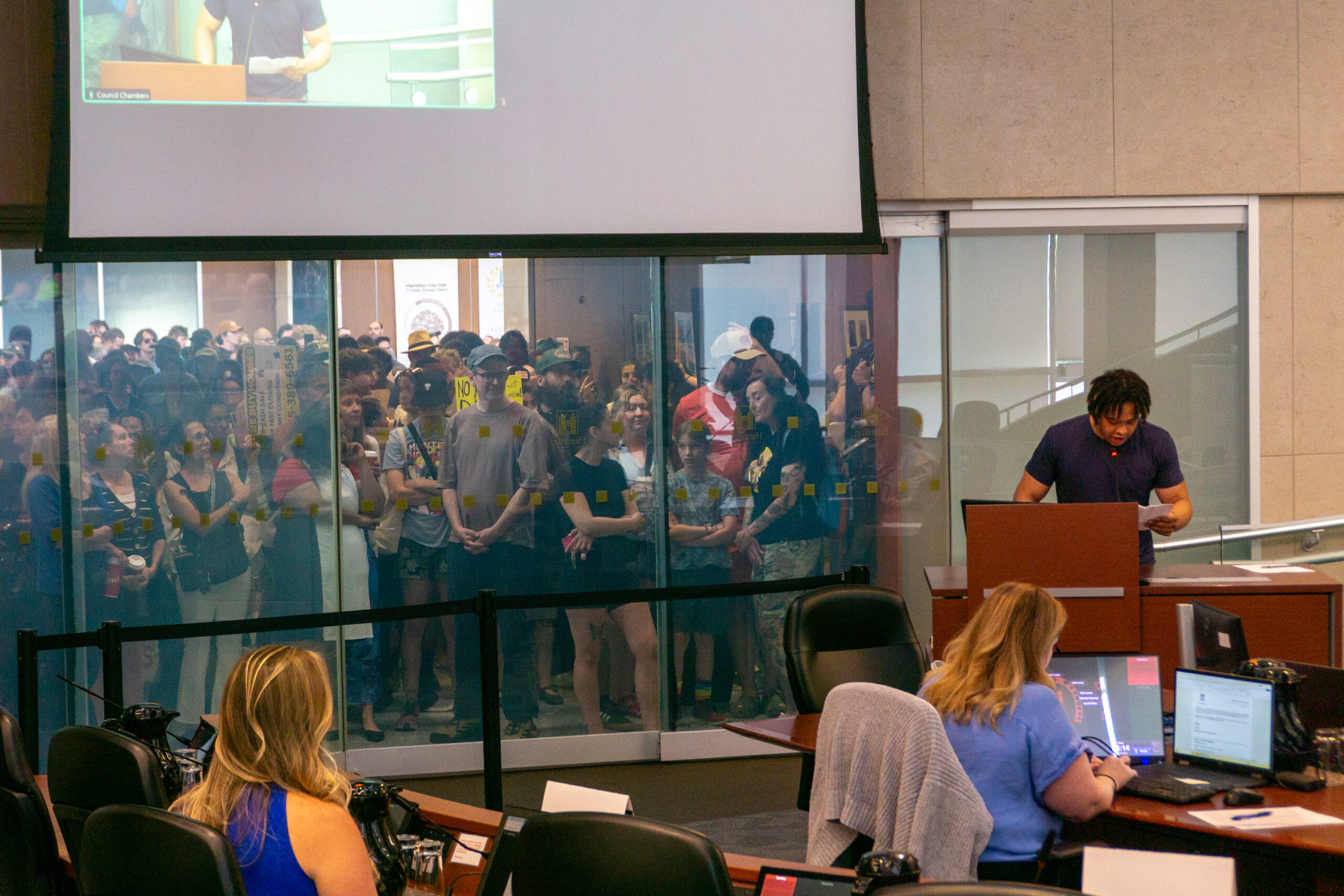
The meeting agenda, posted late in the evening on Thursday, July 9, 2026, states the purpose of the special meeting is for Council to hear “expert, science-based information on AI data centres: what they are, their purpose(s), the different types, sizes, and scales of data centres in use around the world, their respective impacts on communities potential impacts (both positive and negative), and how those impacts may factor into municipal policy decisions.”
The issue gained public attention in the weeks following the May 7, 2026, publication of Slate Asset Management’s severance application for a data centre campus on a 76-hectare section of the former Stelco lands, known as Steelport. The proposal was intended to host federally funded data centres operated by the Digital Research Alliance of Canada. It triggered record-breaking public opposition, drawing 1,209 letters of opposition from residents worried about energy consumption, water depletion, and noise pollution.
The public pushback culminated on June 4, 2026, when hundreds of residents packed a Committee of Adjustment meeting, marking the largest crowd to ever attend such a hearing in Hamilton. The Committee received over 1,200 letters of opposition. In response to the outcry, CoA Member Robert Reid moved to deny the severance, while acknowledging it met all the tests for approval.
“It meets all the regulations for that property. But at the same token, because of the residents, the way they came out today and voiced their opinions, I make a motion to deny the severance,” he stated.
Slate has appealed the denial to the Ontario Land Tribunal.
Concurrently, Ward 3 Councillor Nrinder Nann introduced a motion at City Council for an interim control bylaw. The motion sought to enforce a city-wide moratorium on all new data centre developments for up to two years while municipal zoning regulations are updated.
During the June 24, 2026 City Council ratification meeting, council members approved creating the interim control bylaw in a 15-1 vote, rejecting a proposed exemption for smaller-scale academic facilities like a research data centre planned for 44 Frid Street at the McMaster Innovation Park in a 14-2 vote.
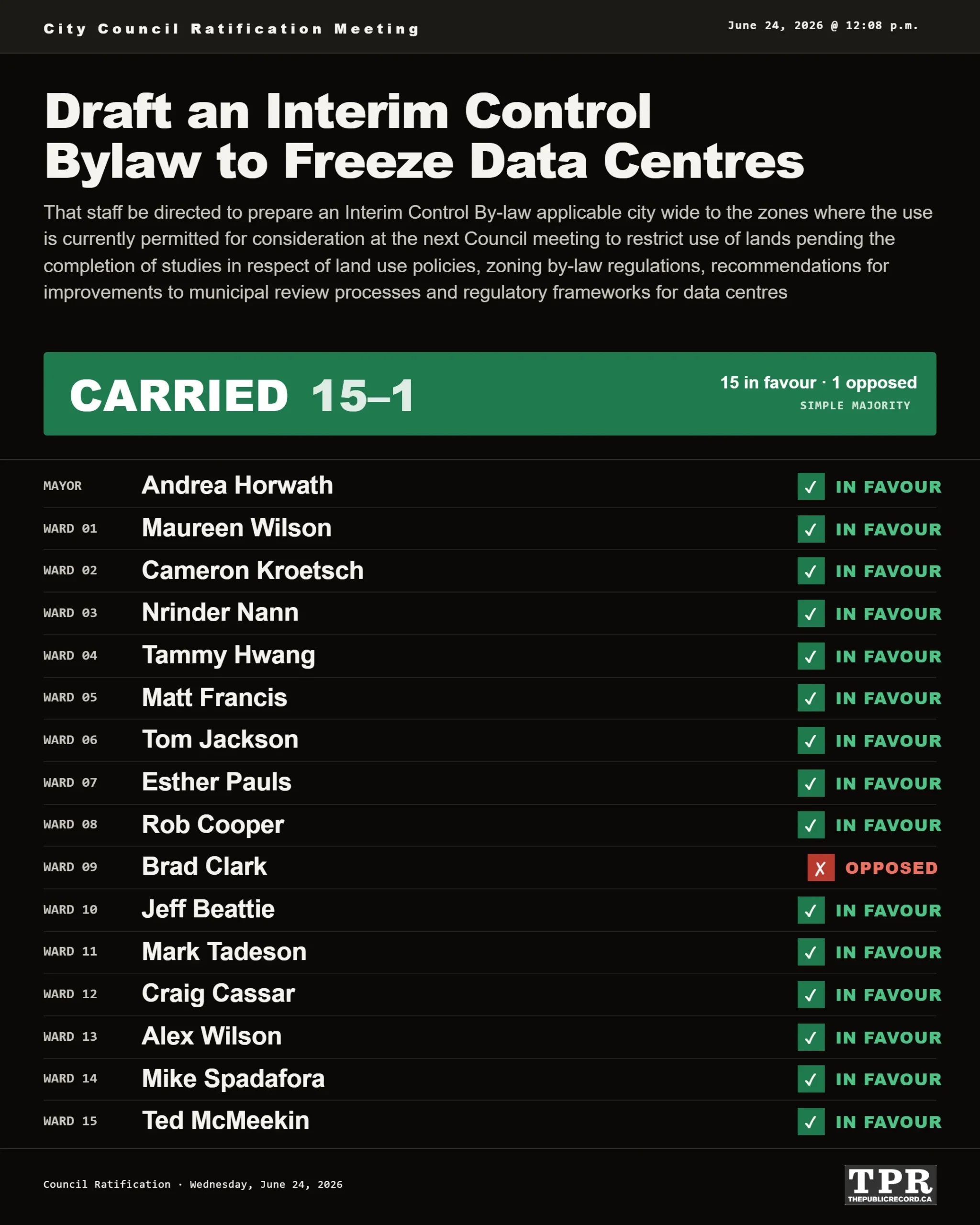
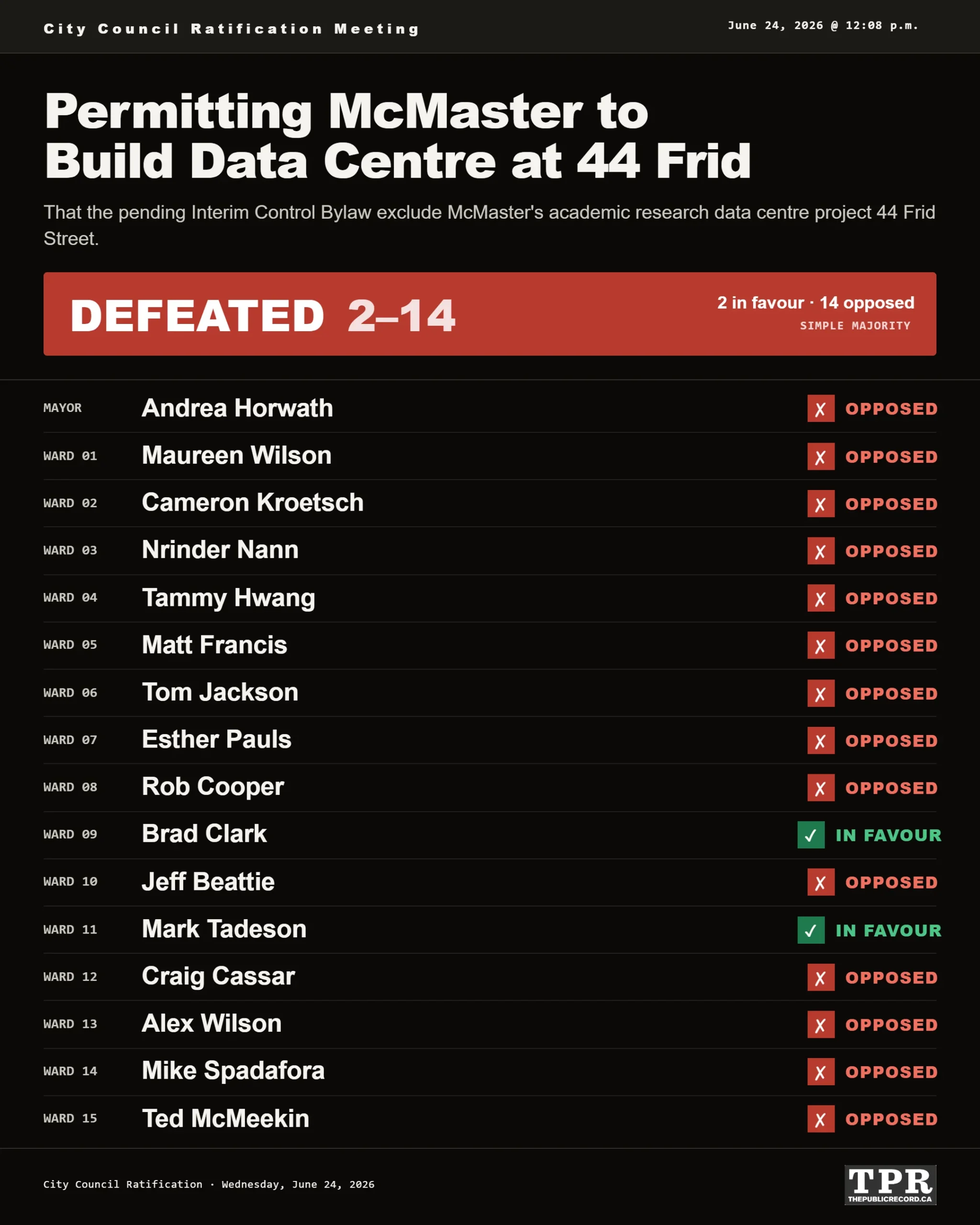
The upcoming special meeting on July 14, 2026, is scheduled to begin at 9:00 a.m. at Hamilton City Hall. The meeting is open to the public. The formal Interim Control Bylaw Bill is scheduled for a ratification vote on July 15.
TPR will provide liveblog coverage of both meetings, including Tuesday’s delegations and Wednesday’s ratification vote.
Production Details
v. 1.0.0
Published: July 10, 2026
Last updated: July 10, 2026
Author: Joey Coleman
Update Record
v. 1.0.0 original version
Discussion
7 commentsWe don’t need a bylaw banning AI data centres for a year. The council needs to educate itself rather than listen to the vocal minority. AI data centres are not perfect, but neither are many of the alternative potential uses of the proposed lands. Banning this for a year can hamper our educational institutions and private enterprise. I’d rather they put in a review process for AI data centres. People are so worried about pollution and the environmental impact of AI data centres, but aren’t picketing the steel plants or manufacturing plants across the city. Each year, there seems to be an airborne plume of pollutants that lands in one of our communities. Why are we not banning these factories? Let’s be realistic here. We need fewer bans and more discussion in order to progress in the best manner that most benefits the city and us citizens. Talk about it, figure it out instead of burying our heads in the sand.
1200 letters of opposition in a city this size is laughable
Your comment makes so much sense. Sadly people are full time protesters and don’t care to educater themselves
“Discussion in order to progress in the best manner that most benefits the city and us citizens” was exactly what was supposed to happen during the 1 year moratorium via the interim control by-law. The undertakings by the university are exempt from planning approvals by the city, so the interim control by-law wouldn’t apply to that specific project.
1200 letters of opposition in a city this size is laughable
Hi Joey,
I am confused about something… you say in this article…
“Council will vote the next day, July 15, to ratify its 15-1 decision to draft an Interim Control Bylaw prohibiting new, or expansion of existing, data centres for up to one year. The bylaw can be renewed for a second year under the Planning Act, but only through a separate Council vote.
If ratified, the bylaw takes effect immediately. It can be appealed to the Ontario Land Tribunal.”
Is council voting to ratify the decision “to draft an Interim Control Bylaw”, in other words, for staff to write it? Or is it expected that staff will have already written the bylaw for the Wed meeting, and if they vote in favour the bylaw takes effect immediately?
I am guessing if it takes effect immediately, this means the wording of the bylaw will be presented on Wed? I am confused as to why there seems to be no public input in the actual working of the bylaw staff is writing.
So they arent voting ‘to have staff write the bylaw’, they are voting on whatever staff comes up with. Any clarification you can provide is greatly appreciated.
Hi Rob,
Good point. Council will ratify the bylaw. It is now on the agenda for Wednesday.
Comments are closed on this story.