Hamilton City Council voted 13 to 3 on Wednesday (May 13, 2026) to ratify an Audit, Finance and Administration Committee decision that freezes development charges for the coming year by adding a four per cent temporary exemption to the City’s existing 20 per cent exemption, neutralizing a scheduled June 1, 2026, inflation increase for all development types.
The City is forecasting the move will cost approximately $5.52 million in foregone development charge revenue. General Manager of Finance and Corporate Services Mike Zegarac stated the shortfall will be absorbed by existing taxpayers and ratepayers, with 70 per cent of the impact hitting the municipal water budget and 30 per cent affecting the property tax levy.
Zegarac explained that mechanically, the City will still apply the four per cent indexing to the base rate to ensure long-term compounding revenue is not lost, but will simultaneously increase the developer discount to offset the cost for the next year.
“Committee did approve indexing development charges by four per cent, so that will continue in perpetuity,” Zegarac said. “For the period of June 1, 2026, to May 31, 2027, committee also approved an adjustment to the temporary development charges discount exemption from 20 per cent to 24 per cent, so effectively offsetting the indexing for that period of time.”
The three votes against the measure came from Councillors Nrinder Nann (Ward 3), Alex Wilson (Ward 13), and Cameron Kroetsch (Ward 2), who criticized the decision as a taxpayer-funded subsidy for the development industry with no guaranteed returns for the public.
“I’m not in favour of moving forward with this,” Councillor Alex Wilson said. “$5.5 million is ten per cent of the new spending in the 2025 budget. I don’t believe that this is a resident priority to the tune of $5.5 million. While I appreciate that there are real realities going on in the sector and that as we go through economic challenges, everyone hurts. To me, the programs that have been developed by the Province and the Feds feel a little bit like infrastructure hunger games at this point, and I don’t think that sending $5.5 million as a community sacrifice is the right way to participate in the program. I don’t support paying to play.”
Councillor Nann echoed those concerns, saying the decision places a burden on residents to subsidize the development industry.
“I will not be supporting the recommendation to bring in a further $5.5 million impact to property taxes, especially given the ongoing conversation around this table that many members diligently want to bring forward the fact that they want to keep property taxes down,” Nann said.
Supporters of the exemption argued the reduction is a necessary intervention to stimulate a stalled local economy, prevent further job losses in the construction trades, and position Hamilton to qualify for billions in potential federal and provincial infrastructure funding under the proposed Canada-Ontario Partnership to Build program.
The Council’s decision follows direct appeals from the local development industry. West End Home Builders Association Chair Dani Gabriel, the director of operations for Marz Homes, told councillors on the AF&A committee that development charge relief is necessary because “the math does not work” in the current economic environment.
“The cost of building a home today exceeds what buyers are able to pay,” Gabriel said. “Our members have delayed projects and reduced staff. Builders across this region are laying people off, and that doesn’t just affect us; it leaves trades and supply partners without work.”
Councillor Maureen Wilson (Ward 1) pushed back against the framing that the exemption is an unwarranted bailout for what is usually a very profitable industry.
“There’s no real political upside for voting for an enhanced development charge reduction because it can be framed as we’re bonusing or privileging private developers who happen to make gobs of money a decade ago, and so why are we doing this now?” Wilson said. “I don’t think public policy should be based on, ‘well, you made a lot of money then, you’re not making it now, you should have saved it.’ We don’t apply that to any other industry, including the auto industry.”
Mayor Andrea Horwath noted that while the specifics of the provincial funding program are still being designed, Hamilton must act now to demonstrate its willingness to partner with higher levels of government to get housing built.
“It’s very rare that we have three orders of government trying to solve the same problem and actually working together to do so, and I think we need to be a part of that effort,” Horwath said. “I will be supporting this as well, because it’s from my perspective what we need to do to play our part to get housing built, to get people back to work, and to help make sure that our economy is firing as effectively as possible.”
Councillor Rob Cooper (Ward 8) pointed to the significant impact the housing downturn is having on local workers, urging Council to look beyond the municipal balance sheet.
“When you look at our own local economy, what’s happening in the last year, 1,900 trades jobs have been lost,” Cooper said. “That’s two and a half times the size of Stelco, just to put it in context for folks. And right now, you look around Hamilton, you see the cranes down. You see the tool belts down as well. And so we have to look at this from the human aspect of what it means to our local economy.”
Councillor Ted McMeekin (Ward 15) added that the City’s willingness to reduce fees serves as a critical signal to financial institutions that are currently hesitant to finance new construction projects in the region.
“Last week, I had a major builder come to see me. We spent about an hour together, and his business came to a standstill because the bank would not provide lender money because of a lack of confidence in the industry,” McMeekin said. “By doing this and moving forward in this way with some initial, tentative support from the two senior levels of government, doing so enhances the confidence of the banks to come to the table when lender credit is needed.”
During the debate, Councillor Brad Clark (Ward 9) said the provincial and federal governments could significantly assist by providing capital funding for the provincially mandated expansion of Hamilton’s water treatment and waste water treatment facilities.
“We have some major infrastructure projects that most certainly, if they funded it, would drop the DC requirement significantly.”
As a single-tier municipality, the City of Hamilton is responsible for the costs of expanding its water and wastewater infrastructure to provide for a forecasted 2051 population of approximately 903,000. This is why 70 per cent of the costs of the one-year development charge indexing waiver will be accounted for by increasing water rates for existing users.
Lower-tier municipalities such as Vaughan and Burlington are able to offer larger percentage development charge waivers because the York and Halton regional governments, respectively, charge and collect development charges for major infrastructure.
Hamilton City Council will debate a resolution this summer requesting senior levels of government to provide grant funding to offset the municipal revenue lost by implementing the development charge discounts.
How Council Voted
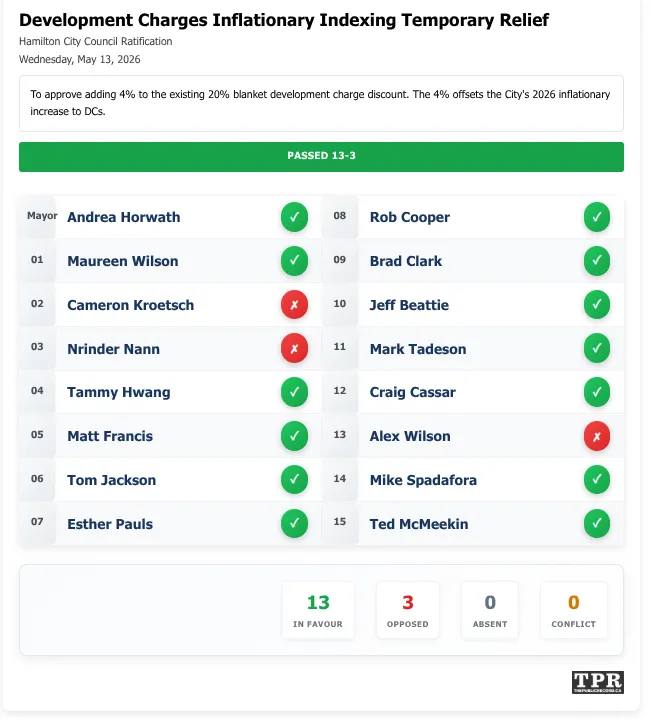
In Favour (13):
- Andrea Horwath (Mayor)
- Maureen Wilson (Ward 1)
- Tammy Hwang (Ward 4)
- Matt Francis (Ward 5)
- Tom Jackson (Ward 6)
- Esther Pauls (Ward 7)
- Rob Cooper (Ward 8)
- Brad Clark (Ward 9)
- Jeff Beattie (Ward 10)
- Mark Tadeson (Ward 11)
- Craig Cassar (Ward 12)
- Mike Spadafora (Ward 14)
- Ted McMeekin (Ward 15)
Opposed (3):
- Cameron Kroetsch (Ward 2)
- Nrinder Nann (Ward 3)
- Alex Wilson (Ward 13)
Production Details
v. 1.0.0
Published: May 14, 2026
Last updated: May 14, 2026
Author: Joey Coleman

Update Record
v. 1.0.0 original version
Discussion
0 commentsComments are closed on this story.