The Ontario Land Tribunal (OLT) has approved a rare request from the City of Hamilton to consolidate common issues from three separate appeals challenging Hamilton’s urban boundary freeze into a single, two-week hearing. The decision, approved by OLT Member Kurtis Smith, means all parties will face one ruling on the merits of the urban boundary freeze, eliminates the need to present identical evidence three times, and prevents the risk of contradictory decisions from separate OLT adjudicators.
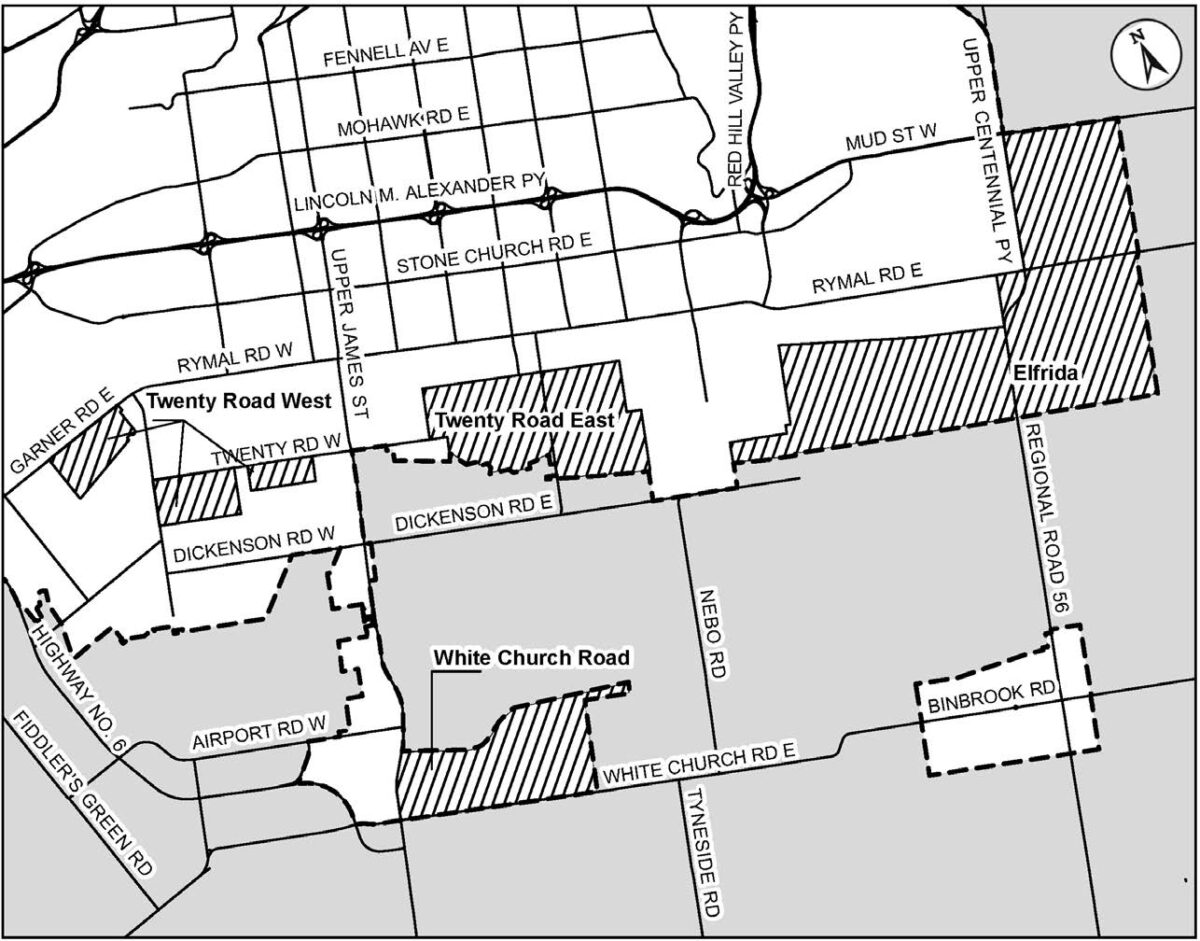
The City is defending City Council’s decision to freeze Hamilton’s urban boundary against three separate appeals. The Upper West Side Landowners Group (UWSLG) seeks to add approximately 700 acres north of the John C. Munro Hamilton International Airport along Twenty Road West and Garner Road East. A second appeal represents approximately 899 acres south of White Church Road in Mount Hope, which is the subject of the White Church Secondary Plan. The largest appeal involves the 3,000-acre Upper Stoney Creek Elfrida lands.
Kim Mullin, an outside lawyer representing the City, presented the multi-party agreement to the OLT. Mullin argued that combining the challenges into one hearing is efficient for all parties and the tribunal, as the City would otherwise be required to present the same evidence and witnesses three separate times. The core legal issue rests on a common set of questions that must be determined before any area-specific decisions can be made.
The five common issues to be heard are: the accuracy of the City’s population forecasts and methodology; whether Hamilton’s urban boundary freeze prevents an appropriate range and mix of land uses (two related questions); and whether the urban boundary freeze prevents the City from providing needed housing to meet population growth (two related questions).
Ira Kagan, lawyer for the Upper West Side Landowners Group, stated that his clients support the consolidation agreement, even though it provides lesser benefit to them as they already have scheduled hearing dates for their appeal. Kagan said the consolidation creates the same set of rules for all Hamilton urban boundary expansion appeals and protects the interests of everyone involved in the process.
The consolidated hearing has been divided into two phases. Phase I, covering the five common issues, is scheduled to begin on April 13, 2026, and will run for two weeks. Phase II hearings will then address the specific land-use issues for each appeal separately.
The UWSLG Phase II hearing will begin on April 27, 2026. The Elfrida Phase II hearing is scheduled to begin on January 18, 2027. No date has been set for the White Church Road lands appeal.
Last term’s City Council voted in November 2021 to freeze the urban boundary in favour of intensification. While the provincial government initially overrode this decision in 2022 to force an expansion, that order was rescinded in October 2023 amidst the fallout of the Greenbelt scandal. The current OLT challenges utilize recent updates to the Planning Act and the 2024 Provincial Planning Statement, which allow private developers to trigger expansion hearings despite Council’s refusal.
Looming over the procedural arguments is a practical “race” for infrastructure capacity. The City has previously indicated that the Upper Centennial Trunk Sewer—the primary servicing infrastructure for these areas—does not have the capacity to support all three proposed expansions simultaneously.
Each of the developers is competing to secure their approvals first, before servicing capacity is taken by others.
This term’s City Council remains unanimously opposed to urban boundary expansions.
OLT Information
Case Numbers: OLT-24-000748, OLT-25-000591, OLT-25-000613

Decision on CanLII: Elfrida Community Builders Group Inc. v Hamilton (City), 2025 CanLII 134091 (ON LT)

Production Details
v. 1.0.1
Published: December 3, 2025
Last updated: February 16, 2025
Author: Joey Coleman

Update Record
v. 1.0.0 original version
v. 1.0.1 added link to ruling on CanLII under the OLT Information section