

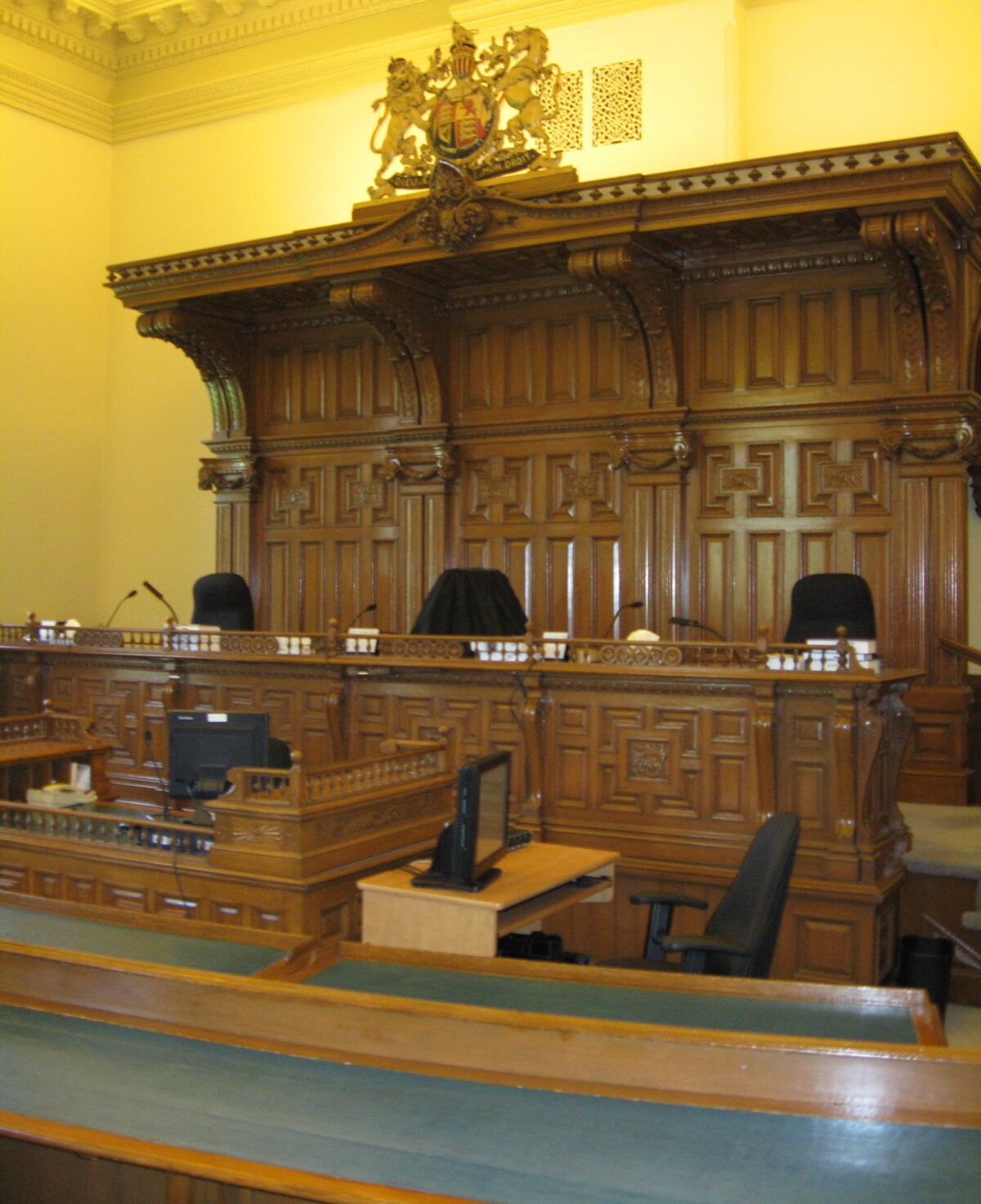

February 10, 2026 at 9:57 AM: GOOD MORNING I’m in Courtroom 7 at Osgoode Hall for today’s Court of Appeal oral arguments regarding the Charter of Rights and Freedoms and encampments. Officially, about Hamilton’s encampment bylaw. In practice, with seven interveners, dealing with the broader issue. #yhmcc Live posts follow
9:57 AM: Note: I am using #yhmcc (Hamilton City Council) as my hashtag due to its uniqueness and ease for future searches.
10:01 AM: At 10:00 a.m., due to renovation work underway in Osgoode Hall, today’s hearing is in a smaller courtroom. There is only one available seat. There are approximately two dozen gowned lawyers. The public seats include some of the Hamilton encampment appellants who have made the trip here to Toronto. #yhmcc
10:03 AM: I am the only Hamilton journalist in the courtroom. The panel is in the courtroom. Justice Grant Huscroft (in the centre), Justice Gary Trotter, Justice Lise Favreau. Counsel are now introducing themselves to the Court. #yhmcc
10:04 AM: The last remaining seat in the public gallery was just taken. #yhmcc
10:06 AM: Justice Huscroft is naming each counsel, having them confirm they are present. He was attempting to pronounce names correctly; after a few unsuccessful attempts, he noted he was not doing that well today — good cheer in the room. #yhmcc
10:10 AM: Sujit Choudhry, counsel for the appellants (encampment litigants), outlines their time schedule. Two hours for the appellants’ arguments. Ten minutes for each of the interveners aligned with their position, in the following order: LEAF, OHRC, CCLA, CCHR, BCCLA. #yhmcc
10:10 AM: LEAF = Women’s Legal Education and Action Fund. OHRC = Ontario Human Rights Commission. CCLA = Canadian Civil Liberties Association. CCHR = Canadian Centre for Housing Rights. BCCLA = British Columbia Civil Liberties Association. #yhmcc
10:13 AM: Sujit Choudhry says today’s case is about human rights and the ability of those denied housing or who cannot afford housing to be able to have shelter against the elements and some privacy within a tent while trying to find permanent housing. #yhmcc
10:15 AM: Choudhry says they are arguing Hamilton’s park bylaw ban against camping / encampments is unconstitutional because it denies shelter to individuals when there are not adequate and sufficient indoor shelter spaces available to them that meet their needs. He is outlining the history of the case. #yhmcc
10:19 AM: Choudhry notes this is the first “unhoused encampment case” to make it to the Court of Appeal for Ontario. He emphasises “unhoused encampment case” to focus their case. #yhmcc
10:22 AM: Choudhry wishes to hand a paper document — a table with three columns — to the three Justices. Lawyer for the City of Hamilton Bevin Shores objects, saying it is new evidence and would require a lengthy response from the City. Justice Huscroft is now conferencing with the other Justices. #yhmcc
10:22 AM: Justice Huscroft accepts the paper document with the table. He firmly states the Court is “disappointed this wasn’t dealt with at case management” and makes clear the panel does not wish this hearing bogged down — it is a tight two-day schedule. #yhmcc
10:26 AM: Choudhry outlines the reason for the appeal of Justice Ramsey’s decision. Beyond claimed errors in law, he argues the Justice used incorrect and discriminatory stereotypes regarding unhoused individuals. He notes Ramsey’s decision is a significant departure from other Ontario and B.C. court rulings. #yhmcc
10:30 AM: Choudhry on the City’s statement that it does not enforce the bylaw during overnight hours, something Justice Ramsey accepted. Choudhry notes that non-enforcement does not make the bylaw immune from Charter scrutiny. #yhmcc
10:34 AM: NOTE: As Choudhry outlines the case and the case law, which have been well covered in my trial-level coverage in the past years, I’m going to try to focus on dynamics in the room.
10:34 AM: Choudhry is now dealing with City documents that were struck from the record by Justice Ramsey. Lawyers for the City stand up and ensure clarity that these documents are disputed and were struck from evidence. Justices Trotter and Favreau both direct questions at Choudhry to focus the issue. #yhmcc
10:36 AM: The documents are copies of the City’s Housing and Homelessness data dashboard, and explanations of what this data is and why it is collected, and City Council reports, and the Point-in-Time Counts. Combined, the appellants are using these to show more unhoused people than shelter beds. #yhmcc
10:42 AM: Arguing admissibility of the City of Hamilton documents regarding the rules of evidence, the public records exception. There is complexity to the rules of evidence. In short, Justice Ramsey did not allow the documents to be entered into the record. Choudhry is arguing that is an error of law. #yhmcc
10:49 AM: Choudhry is discussing how the City counts available shelter spaces, noting that a City-rented hotel room counts as four beds in the City’s count, but a family may not be four people. Thus, the City’s total number is an overcount. #yhmcc
10:53 AM: Justice Huscroft asks Choudhry if there is evidence regarding how the City can know — or not know — what shelter space demand will be. [Gets to the legal issue of what is significant capacity, when are shelters full.] #yhmcc
10:55 AM: Justice Favreau asks a question of clarification regarding how the City of Hamilton counts the number of homeless/unhoused versus estimates of this count. #yhmcc
11:03 AM: Choudhry now discussing shelter restrictions and people being service-restricted. He then turns to the issue of separation of couples, noting that shelters are gender-based and single-bed. This is not accessible. Choudhry is arguing why the ONCA should follow Justice Valente’s 2023 Waterloo decision. #yhmcc
11:03 AM: Choudhry says the idea of “accessible shelter space” is an “objective measure” — that people with high-acuity require shelter spaces which meet their needs. This includes low-barrier housing and supports. [Such as noted in the 2023 Waterloo decision.] https://thepublicrecord.ca/2023/02/ontario-superior-court-strikes-down-waterloo-encampment-bylaw/
11:06 AM: Choudhry now discussing the medical expert evidence that encamping in a tent provides some shelter, warmth, and some level of protection against the risks and harms of being homeless — that homelessness is the problem, not the ability to erect a tent for shelter. #yhmcc
11:15 AM: There is a series of quick questions and responses. I’m doing notes and will catch up here when I can. #yhmcc
11:15 AM: Section 15 Charter arguments are now complete. Now onto Section 1 arguments — what are the reasonable regulations on encampments. Encampment litigants’ lawyer Choudhry says Hamilton’s encampment protocol (as it was) represents a good example of what can be reasonable limitations in a Section 1 test. #yhmcc
11:47 AM: There was approximately 15 minutes of back-and-forth between the Justices and encampment appellant lawyer Choudhry regarding a survey that found 29 per cent of those in encampments would not accept any shelter space. Justice Huscroft asked if the argument is that those 29 per cent should have a Charter right to encamp. #yhmcc
11:47 AM: Encampment litigants’ lawyer Sujit Choudhry responds that with Section 1 reasonable limits, this population needs to be addressed. Quote in next post. #yhmcc
11:47 AM: Justice Huscroft responded that the panel wants to focus on the 29 per cent who will not use shelters. “Are they entitled to set up an ‘encampment subdivision’? Is the argument ‘that’s constitutionally required?’ That ‘they stay in the encampment if they feel like it?'”
11:47 AM: Choudhry clarified they are arguing “The City can set rules regarding where encampments can be, the size of tents, the number of tents” and a list of other rules, but that people should be permitted to remain during the day. #yhmcc
11:47 AM: Justice Huscroft responded that Choudhry’s description of encampments as a “shared use” of parks was washing over the issue — that Justice Ramsey ruled this was not a shared use, noting Ramsey found “taking over public property for private use” causes other people to not use parks. #yhmcc
11:58 AM: Justice Huscroft then emphasised he is asking about the people “who will never go into any kind of shelter,” to which Choudhry responded Section 1 permits regulations and rules.
11:58 AM: Justice Huscroft: “I’m not sure how that helps you here — that people want housing, there is no obligation to provide housing, that is not what you are arguing here, is it?” Choudhry: “If they are looking for housing, they should be able to stay [encamped] under Section 7.” #yhmcc
11:58 AM: For around five minutes, there was a back-and-forth regarding whether Choudhry’s argument amounts to creating permanent “encampment subdivisions,” and what is reasonable under Section 1. #yhmcc
11:58 AM: Justice Huscroft: “You are suggesting an encampment subdivision.” Choudhry: “There is a limit to the number of tents that can be in a cluster due to countervailing interests.” #yhmcc
11:58 AM: Choudhry: “There is some benefit for people being able to select with whom they encamp … a space for a little community; it is not creating a subdivision.” “It is no different than any other limits in society,” he says of the ability to have rules and regulations. #yhmcc
12:01 PM: Catch up, not check up.
12:15 PM: Section 15 Charter arguments are ongoing. The sum is that women and men are reported to have nearly equal experiences of being homeless, yet the number of men’s emergency shelter beds is nearly double that of beds for women. There is a disproportionate impact on women from banning encampments. #yhmcc
12:29 PM: City lawyer Jordan Diacur stood up to object. Justice Huscroft told him “no” before a word was said. Diacur did not sit back down. Justice Huscroft very firmly told him to sit down. “There will be no more interruptions,” and ensured the lawyers were clear about this instruction. #yhmcc
12:29 PM: Crowe argues Justice Ramsey did not explain why he chose the evidence of the City over that of the litigants in regards to the time of day that encampment evictions occurred. Crowe enters case law that requires trial judges to explain credibility assessments, arguing the judge grouped by stereotype. #yhmcc
12:35 PM: Deep into some legal test arguments for damages sought.
12:40 PM: The encampment litigants’ lawyers have 30 minutes remaining and need to reserve time for reply after the City’s arguments. This puts lawyer Crowe on a tight clock. Justice Trotter provides guidance regarding what the Court needs to hear outside of the written submissions. #yhmcc
12:43 PM: Crowe is now arguing for the credibility of encampment litigants’ statements that there were, in fact, encampment evictions during an overnight period. This is important to the error-of-law arguments. #yhmcc
12:53 PM: The encampment litigants’ arguments are complete. Court is on lunch until 2 p.m. #yhmcc
February 10, 2026 at 1:58 PM: New Live Updates Thread. GOOD AFTERNOON — I’m in Courtroom 7 at Osgoode Hall for the continuation of the Court of Appeal hearing on Hamilton’s encampment ban. As the first ban to reach the appellate level, this case is about the broader issue. Interveners up shortly after 2 p.m. #yhmcc
2:04 PM: Before interveners, encampment litigant lawyer Sharon Crowe asks for five minutes to clarify some evidentiary matters and concerns about Justice Ramsey’s decision. That was quickly complete. #yhmcc
2:09 PM: Intervener Women’s Legal Education and Action Fund is now providing their ten-minute submission. This is a gender-based intersectional-lens argument that requests the Court declare encampment bans disproportionately harm women and gender-diverse persons. #yhmcc Factum: https://www.leaf.ca/wp-content/uploads/2026/01/COA-25-CV-0166.FOI-08-JAN-2026.pdf
2:11 PM: Lawyer Erika Anschuetz is arguing in the courtroom for LEAF. She is joined by lawyer Alexa Biscaro via videoconference. #yhmcc
2:20 PM: The next intervener statement is from the Ontario Human Rights Commission. Lawyer Reema Khawja is delivering the OHRC’s submission. #yhmcc
2:24 PM: Justice Huscroft asks a challenging question regarding what case law the OHRC has chosen to argue in this matter. The OHRC provides a comprehensive answer. #yhmcc
2:41 PM: The Canadian Centre for Housing Rights is now making their ten-minute submissions. Lawyer Margaret Flynn arguing in the courtroom, lawyer Princess Doe online. Arguing housing is a human right and government should be providing more housing. #yhmcc
3:05 PM: Interventions on the side of the encampment litigants are now complete. A brief break as the City of Hamilton’s lawyers set up to begin the first hour of their submissions. #yhmcc
3:21 PM: Shores: Justice Ramsey made no palpable and overriding error in determining there were no overnight encampment removals — no use of discriminatory stereotypes in the ruling — the decision was sound and correct. #yhmcc
3:24 PM: Shores: It is important to be clear about what this case is, or is not. This appeal is about determining if Justice Ramsey made a palpable and overriding error. Justice Favreau asks a question regarding the City’s view of legal tests and measures on appeal. #yhmcc
3:27 PM: Shores: The City has acted responsibly and in accordance with case law. The City has permitted overnight temporary sheltering when there are not sufficient shelter spaces. The City acknowledges the Section 7 rulings from B.C. “This is the pivotal issue.” #yhmcc
3:34 PM: Justice Favreau asks the City’s lawyer about Justice Ramsey’s statement “I do not believe them” regarding the evidence of the encampment litigants — one of the appellant arguments is that Ramsey did not explain his decision in this regard. https://canlii.ca/t/k8h37#par38
3:34 PM: Shores says it is possible Justice Ramsey could have chosen better verbiage in this portion of the decision, but that he shows in the entirety of the decision he weighed the credibility of competing evidence. #yhmcc
3:37 PM: Shores is now arguing the evidence that speaks to credibility regarding the encampment litigants’ statements about claims of overnight encampment evictions and removals. #yhmcc
3:40 PM: Shores stated that “5 a.m. is not overnight” in response to a claim that a removal occurred at 5 a.m. Justice Trotter asked “what is overnight?” A discussion follows, with “dusk to dawn” eventually settled on as overnight. #yhmcc
3:48 PM: Shores states the City did not force appellants (encampment litigants) to “sleep rough” and therefore the claims for damages are not founded — the City always permitted overnight use of tents. Justice Huscroft questions this, gets clarity that it was only overnight and that people were expected to pack up during the day. #yhmcc
4:00 PM: Justice Favreau asks where it states in Hamilton’s encampment protocol — referencing the B.C. Adams case — that people can take down a tent during the day and return to the same spot at night. It is conceded that language is not directly in the Hamilton protocol. #yhmcc
4:05 PM: Justice Favreau asks what the City’s goal was during the encampment protocol. Shores: to avoid the health and safety impacts of entrenched encampments. #yhmcc
4:05 PM: And today’s oral arguments are complete. #yhmcc
February 11, 2026 9:57 AM: GOOD MORNING — I’m at Osgoode Hall for Day 2 of 2 of the Court of Appeal oral arguments regarding the Charter of Rights and Freedoms and encampments. Officially about Hamilton’s encampment bylaw, in practice dealing with the broader issue. Continuing with City submissions at 10 a.m. #yhmcc Live posts follow.
9:57 AM: Note: I am using #yhmcc (Hamilton City Council) as my hashtag due to its uniqueness and ease for future searches.
9:59 AM: The public gallery is less populated today. From what I can tell, nearly everyone in the gallery is either court staff or articling students; there is also a high school student. I am the only journalist in the courtroom for what is a significant case — encampment law in Ontario. #yhmcc
10:05 AM: We are awaiting the panel of Justices. #yhmcc
10:06 AM: The panel is in the courtroom. Justice Grant Huscroft (in the centre), Justice Gary Trotter, Justice Lise Favreau. #yhmcc
10:11 AM: Justice Grant Huscroft: “The panel is not entirely clear what is at stake here, what is being contested.” Notes parts of Justice Ramsey’s decision. If more than the overnight temporary encampment/sheltering is at issue, please ensure the panel is aware. #yhmcc
10:11 AM: This gets at the challenge of the matter in front of the Court of Appeal — officially this is an appeal of Justice Ramsey’s decision; practically, because this is the first encampment case at the Ontario appellate level, the Court is dealing with the broader issue. How to balance this. #yhmcc
10:12 AM: The panel is going to be directing a lot of questions at the lawyers for the City of Hamilton. As we saw yesterday, the three appeal Justices are very alive to the issues and are asking challenging questions. #yhmcc
10:16 AM: For the City of Hamilton, lawyer Jordan Diacur says that Hamilton’s position is that Ontario should adopt the British Columbia Court of Appeal encampment framework set by Victoria (City) v. Adams, 2009 BCCA 563. “Adams was correctly decided.” https://canlii.ca/t/26zww #yhmcc
10:16 AM: Diacur: Adams says municipalities must provide overnight emergency shelter spaces. If a municipality does not provide spaces, then overnight temporary encampment is permitted and required by the Charter. There is no permission or allowance for daytime encampments. [NOTE: my summary] #yhmcc
10:19 AM: The ONCA Justices are asking many questions regarding the City of Hamilton’s position on daytime encampments. City lawyers say the City had to deal with “entrenched encampments.” [Note: the Gage Park electrical trenches are not directly cited.] #yhmcc
10:19 AM: The Justices say they do not have an analysis from the parties regarding Section 7 [Charter right to life protections] and daytime encampments/shelters. They are probing this issue with questions. #yhmcc
10:27 AM: Justice Favreau is asking questions of the City of Hamilton’s lawyers regarding Justice Ramsey’s findings that there were no night-time encampment removals or evictions — especially Justice Ramsey’s findings that the encampment litigants were not credible, and how Justice Ramsey arrived at that conclusion. #yhmcc
10:27 AM: The City is arguing that Justice Ramsey’s findings were supported by the facts and affidavit evidence. City lawyer Diacur said Justice Ramsey “could have been harsher” in describing the credibility of the encampment litigants. Justice Trotter challenged Diacur to explain how he could have “been harsher.” #yhmcc
10:27 AM: Diacur was unable to provide a direct answer to Justice Trotter. Justice Trotter noted that Justice Ramsey’s ruling said he “does not believe” the encampment litigants — that was harsh. #yhmcc
10:32 AM: Appeal Justices noting that while the City of Hamilton states bylaw officers never work overnight, the City did not enter timesheets or schedules as evidence in support of that statement. The Justices note that had the ruling involved this evidence, the overnight issue may have been more firmly settled. #yhmcc
10:32 AM: Justice Favreau to the City [note: my condensing, not verbatim] — do you have any case law that accepts using expert witness testimony regarding addictions and memory to assess the credibility of a group of individuals? Favreau is exploring the argument that Justice Ramsey could have relied on stereotypes. #yhmcc
10:35 AM: Pace of question and response is quick right now. I’m taking notes and will catch up on posts when I can.
10:37 AM: Appeal Justices are asking many questions regarding Justice Ramsey’s credibility findings, and the City’s arguments that it is “grounded in the evidence,” and now discussing affidavit evidence that shows “there are individuals who prefer access to drugs [in encampments] over [indoor] shelter.” #yhmcc
10:41 AM: Appeal Justices express concerns regarding Justice Ramsey’s paragraph 24, which the litigants’ appeal states uses stereotypes and constitutes an error of law. The City tries to defend this, and in the event the Court of Appeal finds this paragraph a problem, argues the record shows credibility issues. #yhmcc
10:41 AM: Justice Trotter responds, saying the City’s argument amounts to “bad reasons, good record.” The City’s lawyer says “it can’t be an error of law” for the Court to have considered the record — both litigant statements and expert evidence — regarding the credibility of the litigants. #yhmcc
10:43 AM: City lawyer Jordan Diacur returns to arguing that Ontario should adopt Victoria (City) v. Adams, 2009 BCCA 563. https://canlii.ca/t/26zww #yhmcc
10:47 AM: Discussion regarding how an Adams framework for temporary overnight encampments would function in practice — such as Hamilton’s encampment protocol, which had separation distances from infrastructure. Where would people be allowed to encamp overnight? #yhmcc
10:50 AM: A quick note: when I highlight with “my summary” or similar, I draw attention to having condensed a more complex legal argument or lengthier exchange into this live post format, and that I am exercising more word choice to achieve this. Single quotes (‘) indicate paraphrase; double quotes (“) indicate direct quotations. #yhmcc
10:55 AM: Diacur is now arguing that the Section 7 Charter right is limited to life, liberty, and security of the person. The overnight temporary erection of shelter is limited to circumstances in which no shelter beds are available. It cannot extend to someone’s preference not to be within a shelter. #yhmcc
10:59 AM: Diacur emphasises the need for a “genuine threat to life, liberty, and security of the person.” “Personal preferences — such as ‘I have a pet and I do not want to go into shelter’ — should not grant individuals a Charter-protected right to erect an encampment.” #yhmcc
10:59 AM: Appeal Justices probe what would constitute a preference in the context of the City’s arguments. They note that people have genuine reasons to be fearful of shelter systems, citing examples of this. [They did not explore addiction during this brief set of questions. That has been mentioned elsewhere.] #yhmcc
11:03 AM: Justice Huscroft notes the City is arguing to have its parks bylaw and encampment protocol upheld as constitutional — as per Justice Ramsey’s decision — yet at the same time is saying it does not enforce it. Huscroft delivered a one-liner regarding this that caused some restrained chuckles. #yhmcc
11:06 AM: At the root of this is that, on one hand, this two-day appeal hearing is officially about Justice Ramsey’s Superior Court decision regarding Hamilton’s parks bylaw. At the same time, being the first Ontario appellate-level encampment case, the broader issue is being argued simultaneously. #yhmcc
11:09 AM: The City’s Section 7 arguments are complete. Now onto Section 15, which is the encampment litigants’ and interveners’ argument that homelessness disproportionately impacts women and gender-diverse persons, and that the City does not provide adequate shelter and housing support for these populations. #yhmcc
11:16 AM: For the City, Bevin Shores is presenting the Section 15 response. Shores notes the litigants have only presented evidence that there are fewer women’s spaces than men’s spaces. They did not show a disproportionate impact on women from encampment enforcement. This Section 15 challenge fails, the City argues. #yhmcc
11:28 AM: The City has entered the closing phases of its oral arguments. The current issues are case management rulings. Most of this is going to be relying on the written factums. [Which I was not able to obtain.] #yhmcc
12:18 PM: Andrew Reeson, in-house counsel for the City of Kingston, is appearing by videoconference. He is arguing the immunity threshold for Charter damages as it relates to municipalities — that it should be the same as for provincial governments, and that the Court of Appeal for Ontario should not set a new standard. #yhmcc
12:18 PM: Reeson explains the negative impacts of lowering the thresholds of protections which municipal governments have in regards to their law-making and law-enforcing functions. #yhmcc
12:20 PM: Reeson notes the arguments submitted yesterday and the questions of the Justices, to advance the argument that municipalities are being required to make decisions that engage constitutional issues, and that the challenges of doing so mean municipalities need good-governance immunity protections. #yhmcc
12:24 PM: Reeson delivered a good line regarding how Queen’s Park often does not address challenges municipalities face — “with the exception of Toronto” — when those issues are occurring there. Ten minutes complete. #yhmcc
12:26 PM: Fred Fischer, Director of Legal Services for the City of Toronto, is now making submissions. The submission is information-dense; I’m taking notes and will summarise in posts when I have an opportunity. #yhmcc
12:38 PM: Toronto is complete — there was a lot of information in the submission. Now the Government of Ontario. Standard of Charter analysis is the focus. #yhmcc
12:57 PM: Sujit Choudhry is now at the podium for closing reply on behalf of the encampment litigants. He is given 15 minutes. Choudhry requests to quickly go through his points, then take questions, in the interest of efficiency. Justice Huscroft jokingly notes that not interjecting with questions will be difficult. #yhmcc
12:57 PM: Justice Huscroft’s joke receives approving laughter from across the courtroom. Closing is now underway.
1:28 PM: Apologies — my post noting the hearing had ended did not publish. The hearing is complete. I had to leave the courtroom. Once I am settled, I will catch up on posts from my notes.
Production Details
v. 1.0.0
Published: May 22, 2026
Last updated: May 22, 2026
Author: Joey Coleman
Update Record
v. 1.0.0 original version